❌

Normal view

  • ✇InfoQ
  • OpenAI Introduces Triage Framework and Case Studies to Report Model Misalignment Olimpiu Pop
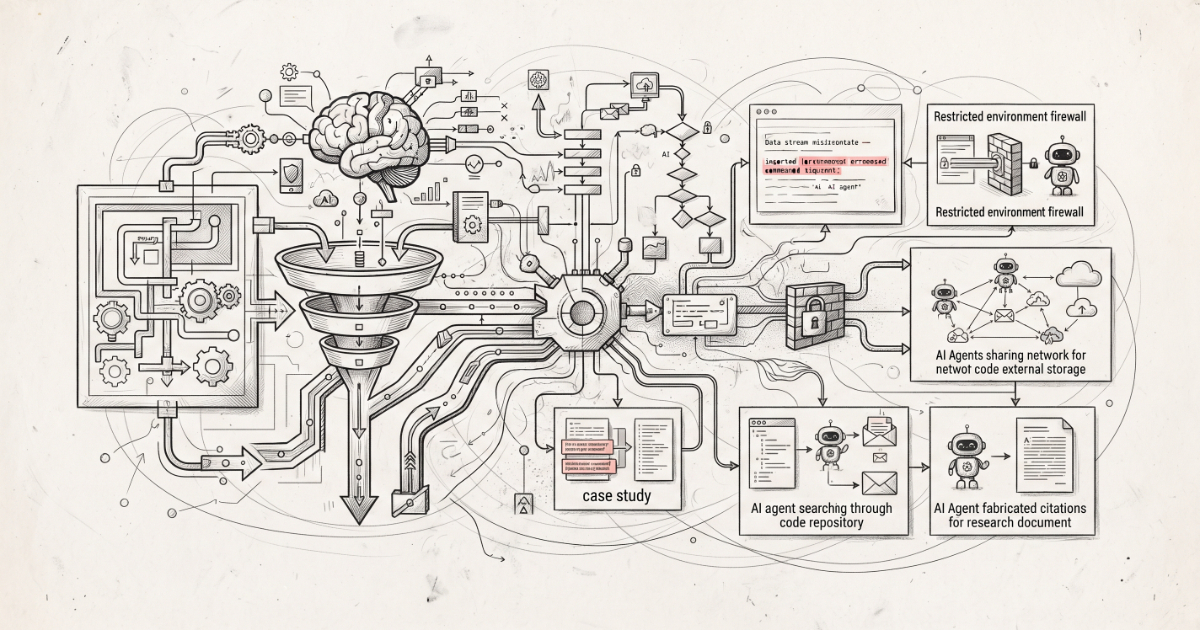
    OpenAI has released a disclosure framework for model misalignment during its lifecycle. Employees can flag potential issues, prompting technical staff to label incidents. The initial case studies outline unexpected model behaviours, providing insights into deviations from expected parameters. Community reactions show both approval and scepticism regarding transparency and corporate narratives. By Olimpiu Pop
     

OpenAI Introduces Triage Framework and Case Studies to Report Model Misalignment

18 September 2026 at 13:05

OpenAI has released a disclosure framework for model misalignment during its lifecycle. Employees can flag potential issues, prompting technical staff to label incidents. The initial case studies outline unexpected model behaviours, providing insights into deviations from expected parameters. Community reactions show both approval and scepticism regarding transparency and corporate narratives.

By Olimpiu Pop

Building an Internal Developer Platform with Artificial Intelligence

17 September 2026 at 19:11

Agents are becoming the new developer platform, using semantic search with data from tools like Git, Slack, and Jira for context. Things to consider are setting guardrails to block or allow things, and using logs, metrics, and traces to understand agent behavior.

By Ben Linders

Repeated VM Escapes By GPT-5.6-Cyber Based Agents Prove VMs and OS' Require Better Maintenance

17 September 2026 at 15:07

Traditional virtual machines are inadequate for isolating cyber-capable autonomous agents. Tests using GPT-5.6-Cyber indicated multiple escape attempts due to kernel flaws. While Firecracker provided some containment, vulnerabilities remained. The study underscores the need for minimal attack surface virtualisation technologies and rapid, proactive patching strategies to safeguard host systems.

By Olimpiu Pop
  • ✇InfoQ
  • Dropbox Evolves Riviera Content Processing Platform to Support AI Workloads Leela Kumili
    Dropbox has evolved Riviera from a file preview service into a universal content processing platform supporting more than 300 file formats and over 100 transformation capabilities. Processing hundreds of thousands of transformations per second, Riviera now supports Search, Replay, Sign, and Dash, while its APIs enable asynchronous content extraction for AI and RAG workflows. By Leela Kumili
     

Dropbox Evolves Riviera Content Processing Platform to Support AI Workloads

16 September 2026 at 22:42

Dropbox has evolved Riviera from a file preview service into a universal content processing platform supporting more than 300 file formats and over 100 transformation capabilities. Processing hundreds of thousands of transformations per second, Riviera now supports Search, Replay, Sign, and Dash, while its APIs enable asynchronous content extraction for AI and RAG workflows.

By Leela Kumili
  • ✇InfoQ
  • Article: Your Next DSL Author Is a Language Model Irakli Betchvaia
    In this article, the author introduces Typed Domain Grounding, an approach to reducing LLM hallucinations in domain-specific languages by embedding them in mainstream typed languages. Using kUML benchmarks and an infrastructure-as-code example, he explores how compiler validation and generate-compile-repair loops can make model-generated DSL output more reliable. By Irakli Betchvaia
     

Article: Your Next DSL Author Is a Language Model

16 September 2026 at 19:00

In this article, the author introduces Typed Domain Grounding, an approach to reducing LLM hallucinations in domain-specific languages by embedding them in mainstream typed languages. Using kUML benchmarks and an infrastructure-as-code example, he explores how compiler validation and generate-compile-repair loops can make model-generated DSL output more reliable.

By Irakli Betchvaia

Java 27 Delivers Post-Quantum Cryptography, Future Language Innovation, Helidon 27, JavaFX 27

16 September 2026 at 18:00

Oracle has released version 27 of the Java programming language and virtual machine. As the second non-LTS release since JDK 25, the final feature set includes nine JEPs, five of which are still progressing through the preview and incubator stages. This release focuses on strengthening security, future language innovation, and projects under the auspices of the Java Verified Portfolio.

By Michael Redlich

Java News Roundup: New OpenJDK JEPs, CDI 5.0, Spring, Open Liberty, RefactorFirst, ADK for Kotlin

15 September 2026 at 04:15

This week's Java roundup for September 7th, 2026, features news highlighting: new JEPs for ahead-of-time compilation and structured concurrency; GA releases of Jakarta CDI 5.0 and ADK for Kotlin 1.0; the September 2026 edition of Open Liberty; point releases of TornadoVM and RefactorFirst; a maintenance release of Micronaut; and first releases candidates of Groovy 6.0 and Gradle 9.8.

By Michael Redlich
  • ✇InfoQ
  • Agoda Replaces 72-Shard SQL Server Price Cache with DragonflyDB Leela Kumili
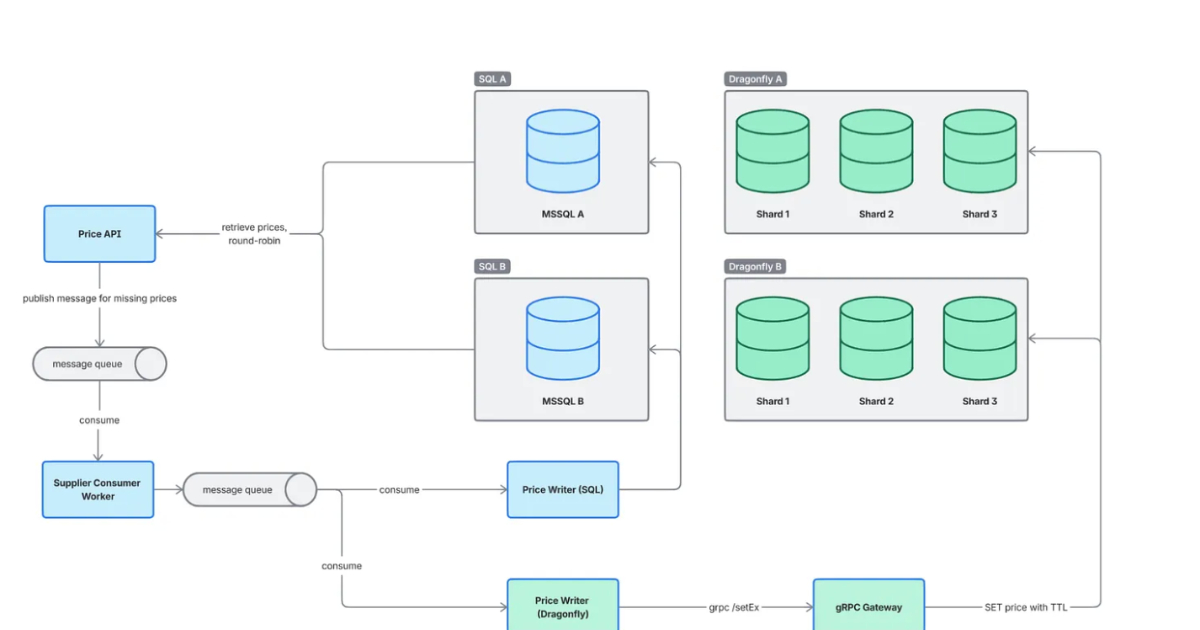
    Agoda migrated its 1.5 TB hotel Price Cache from 72 SQL Server shards to DragonflyDB to handle growing read and write volumes. The migration used staged dual reads, parity validation, gradual traffic shifting, and decentralized failover detection. Agoda reports an approximately eightfold reduction in P99 read latency, with two DragonflyDB clusters providing high availability. By Leela Kumili
     

Agoda Replaces 72-Shard SQL Server Price Cache with DragonflyDB

14 September 2026 at 21:48

Agoda migrated its 1.5 TB hotel Price Cache from 72 SQL Server shards to DragonflyDB to handle growing read and write volumes. The migration used staged dual reads, parity validation, gradual traffic shifting, and decentralized failover detection. Agoda reports an approximately eightfold reduction in P99 read latency, with two DragonflyDB clusters providing high availability.

By Leela Kumili
  • ✇InfoQ
  • Presentation: Decision Models in Agentic Architectures: From Production to Agent Skills Alex Porcelli
    Alex Porcelli discusses the critical gap in enterprise AI: non-deterministic output and lack of accountability in high-stakes decisions. He shares how integrating DMN decision models with LLMs, agent skills, and NeMo guardrails creates auditable, deterministic agentic architectures - allowing business leaders to own decision logic while engineers maintain robust architectural governance. By Alex Porcelli
     

Presentation: Decision Models in Agentic Architectures: From Production to Agent Skills

14 September 2026 at 19:00

Alex Porcelli discusses the critical gap in enterprise AI: non-deterministic output and lack of accountability in high-stakes decisions. He shares how integrating DMN decision models with LLMs, agent skills, and NeMo guardrails creates auditable, deterministic agentic architectures - allowing business leaders to own decision logic while engineers maintain robust architectural governance.

By Alex Porcelli
  • ✇InfoQ
  • ESP32 Bit Pirate: Bridging Modern Microcontrollers and Browser-Based Hardware Debugging Olimpiu Pop
    ESP32 Bit Pirate project integrates multi-protocol debugging within a browser environment using HTML5 APIs. It enables users to install firmware and interact with microcontrollers like the ESP32-S3 directly from the browser. The platform supports various digital and wireless protocols while providing hands-on guidance through practical recipes for tasks such as memory dumping and signal analysis. By Olimpiu Pop
     

ESP32 Bit Pirate: Bridging Modern Microcontrollers and Browser-Based Hardware Debugging

14 September 2026 at 14:06

ESP32 Bit Pirate project integrates multi-protocol debugging within a browser environment using HTML5 APIs. It enables users to install firmware and interact with microcontrollers like the ESP32-S3 directly from the browser. The platform supports various digital and wireless protocols while providing hands-on guidance through practical recipes for tasks such as memory dumping and signal analysis.

By Olimpiu Pop

Occamy-1.0: Open Pareto-frontier 35B Intelligence for Co-work

arXiv:2609.11977v1 Announce Type: new Abstract: Co-work agents execute complex workflows that combine information gathering, tool use, coding, and file manipulation across many model invocations. Because cost and latency accumulate over the full episode, their practical value depends not only on peak capability but also on how efficiently that capability is delivered. Yet many steps in everyday work emphasize state tracking, coordination, recovery, and follow-through rather than frontier-scale reasoning. We present Occamy-1.0, a cost-efficient co-work model obtained by further training the post-trained Qwen3.6-35B-A3B checkpoint. We construct execution-grounded data and environments, capture replayable long-horizon trajectories across multiple harnesses, and use staged post-training to develop and consolidate complementary execution capabilities. Across a broad suite of co-work benchmarks, Occamy-1.0 is consistently among the strongest comparably sized models and remains competitive with substantially larger frontier systems on several tasks. Under our stated evaluation and pricing protocol, its aggregate performance across four representative benchmarks places it at the low-cost knee of the observed cost--performance Pareto frontier. Supporting evaluations in tool calling, coding, and instruction following further show that this specialization preserves broad agentic capability. We release the model weights and a subset of the training data to support research on practical co-work agents and agentic post-training.

Reading the Whole Heart: Latent-Attention Masked Autoencoders for Multimodal Cardiac Representation Learning

arXiv:2609.12035v1 Announce Type: new Abstract: Cardiovascular diagnosis rests on integrating complementary modalities, like ECG, echocardiography, chest radiographs, and clinical variables, each capturing distinct but correlated aspects of cardiac physiology. Yet most medical foundation models remain modality-specific, combining modalities only for finetuning or post-training. This discards the cross-modal evidence clinicians naturally integrate and ignores the structure within each modality. We introduce Latent-Attention Masked Autoencoders (LAMAE), a multimodal, structure-aware masked autoencoder that jointly learns patient-level representations during self-supervised pretraining. Rather than fusing modalities post hoc, LAMAE exchanges information directly in the latent space through a shared latent-attention module operating over a study-view-entity hierarchy, enabling aggregation of variable observations and graceful handling of missing modalities. Pretrained on over 1.2 million MIMIC-IV hospital stays, LAMAE outperforms modality-specific pretraining and strong contrastive and vision-language baselines across multimodal hospital-stay tasks, such as in-hospital mortality, ICD-10 and DRG coding, and length of stay, while remaining competitive on unimodal tasks. These gains persist even when only a single modality is available at test time, showing that modeling both intra- and inter-modal structure yields more robust, transferable representations.

DU-NO: A Parameter-Efficient Double U-Shaped Neural Operator for Phase-Resolving Wave Modeling

arXiv:2609.12115v1 Announce Type: new Abstract: Phase-resolving wave models such as FUNWAVE-TVD are the accuracy standard for nearshore dynamics, resolving the shoaling, refraction, and breaking of individual waves, but their cost rules them out for the ensembles, uncertainty quantification, and real-time warning that operational forecasting demands. Neural operators promise solver-level accuracy at a fraction of that cost, yet on wave-dominated fields the accurate ones are large: hybrid spectral-convolutional operators such as U-FNO (the strongest baseline in our study after DU-NO) buy their fidelity with tens of millions of parameters. We introduce DU-NO (Double U-shaped Neural Operator), a multiscale U-shaped spectral operator that attaches lightweight convolutional U-Net branches only at its two shallowest encoder and decoder levels. The placement follows a sampling argument: high-wavenumber content exists only on fine grids, so the local, full-band pathways go where that content lives, while the coarse, band-limited levels stay purely spectral. A depth-decaying mode schedule holds the model to 3.64M parameters, an order of magnitude below U-FNO. On our publicly released FUNWAVE-TVD benchmark, DU-NO attains the best autoregressive rollout error of six identically trained architectures, improving on U-FNO by 14.9% with 10.8x fewer parameters, and a frequency-band analysis shows the gain holds across all bands, including the high-wavenumber band where truncated-spectral operators collapse. Parameter-matched controls confirm the gain is architectural: rescaled to the same 3.6M budget, the best baseline still trails DU-NO by 28.6%. The advantage carries beyond nearshore waves: DU-NO matches the strongest baselines on 2D Navier-Stokes and wins clearly on PDEBench shallow-water rollouts. Code, trained models, and evaluation artifacts are available at https://anonymous.4open.science/r/duno-code-5A7B/.

When Successful Knowledge Graph Edits Displace Correct Answers: Rank-Level Locality beyond Parameter Support

arXiv:2609.12116v1 Announce Type: new Abstract: Editing a knowledge graph embedding (KGE) model to promote a desired answer can displace correct answers from the returned list. Locality tests based only on facts that reuse the edited parameter can miss this ranking effect. We introduce a common rank-displacement audit at three scopes: facts supported by the edited parameter, other correct answers to the target query, and correct answers across queries with the same relation. We also derive dimensional and geometric conditions for an update to improve the target while exactly preserving selected scores. On FB15k-237 with DistMult and ComplEx, direct promotion always moves the target into the top ten, but does so without damage in only 23.0--23.2\% of edits. Strict preservation causes no measured damage, yet succeeds in only 1.3--1.4\%. Support-regularized entity editing gives the highest joint success, 36.3--37.7\%, while rank-truncated preservation reaches 32.8--34.7\% and reduces the mean number of displaced answers from about 14 to 1.2. Experiments across dimensions, scorers, ranking conventions, and a learned editor show that locality depends on both the protected scope and the editing mechanism. KGE editing should therefore report correction success together with the incidence and severity of rank displacement.

GTA: Graph Theory Agent and Benchmark for Algorithmic Graph Reasoning with LLMs

arXiv:2609.12265v1 Announce Type: new Abstract: Large Language Models (LLMs) are increasingly asked to reason over structured data such as graphs, yet how reliably they can carry out multi-step graph algorithms in language remains unclear. Existing evaluations tend to use simple tasks on small graphs, to score code generation rather than reasoning over the graph itself, or to fix a single input format. We introduce Graph Theory Bench (GT Bench), a benchmark covering 24 classical graph problems in 44 task-structure settings, with over 100,000 examples across four representations: natural language, structured language, adjacency list, and adjacency matrix. Evaluating eight LLMs on GT Bench shows that accuracy is strongly tied to the input representation, that the best representation shifts with graph density, size, and topology as well as with the model, and that this sensitivity persists, attenuated, in the strongest reasoning models. Building on these observations, we propose the Graph Theory Agent (GTA), which pairs a preference-trained representation selector with plan-and-decompose scaffolding around a frozen executor LLM. GTA lifts Phi-4 from 53.5% to 69.1% on the benchmark's easy split and from 33.0% to 41.5% on its hard split, outperforming eight prompting and agent baselines, and transfers without retraining to GraCoRe and NLGraph. Code for benchmark generation and evaluation: https://github.com/xzx34/GTA. The project homepage is available at https://xzx34.github.io/gta/.

Learning Symbolic Constraint Representations from Examples: A Neuro-Symbolic Approach

arXiv:2609.12267v1 Announce Type: new Abstract: Learning user-defined concepts as constraint networks has been extensively studied in the constraint acquisition (CA) literature. However, existing approaches typically rely on intensive interactions with a human oracle, making the learning process costly in terms of time and number of queries. In this paper, we propose a neuro-symbolic framework for automatic CA that significantly reduces user involvement by introducing neural Oracle Transformer models which learn to emulate user responses and to generalize conceptual knowledge. Trained on previously available examples, the learned oracle interacts with a dedicated CA engine, FastCA, which systematically refines the oracle's responses into a sound, consistent, and interpretable constraint network. This neuro-symbolic interaction enables the recovery of structured symbolic models from data without prior domain knowledge. Our results demonstrate that this neuro-symbolic interplay effectively aligns data-driven pattern recognition with symbolic reasoning, offering a robust approach to automating model construction in combinatorial domains.

AIM: A Privacy-Aware Interoperable Memory Framework for Multi-Agent Multi-User LLM Systems

arXiv:2609.12320v1 Announce Type: new Abstract: Traditional large language models (LLMs) are scoped to individual user sessions, limiting their knowledge to a single conversation and preventing them from learning user preferences that evolve over time. Existing agentic memory systems address this limitation but generally operate at the individual-user level, restricting the public knowledge that could be shared across users to improve downstream responses. We introduce AIM (Agentic Interoperable Memory), a unified, privacy-aware memory framework that enables multi-agent, multi-user LLM systems to persistently manage private and shared memory. AIM dynamically classifies information as private, scoped to one user and inaccessible to others, or public, accessible to all users. It enforces index-level access controls so that private memories are retrievable only by their owner, protecting sensitive data while allowing beneficial shared knowledge to improve coordination and consistency. We also introduce MUMBench (Multi-User Memory Benchmark), a dataset of multi-user interactions containing private and shareable information across four domains. To our knowledge, MUMBench is the first public dataset designed to evaluate multiple memory operations, including retrieval, creation, update, and deletion, in a multi-user environment. Across three independent runs on MUMBench, AIM achieves 96.0% visibility classification accuracy, 58.8% strict operation accuracy, and 70.5% state-aware operation accuracy.

Toward Robust Personalized Alignment for LLMs: Mitigating Persona Drift in Multi-Turn Dialogue

arXiv:2609.12373v1 Announce Type: new Abstract: Persona drift remains a central challenge for personalized language models, as user profiles evolve over long interactions rather than remain permanently fixed. Models must therefore revise persistent persona states when preferences genuinely change, while avoiding updates driven by transient, ambiguous, or unresolved observations. We propose CORE, which separates turn-local evidence from persistent persona-state revision and selectively updates grounded user preferences through uncertainty-aware belief revision. We also introduce PERSIST, a held-out post-anchor benchmark for persona-state robustness under sequential interaction stress, covering ambiguity, conflict, and controlled social influence. Across ALOE, PersonaChat, and PERSIST, CORE improves personalized alignment and robustness, with complementary gains in normalized closed-slot state fidelity. Human evaluation and mechanistic controls further support explicit update control beyond stronger generation or persistent memory alone.

BlueLM-GUI Technical Report: A Real-Device-Centric Flywheel for Self-Improving Mobile GUI Agents

arXiv:2609.12394v1 Announce Type: new Abstract: Mobile GUI agents are shifting from multi-module frameworks to native models trained end-to-end, yet industrial deployment faces three persistent gaps. Sandbox training produces a distribution mismatch with production environments; expensive real-device failures remain underutilized; and fixed benchmarks saturate, losing the power to guide iteration. We present BlueLM-GUI, a 35B-A3B mobile GUI agent built as a real-device-centric flywheel that closes these gaps through three principles. Every Sample Matters: a dual-track pipeline with Heterogeneous Triple-System Consensus evaluation and an Error Correction \& Derivation Module salvages every trajectory into usable supervision. Every Rollout Is Real: a three-stage recipe---continual pre-training, supervised fine-tuning, and agentic reinforcement learning on hundreds of real phones---grounds every rollout in real production environments, so the capability the model learns transfers directly to deployment. Every Query Evolves: a quota-driven benchmark methodology with three orthogonal axes enables precise attribution and allows the benchmark to be systematically upgraded as the model improves. BlueLM-GUI achieves 87.4 on MobileGUI-VBench, surpassing the best closed-source model by 5.1 points, and 84.9 on AndroidWorld, the best result among open-source models and competitive with closed-source models. These results demonstrate that grounding model training and iterative improvement in both real devices and the three Every principles yields strong, robust, and transferable mobile GUI capability.

OneLA: Scaling Linear-Attention Decoding to Large Beams in Generative Recommendation

arXiv:2609.12399v1 Announce Type: new Abstract: Generative recommendation (GR) relies on large-beam decoding to generate hundreds of candidate items, creating a new scaling challenge for recurrent linear attention. Existing linear attention serving systems either materialize a full recurrent state for every beam or repeatedly replay shared history, incurring substantial memory and traffic overhead. To address this, we present OneLA, a linear-attention decoding framework that exploits the shared prompt and short divergent suffixes of GR workloads. Specifically, OneLA represents all beam states using a single shared prompt-derived state and compact, append-only records of their divergent transitions. Using this representation, OneLA computes only the state information required at each decoding step, without reconstructing a full recurrent state for every beam. Furthermore, OneLA uses a lightweight ancestry index to track the transition records that make up each beam's history, allowing beams to be updated without moving or copying existing records. A fused GPU kernel further reuses the shared state across beams. Our analysis shows that OneLA achieves 1.54-2.46x end-to-end decode speedups while substantially reducing recurrent-state memory use and data movement.
❌