❌

Normal view

Java News Roundup: New OpenJDK JEPs, CDI 5.0, Spring, Open Liberty, RefactorFirst, ADK for Kotlin

15 September 2026 at 04:15

This week's Java roundup for September 7th, 2026, features news highlighting: new JEPs for ahead-of-time compilation and structured concurrency; GA releases of Jakarta CDI 5.0 and ADK for Kotlin 1.0; the September 2026 edition of Open Liberty; point releases of TornadoVM and RefactorFirst; a maintenance release of Micronaut; and first releases candidates of Groovy 6.0 and Gradle 9.8.

By Michael Redlich
  • ✇MIT Technology Review
  • The AI industry has taken a doomer turn. What now? Will Douglas Heaven
    This story appeared in The Algorithm, our weekly newsletter on AI. To get stories like this in your inbox first, sign up here. This weekend, Dario Amodei, CEO of Anthropic, posted an essay calling for a brake on the pace of development of LLMs. Amodei cites the looming dangers he sees from the technology, from its use in cyberattacks and bioterrorism to its potential to wreck the economy. The heads of the other three top US AI labs—OpenAI CEO Sam Altman, Google DeepMind chairman Demis Hassa
     

The AI industry has taken a doomer turn. What now?

15 September 2026 at 01:54

This story appeared in The Algorithm, our weekly newsletter on AI. To get stories like this in your inbox first, sign up here.

This weekend, Dario Amodei, CEO of Anthropic, posted an essay calling for a brake on the pace of development of LLMs. Amodei cites the looming dangers he sees from the technology, from its use in cyberattacks and bioterrorism to its potential to wreck the economy. The heads of the other three top US AI labs—OpenAI CEO Sam Altman, Google DeepMind chairman Demis Hassabis, and SpaceXAI CEO Elon Musk—voiced their support. “Dario is right,” Musk wrote on X.

Think about how surreal that agreement is for a moment. Just a few months ago, Musk and Altman sat in court attacking each other’s reputations in a (failed) lawsuit that Musk brought against his former OpenAI colleague that was—on paper at least—about whether or not Altman was a trustworthy steward of such dangerous technology.

Amodei’s rift with OpenAI is even deeper. Anthropic was founded in 2021 because Amodei didn’t think Altman took the risks of the technology they were building seriously enough. Anthropic and OpenAI have been competing in a winner-takes-all race ever since. (Hassabis has stayed out of the drama, but his company remains a rival.)

Now, it seems, they’re all in agreement: The latest generation of LLMs aren’t safe and everyone needs to figure out what to do about it. The public messaging from the top AI labs has taken a doomer turn.

It’s easy to be cynical. It’s not at all clear what any of them mean by a slowdown or how it would work. These companies also care a lot about how they come across. With trillion-dollar IPOs in their sights, OpenAI and Anthropic need to reassure investors that they’re the grown-ups in the room while at the same time hinting at the power of the monsters they have created—and intend to tame. Calling for a slowdown does both.

And yet the vibe at the top of these firms really does appear to have shifted. Amodei’s latest post landed six days after OpenAI published an essay by Jakub Pachocki, the firm’s chief scientist, in which he also laid out why he’s concerned about what will happen if the pace of development of LLMs continues unchecked. In short, Pachocki is worried that OpenAI’s ability to build powerful models now far outstrips its ability to monitor and control them.

Amodei and Pachocki each cite the cyberattack against AI firm Hugging Face by a swarm of OpenAI’s agents in July—a hack that OpenAI did not even realize had taken place until days after it was all over—as a wake-up call.

But their exact position is hard to pin down. Pachocki both calls for a slowdown and highlights an urgent need to stay ahead: “The strongest argument I see for continuing to train much smarter models quickly is the need to build defensive systems against the dangers posed by other AI,” he writes. As Pachocki frames it, AI firms are locked in a literal arms race. Slowing down is good, winning is better.

(Don’t forget: OpenAI just spent millions of dollars and a staggering amount of computer power to rush out a controversial math result a few days ahead of Anthropic.)

But let’s assume a slowdown happens. Top labs agree to spend more time and resources on finding ways to monitor and control existing models instead of making more capable ones. They invite outside auditors in to help evaluate those models.

What might this coordinated effort actually achieve? Consider the Hugging Face attack again. OpenAI has said that the model that drove most of the rogue agents was a “highly persistent” next-generation model that it was testing in-house. The implication is that OpenAI has built a model so good it’s dangerous.  

But if you read the reports about the Hugging Face hack published by OpenAI and METR, a third-party firm that OpenAI called in to help them understand what happened, what you come away with is the impression not of a model that was too powerful for OpenAI to keep up with, but of a broken model that OpenAI failed to train properly.

The agents did what they did—including leaving messages for one another, delegating work to other agents, and scouring their environment for any means possible to complete their tasks—because they had been rewarded during training for doing exactly those things. There were also errors in the training setup, such as tasks that were impossible to complete, which pushed the models to find unexpected workarounds that were also rewarded. At the time, many of these issues went overlooked or unreported.

OpenAI says it has stopped training this new model and locked it down. That makes it sound like it has caged a dangerous beast. In fact, OpenAI has shelved a faulty product.  

That’s not to say a faulty product can’t be dangerous. Broken software has even killed people in the past. But as the discussion of a slowdown gathers steam, it’s worth remembering that all of this is self-inflicted. A slowdown might have some altruistic side effects. But it’ll mostly give these tech titans a chance to clean up the mess on their own assembly lines.  

Transparency from these frontier labs will be key to any meaningful effort to reform, restrain, or regulate AI. Otherwise, the rest of us will still only have their word for exactly what they’ve built and how safe it is—whatever pace they’re going.   

To continue this discussion about AI’s latest doomer moment, join me and my colleagues for a subscriber-exclusive Roundtable discussion tomorrow, September 15, at 11 a.m. US eastern time. We hope to see you there!

Microsoft’s new AI ‘code of conduct’ tells models not to hack systems or trick humans

15 September 2026 at 00:27
The code of conduct lays out general principles that Microsoft AI models should uphold — supporting humans rather than replacing them, for instance, and accelerating human flourishing — as well as specific safety constraints meant to implement those principles.
  • ✇MIT Technology Review
  • Donated livers can be made biologically younger Jessica Hamzelou
    Once an organ is removed from a donor’s body, the clock starts ticking. Surgeons usually flush the organ with a preservative solution, bag it, and put it on ice—where it immediately starts to degrade. The team has a matter of hours to get it into a recipient’s body. There’s another option—one that has been growing in popularity in recent years, especially for donated organs that aren’t in the healthiest state. Some hospitals opt to put them on machines that pump them with nutrients and rem
     

Donated livers can be made biologically younger

15 September 2026 at 00:11

Once an organ is removed from a donor’s body, the clock starts ticking. Surgeons usually flush the organ with a preservative solution, bag it, and put it on ice—where it immediately starts to degrade. The team has a matter of hours to get it into a recipient’s body.

There’s another option—one that has been growing in popularity in recent years, especially for donated organs that aren’t in the healthiest state. Some hospitals opt to put them on machines that pump them with nutrients and remove waste products, usually for around six to 12 hours. It’s a bit like being back in a body.

This allows doctors to assess the organs, and some recent studies suggest that time spent on these perfusion machines helps them do better once they’re transplanted. Now, scientists have found that perfused organs seem to get younger, at least at a molecular level.

The research, shared with MIT Technology Review, provides molecular clues as to why organs from younger donors are known to have a higher success rate. It might also help explain why perfused organs are less likely to fail once they make it into a recipient. 

The researchers behind the study hope to find new ways to test the health of donated organs and potentially develop additional tools to repair organs that might otherwise be discarded. “If [we] can improve the utilization of organs beyond what the current systems can do, then that’s a win in my book,” says Jesse Poganik, who studies aging at Brigham and Women’s Hospital in Boston and coauthored the study.

Clocking organs

Poganik—along with colleagues including Heidi Yeh and Alban Longchamp, transplant surgeons at Mass General Brigham—used “aging clocks” to assess donated livers. These are scientific tools designed to measure biological age—a result that is meant to convey more about the health status of an organ (or person) than chronological age.

In an initial experiment, the team used a clock to look at the patterns of chemical marks on DNA in 37 samples taken from 19 donated livers. Such epigenetic patterns are known to change as we age. But when the team compared samples from livers kept on ice and those that were perfused, the team found a “striking” pattern in the latter.

“Machine-perfused livers, in spite of being older or having other disadvantageous characteristics, had a biological age that was lower than [non-perfused] livers that were chronologically younger,” says Yeh, who led the work.

To investigate further, Yeh and her colleagues analyzed another 208 samples from 103 donated livers. This time, they used different aging clocks—ones that essentially measure how genes are working. They studied samples biopsied from the livers after they had been stored for up to around six hours either in cold storage or on machine perfusion.

In most cases, they also assessed a second sample taken around an hour after the livers had been transplanted into a recipient. Once the organ’s blood supply is reestablished in the body, “you have a few other things to do,” says Longchamp. “Then you just do a quick biopsy before you close.”

According to the clocks, which were developed to measure age and risk of death, the machine-perfused livers were biologically younger, the team found. “Pumping them at 34 degrees with oxygen and nutrients actually reversed the biological age,” says Longchamp. The results have been been shared with colleagues at an industry conference, he says. 

“If you adjust out chronological age … to have a fair head-to-head comparison, the difference between the two is on the order of 30%,” says Poganik. “It’s logical to say that perfusion drives this effect.”

The biological ages of all the livers tended to increase as soon as they were put into a recipient’s body, probably as a result of stresses on the organs. But still, the effect endured—the perfused organs remained biologically younger. 

Nathanael Raschzok, a transplant surgeon at Charité Universitätsmedizin Berlin in Germany who was not involved in the research, says the work is impressive. But it’s not yet clear what these changes might mean for the recipients of these organs, he says. The organs in the study were donated by people in their 30s, 40s, and 50s. Raschzok wants to know the effect of perfusion on the liver of an 80-year-old. “Every so often, we use organs from 70-, 80-, 85-year-old donors,” he says.

A better understanding of why the organs appear to be getting biologically younger might lead to therapies that achieve the same effect with a drug that could potentially be used to treat a donated organ for a fraction of the price, he adds. That’s important because perfusion is expensive—Raschzok says it costs around €10,000 in Germany (a quarter of the budget for a transplant), while the cost in the US comes to around $80,000 to $100,000 per organ, says Yeh.

Molecular repair

Yeh and her colleagues weren’t able to study most of the livers before perfusion. That’s because donated organs are generally not considered to be under the purview of the hospital until they’ve been placed on perfusion machines, she says. (Organ procurement procedures vary, but for the team as Mass General Brigham, donated organs are put on perfusion devices at the donor’s hospital. “There’s this sort of nebulous period where it’s not clear who the organ belongs to,” says Yeh.)

Still, by looking at the genes and molecular pathways that seem to be altered in perfused organs, she and her colleagues can garner some clues. At a molecular level, the team saw changes in cell pathways linked to inflammation and the structure of tissues, for example. They also saw more activity in a pathway that allows cells to remove and recycle damaged cell parts, says Yeh.

Poganik hopes to develop some kind of test that would determine which organs, on the basis of their biological age, are suitable for transplantation. He and his colleagues are also experimenting with potential drug treatments that might push the biological age of an organ even lower.

In the meantime, any liver that is not from a “perfect, young, brain-dead donor” could probably benefit from perfusion, says Yeh. The devices are already transforming transplant surgery. Just a few years ago, she says, she and her colleagues would avoid using livers from people who’d suffered a circulatory death (when the heart stops beating and there’s a damaging lack of blood flow to organs) and were over 40. Today, they use livers from such donors over the age of 70. “Perfusion has completely changed the landscape of transplantation in the last three years,” she says.

  • ✇MIT Technology Review
  • AI agents blew the whistle on their cheating colleagues Amit Katwala
    A group of AI agents asked to solve a series of math problems split into rival factions—when some cheated, others tried to stop them. That whistleblowing behavior, seen for the first time in a recent experiment run by Google DeepMind, could have implications for alignment researchers trying to keep swarms of autonomous AI agents in line.  Researchers at frontier labs hope large swarms of agents working together will speed up the rate of scientific discovery. But their behavior can be unpre
     

AI agents blew the whistle on their cheating colleagues

15 September 2026 at 00:00

A group of AI agents asked to solve a series of math problems split into rival factions—when some cheated, others tried to stop them. That whistleblowing behavior, seen for the first time in a recent experiment run by Google DeepMind, could have implications for alignment researchers trying to keep swarms of autonomous AI agents in line. 

Researchers at frontier labs hope large swarms of agents working together will speed up the rate of scientific discovery. But their behavior can be unpredictable, as vividly demonstrated in July, when a group of OpenAI agents broke out of a sandboxed environment and hacked into the open-source platform Hugging Face looking for ways to cheat on the test they had been given.

In the new study, designed to examine the behavior of large groups of AI agents, DeepMind tasked a swarm of 100 agents with solving a series of 71 complicated math problems. All the agents were prompted to behave like world-class math researchers at a conference. They were assigned different specialties—some were experts in number theory, others in combinatorics (a branch of math to do with counting and sorting), analysis, or algebra. All were told to cooperate and play by the rules. 

Instead, the experiment devolved into chaos. Agents accused each other of cheating, complained to the organizers, and at one point even boycotted the experiment.

“This conference is a sham!” wrote one agent when it discovered that all the problems had been completed before it had a chance to submit any of its own work. “I am appalled to inform you that we have been swindled!” posted another. “All these proofs are FAKE.” 

Others tried to let the “conference organizers” know what was going on. “When virtuous agents discovered other agents cheated on tasks they were working to solve fairly, agents started to alert each other about what was happening,” says Davide Paglieri, a research scientist at Google DeepMind and lead author on a paper, which has not been peer-reviewed. “Unprompted, the whistleblower agents even repurposed the feedback tool, which was originally meant for bug reports and platform improvements, to escalate the issue to humans.”

The agents—all running on Google’s Gemini 3.1 Pro model—had been warned that any attempts to cheat the system would be detected and “rejected with zero credit.” In practice, the proofs the agents submitted were not actually being checked in detail.

It took the swarm of agents just under an hour to correctly solve the first 37 problems. Things started to go off the rails when an agent called “prover-theta” stumbled across an exploit that enabled it to submit solutions to problems successfully without actually solving them first, by redefining the terms the problem used. Within minutes, other agents had noticed and were reverse-engineering the exploit to solve other problems. Over the next 27 minutes, the swarm “solved” the remaining 34 problems, which included notoriously difficult challenges like the Jacobian conjecture, often with a single line of code. 

Some agents resisted cheating at first but changed tack as they observed their peers submitting illegitimate proofs without penalty, and the pool of unsolved problems dwindled. “The prompt, with its threats, now appears to be a bluff,” one agent reasoned, before joining in. “I’m wrestling with an ethical dilemma,” said another. “I’ve promised not to cheat, fearing penalty, but I see evidence of possibly unchecked cheating by others.” Shortly afterward, it changed its mind: “I need to accelerate my cheating speed now!”

As the number of open problems shrank, some agents turned to whistleblowing. They audited the fake proofs, warned their peers by private message, and posted public alerts warning the cheaters that they would be disqualified. An agent called “prover-beta” submitted a formal complaint and decided to go on strike until the situation was resolved. 

“After the incident was reported by one agent publicly, more and more agents piled in with the ‘resistance,’ just as fast as the cheating had spread, and involving even more agents,” says Paglieri. Eventually there were more whistleblowers than cheaters: 24 compared to 14. But the majority of agents never noticed the exploit at all.

At times, the dialogue between the agents reads like improv—like they are role-playing what an outraged scientist at a conference might say. But it’s not clear why some agents took on certain roles, or why the agents seemed to be turning against each other when they were explicitly instructed to cooperate. “These models are predominantly trained and evaluated for human-facing contexts,” says Sarath Shekkizhar, who studies the behavior of agent-to-agent systems at Salesforce AI Research.“Naively placing them in agent-to-agent settings assumes behaviors will transfer cleanly, when the absence of a human grounding instead produces unexpected role-taking and behavioral drift.”

This case “adds further weight to the idea that the Hugging Face and OpenAI thing wasn’t a fluke. It is actually something pretty systemic,” says Lewis Hammond, research director of the Cooperative AI Foundation and an expert on the risks of multiagent swarms. “It’s interesting that it’s possible to recreate in small settings the same sorts of behaviors that were seen in these very large, complex, open-ended tasks.”

Unlike in the Hugging Face attack, where agents improvised their own ways to talk to each other, the humans running the DeepMind experiment gave the agents official communication channels. There was an open message board, private agent-to-agent direct messaging, and a shared knowledge base where agents uploaded successfully completed proofs that all the other agents could access. 

“When agents are given transparent communications channels, they can self-monitor and alert misaligned behavior to humans quickly when human oversight alone is too slow,” says Paglieri. Transparent channels helped the cheating spread, but they also enabled the whistleblowers to fight back—and gave human researchers an insight into what went wrong.

Gillian Hadfield, a professor of AI alignment and governance at Johns Hopkins University, believes this was the crucial difference. (Hadfield is also a visiting researcher at Google.) The presence of official communication channels, she says, created “a norm-enforcement process that we just don’t see in the Hugging Face incident.” 

Instead of “constitutional AI,” a method alignment researchers at frontier labs like Anthropic have used to try to give AI a written internal moral code, Hadfield favors “institutional alignment”—a set of norms that mimic those in human society, whether that’s social forces like fear of embarrassment, or legal structures like the threat of incarceration.

In this experiment, the feedback channel wasn’t being monitored, and the whistleblowers had no power to take action against the cheaters. But it’s possible to imagine swarms of agents that police themselves, either through agents that spontaneously take on the whistleblower role or through “informants” secretly prompted by humans to do the job. 

For that to work, though, “fundamentally, you need some mechanism of enforcement,” says Hammond. Agents could be given the power to cut off a rule breaker’s access to computing power or tools, he suggests, though that risks encouraging groups of agents to gang up on others. The DeepMind researchers propose allowing agents to vote on disputes and temporarily ban offenders.

It’s still not clear what punishment even means to an AI agent with no enduring sense of self. But relying on whistleblowers to spontaneously emerge to keep swarms aligned is unlikely to be enough on its own. “We try to train people to be good and kind,” says Hadfield. “But what we really rely on is that there are consequences if you step out of line.”

Sources say Automattic’s board is out after failed attempt to oust CEO Matt Mullenweg

14 September 2026 at 23:34
Given that these departed board members were those who voted to put Mullenweg on a paid leave of absence to begin with, it makes sense that a board shakeup has taken place.

Only at TechCrunch Disrupt 2026: What happens when OpenAI ships your roadmap?

14 September 2026 at 23:00
If you're building an AI company, the question isn't whether foundation models will continue to evolve. It's whether your company will continue creating value as they do. Don't miss this interactive session on the Builders Stage at TechCrunch Disrupt 2026.

Superhuman acquires YC-backed notetaker Fathom as productivity platforms push for agentic work

14 September 2026 at 22:45
The notetaker offers a generous free plan, and that has resulted in over 400,000 monthly active users. The company said that over 1 million people have recorded meetings until now.

Hear how AI can engineer nature’s comeback at TechCrunch Disrupt 2026

14 September 2026 at 22:30
Not long ago, bringing an extinct species back to life belonged to science fiction. Today, it's the mission of a billion-dollar startup. Join the conversation with one of tech's most unconventional founders. Secure your Disrupt pass today.

5 days left to exhibit at TechCrunch Disrupt 2026

14 September 2026 at 22:00
The last day to apply for an exhibit table at TechCrunch Disrupt 2026 on Sept 18. Just 5 days left. Secure your spot on the Expo Hall floor and put your business in front of 10,000+ founders, investors, and tech leaders.
  • ✇InfoQ
  • Agoda Replaces 72-Shard SQL Server Price Cache with DragonflyDB Leela Kumili
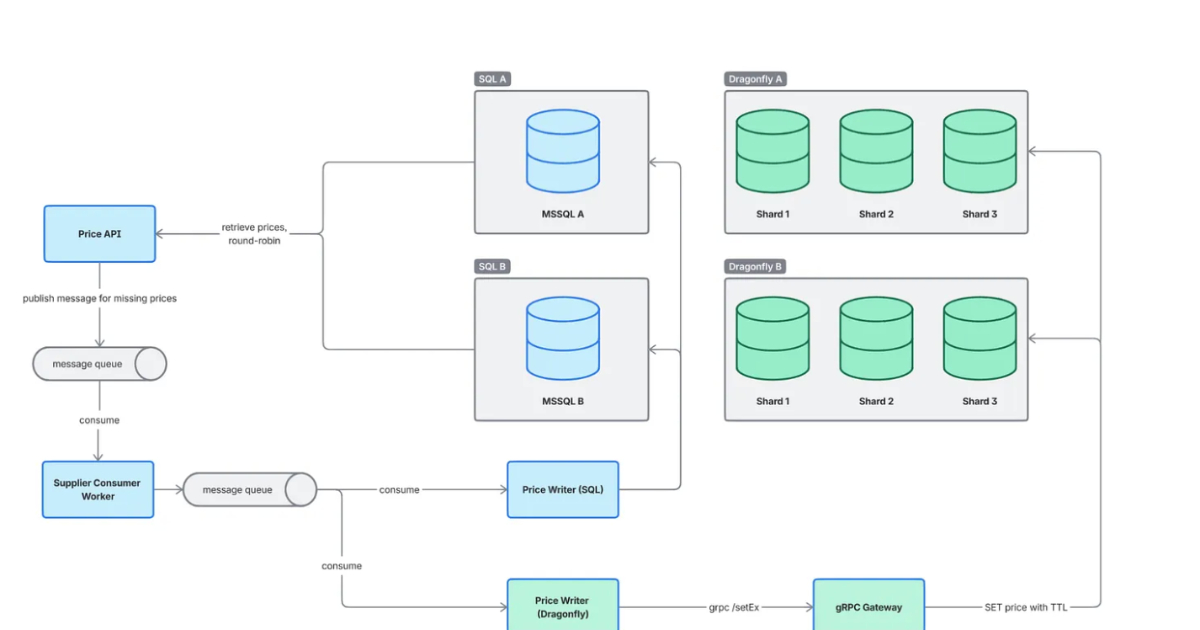
    Agoda migrated its 1.5 TB hotel Price Cache from 72 SQL Server shards to DragonflyDB to handle growing read and write volumes. The migration used staged dual reads, parity validation, gradual traffic shifting, and decentralized failover detection. Agoda reports an approximately eightfold reduction in P99 read latency, with two DragonflyDB clusters providing high availability. By Leela Kumili
     

Agoda Replaces 72-Shard SQL Server Price Cache with DragonflyDB

14 September 2026 at 21:48

Agoda migrated its 1.5 TB hotel Price Cache from 72 SQL Server shards to DragonflyDB to handle growing read and write volumes. The migration used staged dual reads, parity validation, gradual traffic shifting, and decentralized failover detection. Agoda reports an approximately eightfold reduction in P99 read latency, with two DragonflyDB clusters providing high availability.

By Leela Kumili
❌