Nat Commun. 2025 Sep 25;16(1):8388. doi: 10.1038/s41467-025-63050-9.ABSTRACTSpatial technologies examining the cell and tissue microenvironment at near single-cell resolution are revealing important molecular insights. However, few tools enable integrated, interactive analysis of spatial-omics with tissue morphology in the same functional tissue unit. Here, we present FUSION (Functional Unit State Identification in Whole Slide Images), a web-based platform for visualizing and analyzing spatial-o
Spatial technologies examining the cell and tissue microenvironment at near single-cell resolution are revealing important molecular insights. However, few tools enable integrated, interactive analysis of spatial-omics with tissue morphology in the same functional tissue unit. Here, we present FUSION (Functional Unit State Identification in Whole Slide Images), a web-based platform for visualizing and analyzing spatial-omics data with high-resolution histology. FUSION provides workflows for assessing cell compositions, quantitative morphometrics, and comparative tissue analyses. We demonstrate applicability across spatial assays, including 10x Visium, Visium HD, 10x Xenium, Cell DIVE, and PhenoCycler, applied to healthy and diseased tissues from kidney, small intestine, lung, and skin in the Human BioMolecular Atlas Program. FUSION is cloud-based, open-source, and accessible at https://fusion.hubmapconsortium.org/ , hosting over 50 paired datasets and tutorials. In a series of use cases, we show its capacity to distinguish renal glomeruli injury states, quantify morphometric changes, and characterize fibrosis with immune infiltration.
Background: Clinical decision support (CDS) is one strategy to increase evidence-based practices by clinicians. Despite its potential, CDS tools have had mixed results and are often disliked by clinicians. Principles from behavioral economics, including “nudges,” may improve the effectiveness and clinician satisfaction of CDS tools. Objective: This paper outlines a pragmatic approach grounded in implementation science to identify and prioritize how to incorporate different types of nudges into C
Background: Clinical decision support (CDS) is one strategy to increase evidence-based practices by clinicians. Despite its potential, CDS tools have had mixed results and are often disliked by clinicians. Principles from behavioral economics, including “nudges,” may improve the effectiveness and clinician satisfaction of CDS tools. Objective: This paper outlines a pragmatic approach grounded in implementation science to identify and prioritize how to incorporate different types of nudges into CDS tools. Methods: We applied the Messenger, Incentives, Norms, Defaults, Salience, Priming, Affect, Commitments and Ego (MINDSPACE) nudge framework and the Practical, Robust Implementation and Sustainability Model (PRISM) implementation science framework to systematically and pragmatically identify and prioritize different types of nudges for CDS tools. A case example of a CDS tool to improve guideline-concordant prescribing for patients with heart failure was used to illustrate how these frameworks can be applied in real-life scenarios. We describe a process of how these frameworks can be used pragmatically by clinicians and informaticists or more technical CDS builders to apply nudge theory to CDS tools. Results: Four iterative steps guided by PRISM were defined: 1) engage partners for user-centered design, 2) develop a shared understanding of the nudge types, 3) determine the nudge type for the overarching CDS format, and 4) brainstorm and prioritize nudge types and forms to address each modifiable contextual issue. These steps are iterative and intended to be adapted to align with the local resources and needs of various clinical scenarios and settings. We provide illustrative examples of how this approach was applied to the case example, including who we engaged, details of nudge design decisions, and lessons learned. Conclusions: We present a pragmatic approach to guide the selection and prioritization of nudges, informed by implementation science. This approach can be used to comprehensively and systematically consider key issues in designing CDS to optimize clinician satisfaction, effectiveness, equity, and sustainability while minimizing the potential for unintended consequences. The findings can be adapted and generalized to other health settings and clinical situations, advancing the goals of learning health systems to expedite the translation of evidence into practice.
Background: Clinical decision support systems (CDSSs) have gained prominence in health care, aiding professionals in decision-making and improving patient outcomes. While physicians often use CDSSs for diagnosis and treatment optimization, nurses rely on these systems for tasks such as patient monitoring, prioritization, and care planning. In nursing practice, CDSSs can assist with timely detection of clinical deterioration, support infection control, and streamline care documentation. Despite t
Background: Clinical decision support systems (CDSSs) have gained prominence in health care, aiding professionals in decision-making and improving patient outcomes. While physicians often use CDSSs for diagnosis and treatment optimization, nurses rely on these systems for tasks such as patient monitoring, prioritization, and care planning. In nursing practice, CDSSs can assist with timely detection of clinical deterioration, support infection control, and streamline care documentation. Despite their potential, the adoption and use of CDSSs by nurses face diverse challenges. Barriers such as alarm fatigue, limited usability, lack of integration with workflows, and insufficient training continue to undermine effective implementation. In contrast to the relatively extensive body of research on CDSS use by physicians, studies focusing on nurses remain limited, leaving a gap in understanding the unique facilitators and barriers they encounter. Objective: This study aimed to explore the facilitators and barriers influencing the adoption and use of CDSSs by nurses in hospitals, using an extended Fit Between Individuals, Tasks, and Technology (FITT) framework. Methods: A qualitative study was conducted using semistructured interviews with 22 nurses from across the Netherlands, representing 3 hospital types: general (n=9), top-clinical (n=12), and academic (n=1). The sample included a diverse mix of practicing nurses, nurses-in-training, and clinical nurse information officers, with clinical experience ranging from 1.5 to 38 years. Interview transcripts were analyzed thematically, beginning with an inductive coding approach to identify key factors. These were then categorized deductively using the extended FITT framework. In total, 988 code instances were examined. To ensure analytical rigor, the coding process was separately conducted by 2 researchers and reviewed by an expert panel. Results: A total of 26 distinct factors were identified, categorized into 4 FITT dimensions: technology-individual, technology-task, task-individual, and organizational context. Of these, 11 factors were facilitators (eg, cognition, clarification, and prevention), 7 were barriers (eg, alarm fatigue, poor design, and limited digital proficiency), and 8 were both facilitators and barriers depending on the context (eg, acceptance, workload, and training). In addition, key value tensions emerged, such as the balance between standardization and professional autonomy, and the trade-off between enhanced decision support and increased administrative burden. Conclusions: The findings underscore the complexity of CDSS adoption in nursing practice, highlighting the interaction of facilitators and barriers across FITT dimensions. Practical recommendations include participatory design processes, targeted training programs, advanced alert management systems, and strong organizational support. Addressing value tensions and aligning CDSS functionality with nurses’ workflows can enhance adoption and optimize patient outcomes. Trial Registration:
npj Digital Medicine, Published online: 25 September 2025; doi:10.1038/s41746-025-01852-3Multimodal foundation model and benchmark for comprehensive retinal OCT image analysis
npj Digital Medicine, Published online: 25 September 2025; doi:10.1038/s41746-025-01956-wQuality safety and disparity of an AI chatbot in managing chronic diseases: simulated patient experiments
npj Digital Medicine, Published online: 25 September 2025; doi:10.1038/s41746-025-01954-yOphthalmic drug discovery and development using artificial intelligence and digital health technologies
Nature, Published online: 24 September 2025; doi:10.1038/s41586-025-09312-4The Biodiversity Cell Atlas aims to create comprehensive single-cell molecular atlases across the eukaryotic tree of life, which will be phylogenetically informed, rely on high-quality genomes and use shared standards to facilitate comparisons across species.
The Biodiversity Cell Atlas aims to create comprehensive single-cell molecular atlases across the eukaryotic tree of life, which will be phylogenetically informed, rely on high-quality genomes and use shared standards to facilitate comparisons across species.
Nature, Published online: 24 September 2025; doi:10.1038/d41586-025-02595-7Immune cells can target cancer in the clinic. The ability to test a gene-editing technology in mice on a large scale should improve such immunotherapies.
Immune cells can target cancer in the clinic. The ability to test a gene-editing technology in mice on a large scale should improve such immunotherapies.
When one of my patients was first diagnosed with sarcoidosis, her specialist gave her two options: take steroids or join a clinical trial. She opted for the trial, hoping it might lead to better treatment for herself and others.
However, her initial excitement waned as the logistical demands began to take a toll on her personal and professional life. With twice-monthly appointments, each trial day required an early two-hour drive, followed by eight hours of appointments, and concluded with a
When one of my patients was first diagnosed with sarcoidosis, her specialist gave her two options: take steroids or join a clinical trial. She opted for the trial, hoping it might lead to better treatment for herself and others.
However, her initial excitement waned as the logistical demands began to take a toll on her personal and professional life. With twice-monthly appointments, each trial day required an early two-hour drive, followed by eight hours of appointments, and concluded with a long drive home — all while managing symptoms of the disease. The trial sponsor eventually covered an overnight hotel room to ease her travel, but that doubled her time away from work and further amplified her stress.
Sci Prog. 2025 Jul-Sep;108(3):368504251383055. doi: 10.1177/00368504251383055. Epub 2025 Sep 24.ABSTRACTObjectiveTo synthesize recent molecular advances that inform diagnosis, risk-stratification, and perioperative treatment in early-stage and locally advanced non-small cell lung carcinoma (NSCLC), with emphasis on comprehensive genomic profiling, minimal residual disease (MRD) detection by circulating tumor DNA (ctDNA), and the translation of biomarkers into targeted and immunotherapy strategie
ObjectiveTo synthesize recent molecular advances that inform diagnosis, risk-stratification, and perioperative treatment in early-stage and locally advanced non-small cell lung carcinoma (NSCLC), with emphasis on comprehensive genomic profiling, minimal residual disease (MRD) detection by circulating tumor DNA (ctDNA), and the translation of biomarkers into targeted and immunotherapy strategies.MethodsSystematic review registered in PROSPERO (CRD420251076423). Searches of PubMed, Scopus, Web of Science, and Embase (January 2015-April 2025) followed PRISMA 2020/PRISMA-S. From 4640 records, 890 duplicates were removed; 3750 titles/abstracts were screened; 150 full texts were assessed; 75 studies met inclusion criteria. Risk of bias used Newcastle-Ottawa Scale (NOS) for observational studies and Cochrane RoB 2 tool for randomized controlled trials; certainty was summarized with GRADE where applicable.ResultsActionable alterations (e.g. EGFR, ALK, KRAS, MET, RET, BRAF, NTRK) are prevalent in early-stage NSCLC and comparable to advanced disease, supporting routine comprehensive genomic profiling in curative-intent settings. Next-generation sequencing (NGS) and ctDNA enable the detection of MRD, earlier relapse prediction, and dynamic treatment monitoring. Perioperative strategies integrating targeted therapy and immunotherapy (e.g. adjuvant EGFR-TKI, neoadjuvant chemo-immunotherapy) improve pathological and disease-free outcomes in selected biomarker-defined populations. Evidence profiles generally show low-to-moderate risk of bias and moderate-to-high certainty for key outcomes related to profiling and MRD, with heterogeneity across platforms and endpoints.ConclusionsMolecular advances-particularly broad NGS and ctDNA-based MRD-are reshaping the perioperative management of early and locally advanced NSCLC, enabling precision selection for targeted and immunotherapy approaches. Standardization of testing workflows and reporting, and cost-effective implementation are priorities for equitable adoption and for future trials that combine NGS, MRD, and multi-omic/AI-driven risk stratification.
npj Digital Medicine, Published online: 24 September 2025; doi:10.1038/s41746-025-01925-3Expanding care coordination in an integrated health system through causal machine learning
npj Digital Medicine, Published online: 24 September 2025; doi:10.1038/s41746-025-01881-yEmbedded framework for clinical medical image segment anything in resource limited healthcare regions
Background: Diabetes-related foot ulceration (DFU) is a common complication of diabetes, with a significant impact on survival, health care costs, and health-related quality of life. The prognosis of DFU varies widely among individuals. The International Working Group on the Diabetic Foot recently updated their guidelines on how to classify ulcers using “classical” classification and scoring systems. No system was recommended for individual prognostication, and the group considered that more det
Background: Diabetes-related foot ulceration (DFU) is a common complication of diabetes, with a significant impact on survival, health care costs, and health-related quality of life. The prognosis of DFU varies widely among individuals. The International Working Group on the Diabetic Foot recently updated their guidelines on how to classify ulcers using “classical” classification and scoring systems. No system was recommended for individual prognostication, and the group considered that more detail in ulcer characterization was needed and that machine learning (ML)–based models may be the solution. Despite advances in the field, no assessment of available evidence was done. Objective: This study aimed to identify and collect available evidence assessing the ability of ML-based models to predict clinical outcomes in people with DFU. Methods: We searched the MEDLINE database (PubMed), Scopus, Web of Science, and IEEE Xplore for papers published up to July 2023. Studies were eligible if they were anterograde analytical studies that examined the prognostic abilities of ML models in predicting clinical outcomes in a population that included at least 80% of adults with DFU. The literature was screened independently by 2 investigators (MMS and DAR or EH in the first phase, and MMS and MAS in the second phase) for eligibility criteria and data extracted. The risk of bias was evaluated using the Quality In Prognosis Studies tool and the Prediction model Risk Of Bias Assessment Tool by 2 investigators (MMS and MAS) independently. A narrative synthesis was conducted. Results: We retrieved a total of 2412 references after removing duplicates, of which 167 were subjected to full-text screening. Two references were added from searching relevant studies’ lists of references. A total of 11 studies, comprising 13 papers, were included focusing on 3 outcomes: wound healing, lower extremity amputation, and mortality. Overall, 55 predictive models were created using mostly clinical characteristics, random forest as the developing method, and area under the receiver operating characteristic curve (AUROC) as a discrimination accuracy measure. AUROC varied from 0.56 to 0.94, with the majority of the models reporting an AUROC equal or superior to 0.8 but lacking 95% CIs. All studies were found to have a high risk of bias, mainly due to a lack of uniform variable definitions, outcome definitions and follow-up periods, insufficient sample sizes, and inadequate handling of missing data. Conclusions: We identified several ML-based models predicting clinical outcomes with good discriminatory ability in people with DFU. Due to the focus on development and internal validation of the models, the proposal of several models in each study without selecting the “best one,” and the use of nonexplainable techniques, the use of this type of model is clearly impaired. Future studies externally validating explainable models are needed so that ML models can become a reality in DFU care. Trial Registration: PROSPERO CRD42022308248; https://www.crd.york.ac.uk/PROSPERO/view/CRD42022308248
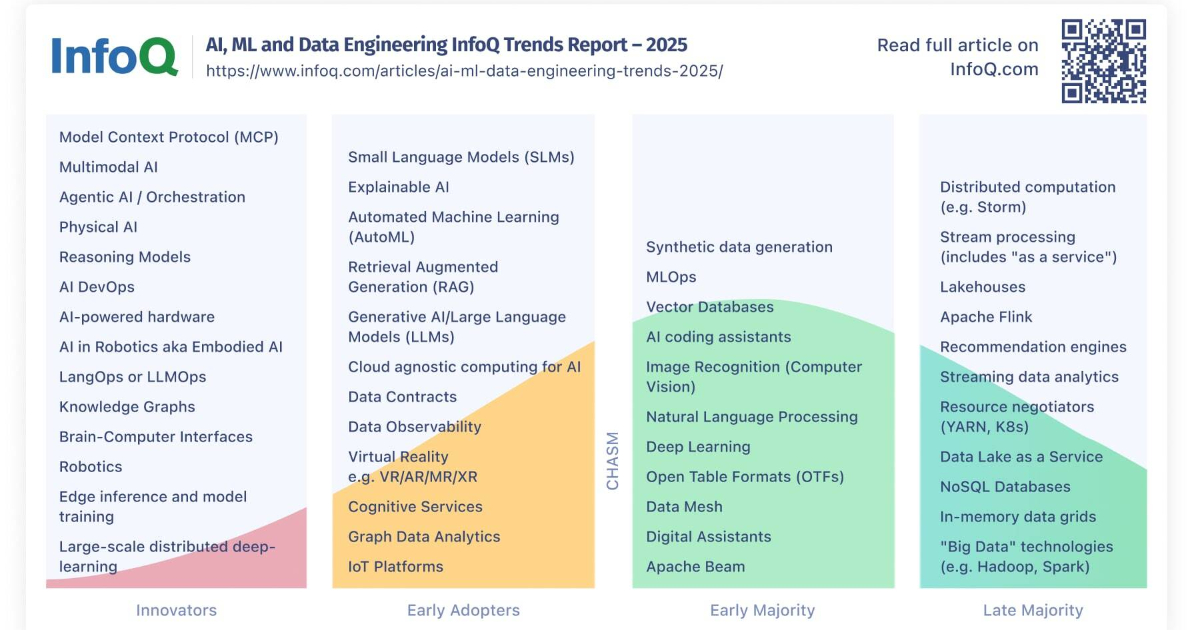
This InfoQ Trends Report offers readers a comprehensive overview of emerging trends and technologies in the areas of AI, ML, and Data Engineering. This report summarizes the InfoQ editorial team’s and external guests' view on the current trends in AI and ML technologies and what to look out for in the next 12 months. By Srini Penchikala, Savannah Kunovsky, Anthony Alford, Daniel Dominguez, Vinod Goje
This InfoQ Trends Report offers readers a comprehensive overview of emerging trends and technologies in the areas of AI, ML, and Data Engineering. This report summarizes the InfoQ editorial team’s and external guests' view on the current trends in AI and ML technologies and what to look out for in the next 12 months.
By Srini Penchikala, Savannah Kunovsky, Anthony Alford, Daniel Dominguez, Vinod Goje
As companies race to implement AI, many are finding that project success hinges directly on the quality of their data. This dependency is causing many ambitious initiatives to stall, never making it beyond the experimental proof-of-concept stage.
So, what’s the secret to turning these experiments into real revenue generators? AI News caught up with Martin Frederik, regional leader for the Netherlands, Belgium, and Luxembourg at data cloud giant Snowflake, to find out.
“There’s no AI strate
As companies race to implement AI, many are finding that project success hinges directly on the quality of their data. This dependency is causing many ambitious initiatives to stall, never making it beyond the experimental proof-of-concept stage.
So, what’s the secret to turning these experiments into real revenue generators? AI News caught up with Martin Frederik, regional leader for the Netherlands, Belgium, and Luxembourg at data cloud giant Snowflake, to find out.
“There’s no AI strategy without a data strategy,” Frederik says simply. “AI apps, agents, and models are only as effective as the data they’re built on, and without unified, well-governed data infrastructure, even the most advanced models can fall short.”
Improving data quality is key to AI project success
It’s a familiar story for many organisations: a promising proof-of-concept impresses the team but never translates into a tool that makes the company money. According to Frederik, this often happens because leaders treat the technology as the end goal.
“AI is not the destination – it’s the vehicle to achieving your business goals,” Frederik advises.
When projects get stuck, it’s usually down to a few common culprits: the project isn’t truly aligned with what the business needs, teams aren’t talking to each other, or the data is a mess. It’s easy to get disheartened by statistics suggesting that 80% of AI projects don’t reach production, but Frederik offers a different perspective. This isn’t necessarily a failure, he suggests, but “part of the maturation process”.
For those who get the foundation right, the payoff is very real. A recent Snowflake study found that 92% of companies are already seeing a return on their AI investments. In fact, for every £1 spent, they’re getting back £1.41 in cost savings and new revenue. The key, Frederik repeats, is having a “secure, governed and centralised platform” for your data from the very beginning.
It’s not just about tech, it’s about people
Even with the best technology, an AI strategy can fall flat if the company culture isn’t ready for it. One of the biggest challenges is getting data into the hands of everyone who needs it, not just a select few data scientists. To make AI work at scale, you have to build strong foundations in your “people, processes, and technology.”
This means breaking down the walls between departments and making quality data and AI tools accessible to everyone.
“With the right governance, AI becomes a shared resource rather than a siloed tool,” Frederik explains. When everyone works from a single source of truth, teams can stop arguing about whose numbers are correct and start making faster and smarter decisions together.
The next leap: AI that reasons for itself
The true breakthrough we’re seeing now is the emergence of AI agents that can understand and reason over all kinds of data at once regardless of structure quality; from the neat rows and columns in a spreadsheet, to the unstructured information in documents, videos, and emails. Considering that this unstructured data makes up 80-90% of a typical company’s data, this is a huge step forward.
New tools are enabling staff, no matter their technical skill level, to simply ask complex questions in plain English and get answers directly from the data.
Frederik explains that this is a move towards what he calls “goal-directed autonomy”. Until now, AI has been a helpful assistant you had to constantly direct. “You ask a question, you get an answer; you ask for code, you get a snippet,” he notes.
The next generation of AI is different. You can give an agent a complex goal, and it will figure out the necessary steps on its own, from writing code to pulling in information from other apps to deliver a complete answer. This will automate the most time-consuming parts of a data scientist’s job, like “tedious data cleaning” and “repetitive model tuning.”
The result? It frees up your brightest minds to focus on what really matters. This elevates your people “from practitioner to strategist” and allows them to drive real value for the business. That can only be a good thing.
Snowflake is a key sponsor of this year’s AI & Big Data Expo Europe and will have a range of speakers sharing their deep insights during the event. Swing by Snowflake’s booth at stand number 50 to hear more from the company about making enterprise AI easy, efficient, and trusted.
Want to learn more about AI and big data from industry leaders? Check out AI & Big Data Expo taking place in Amsterdam, California, and London. The comprehensive event is part of TechEx and is co-located with other leading technology events, click here for more information.
AI News is powered by TechForge Media. Explore other upcoming enterprise technology events and webinars here.
Background: Large language model (LLM) fine tuning is the process of adjusting out-of-the-box model weights using a dataset of interest. Fine tuning can be a powerful technique to improve model performance in fields like medicine, where data access is restricted and LLMs may have poor out-of-the-box performance. Objective: In this study we investigated the benefits of fine tuning with supervised fine tuning (SFT) and direct preference optimization (DPO) across a range of LLM applications for med
Background: Large language model (LLM) fine tuning is the process of adjusting out-of-the-box model weights using a dataset of interest. Fine tuning can be a powerful technique to improve model performance in fields like medicine, where data access is restricted and LLMs may have poor out-of-the-box performance. Objective: In this study we investigated the benefits of fine tuning with supervised fine tuning (SFT) and direct preference optimization (DPO) across a range of LLM applications for medicine Methods: We use Llama3 7B and Mistral 7B v2 to compare the performance of SFT and DPO across four datasets for common natural language tasks in medicine. The tasks evaluated were simple classification, clinical reasoning, summarization, and clinical triage. Results: Clinical Reasoning accuracy increased 8% and 7% with DPO over SFT for Llama3 (p value 0.003) and Mistral2 (p value 0.004) respectively. Summarization quality, graded on a five point Likert scale, increased 0.13 and 0.10 for Llama3 and Mistral2 (p values

 Login
Login