❌

Normal view

Neon, the No. 2 social app on the Apple App Store, pays users to record their phone calls and sells data to AI firms

25 September 2025 at 03:50
A new call recording app is gaining traction for offering to pay users for voice data from calls, which is sold to AI companies.
  • ✇STAT
  • Opinion: My patient almost quit a clinical trial to save her job Ennis James
    When one of my patients was first diagnosed with sarcoidosis, her specialist gave her two options: take steroids or join a clinical trial. She opted for the trial, hoping it might lead to better treatment for herself and others. However, her initial excitement waned as the logistical demands began to take a toll on her personal and professional life. With twice-monthly appointments, each trial day required an early two-hour drive, followed by eight hours of appointments, and concluded with a
     

Opinion: My patient almost quit a clinical trial to save her job

24 September 2025 at 16:30

When one of my patients was first diagnosed with sarcoidosis, her specialist gave her two options: take steroids or join a clinical trial. She opted for the trial, hoping it might lead to better treatment for herself and others.

However, her initial excitement waned as the logistical demands began to take a toll on her personal and professional life. With twice-monthly appointments, each trial day required an early two-hour drive, followed by eight hours of appointments, and concluded with a long drive home — all while managing symptoms of the disease. The trial sponsor eventually covered an overnight hotel room to ease her travel, but that doubled her time away from work and further amplified her stress.

Read the rest…

© Adobe

Molecular advances in early-stage and locally advanced non-small cell lung carcinoma: Shaping the future of precision oncology-systematic review

24 September 2025 at 18:00

Sci Prog. 2025 Jul-Sep;108(3):368504251383055. doi: 10.1177/00368504251383055. Epub 2025 Sep 24.

ABSTRACT

ObjectiveTo synthesize recent molecular advances that inform diagnosis, risk-stratification, and perioperative treatment in early-stage and locally advanced non-small cell lung carcinoma (NSCLC), with emphasis on comprehensive genomic profiling, minimal residual disease (MRD) detection by circulating tumor DNA (ctDNA), and the translation of biomarkers into targeted and immunotherapy strategies.MethodsSystematic review registered in PROSPERO (CRD420251076423). Searches of PubMed, Scopus, Web of Science, and Embase (January 2015-April 2025) followed PRISMA 2020/PRISMA-S. From 4640 records, 890 duplicates were removed; 3750 titles/abstracts were screened; 150 full texts were assessed; 75 studies met inclusion criteria. Risk of bias used Newcastle-Ottawa Scale (NOS) for observational studies and Cochrane RoB 2 tool for randomized controlled trials; certainty was summarized with GRADE where applicable.ResultsActionable alterations (e.g. EGFR, ALK, KRAS, MET, RET, BRAF, NTRK) are prevalent in early-stage NSCLC and comparable to advanced disease, supporting routine comprehensive genomic profiling in curative-intent settings. Next-generation sequencing (NGS) and ctDNA enable the detection of MRD, earlier relapse prediction, and dynamic treatment monitoring. Perioperative strategies integrating targeted therapy and immunotherapy (e.g. adjuvant EGFR-TKI, neoadjuvant chemo-immunotherapy) improve pathological and disease-free outcomes in selected biomarker-defined populations. Evidence profiles generally show low-to-moderate risk of bias and moderate-to-high certainty for key outcomes related to profiling and MRD, with heterogeneity across platforms and endpoints.ConclusionsMolecular advances-particularly broad NGS and ctDNA-based MRD-are reshaping the perioperative management of early and locally advanced NSCLC, enabling precision selection for targeted and immunotherapy approaches. Standardization of testing workflows and reporting, and cost-effective implementation are priorities for equitable adoption and for future trials that combine NGS, MRD, and multi-omic/AI-driven risk stratification.

PMID:40990633 | PMC:PMC12461064 | DOI:10.1177/00368504251383055

Expanding care coordination in an integrated health system through causal machine learning

npj Digital Medicine, Published online: 24 September 2025; doi:10.1038/s41746-025-01925-3

Expanding care coordination in an integrated health system through causal machine learning

Diabetic Foot Ulcer Classification Models Using Artificial Intelligence and Machine Learning Techniques: Systematic Review

Background: Diabetes-related foot ulceration (DFU) is a common complication of diabetes, with a significant impact on survival, health care costs, and health-related quality of life. The prognosis of DFU varies widely among individuals. The International Working Group on the Diabetic Foot recently updated their guidelines on how to classify ulcers using “classical” classification and scoring systems. No system was recommended for individual prognostication, and the group considered that more detail in ulcer characterization was needed and that machine learning (ML)–based models may be the solution. Despite advances in the field, no assessment of available evidence was done. Objective: This study aimed to identify and collect available evidence assessing the ability of ML-based models to predict clinical outcomes in people with DFU. Methods: We searched the MEDLINE database (PubMed), Scopus, Web of Science, and IEEE Xplore for papers published up to July 2023. Studies were eligible if they were anterograde analytical studies that examined the prognostic abilities of ML models in predicting clinical outcomes in a population that included at least 80% of adults with DFU. The literature was screened independently by 2 investigators (MMS and DAR or EH in the first phase, and MMS and MAS in the second phase) for eligibility criteria and data extracted. The risk of bias was evaluated using the Quality In Prognosis Studies tool and the Prediction model Risk Of Bias Assessment Tool by 2 investigators (MMS and MAS) independently. A narrative synthesis was conducted. Results: We retrieved a total of 2412 references after removing duplicates, of which 167 were subjected to full-text screening. Two references were added from searching relevant studies’ lists of references. A total of 11 studies, comprising 13 papers, were included focusing on 3 outcomes: wound healing, lower extremity amputation, and mortality. Overall, 55 predictive models were created using mostly clinical characteristics, random forest as the developing method, and area under the receiver operating characteristic curve (AUROC) as a discrimination accuracy measure. AUROC varied from 0.56 to 0.94, with the majority of the models reporting an AUROC equal or superior to 0.8 but lacking 95% CIs. All studies were found to have a high risk of bias, mainly due to a lack of uniform variable definitions, outcome definitions and follow-up periods, insufficient sample sizes, and inadequate handling of missing data. Conclusions: We identified several ML-based models predicting clinical outcomes with good discriminatory ability in people with DFU. Due to the focus on development and internal validation of the models, the proposal of several models in each study without selecting the “best one,” and the use of nonexplainable techniques, the use of this type of model is clearly impaired. Future studies externally validating explainable models are needed so that ML models can become a reality in DFU care. Trial Registration: PROSPERO CRD42022308248; https://www.crd.york.ac.uk/PROSPERO/view/CRD42022308248

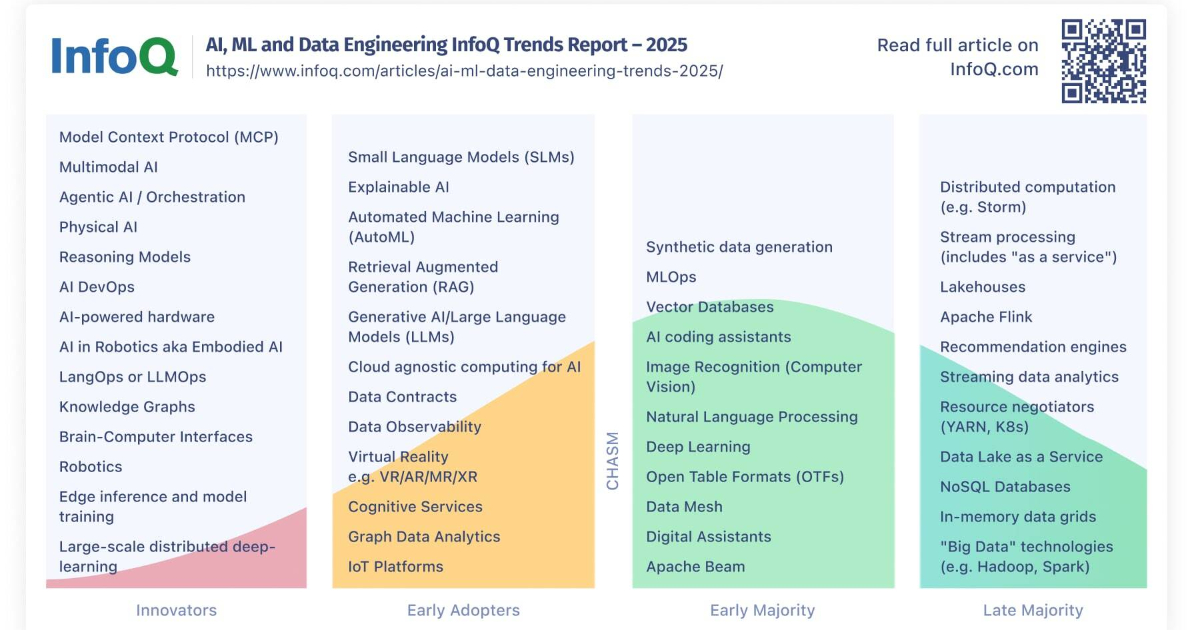
Article: InfoQ AI, ML and Data Engineering Trends Report - 2025

This InfoQ Trends Report offers readers a comprehensive overview of emerging trends and technologies in the areas of AI, ML, and Data Engineering. This report summarizes the InfoQ editorial team’s and external guests' view on the current trends in AI and ML technologies and what to look out for in the next 12 months.

By Srini Penchikala, Savannah Kunovsky, Anthony Alford, Daniel Dominguez, Vinod Goje
❌