❌

Normal view

  • ✇AI News
  • IBM: How robust AI governance protects enterprise margins Ryan Daws
    To protect enterprise margins, business leaders must invest in robust AI governance to securely manage AI infrastructure. When evaluating enterprise software adoption, a recurring pattern dictates how technology matures across industries. As Rob Thomas, SVP and CCO at IBM, recently outlined, software typically graduates from a standalone product to a platform, and then from a platform to foundational infrastructure, altering the governing rules entirely. At the initial product stage, exert
     

IBM: How robust AI governance protects enterprise margins

10 April 2026 at 21:57

To protect enterprise margins, business leaders must invest in robust AI governance to securely manage AI infrastructure.

When evaluating enterprise software adoption, a recurring pattern dictates how technology matures across industries. As Rob Thomas, SVP and CCO at IBM, recently outlined, software typically graduates from a standalone product to a platform, and then from a platform to foundational infrastructure, altering the governing rules entirely.

At the initial product stage, exerting tight corporate control often feels highly advantageous. Closed development environments iterate quickly and tightly manage the end-user experience. They capture and concentrate financial value within a single corporate entity, an approach that functions adequately during early product development cycles.

However, IBM’s analysis highlights that expectations change entirely when a technology solidifies into a foundational layer. Once other institutional frameworks, external markets, and broad operational systems rely on the software, the prevailing standards adapt to a new reality. At infrastructure scale, embracing openness ceases to be an ideological stance and becomes a highly practical necessity.

AI is currently crossing this threshold within the enterprise architecture stack. Models are increasingly embedded directly into the ways organisations secure their networks, author source code, execute automated decisions, and generate commercial value. AI functions less as an experimental utility and more as core operational infrastructure.

The recent limited preview of Anthropic’s Claude Mythos model brings this reality into sharper focus for enterprise executives managing risk. Anthropic reports that this specific model can discover and exploit software vulnerabilities at a level matching few human experts.

In response to this power, Anthropic launched Project Glasswing, a gated initiative designed to place these advanced capabilities directly into the hands of network defenders first. From IBM’s perspective, this development forces technology officers to confront immediate structural vulnerabilities. If autonomous models possess the capability to write exploits and shape the overall security environment, Thomas notes that concentrating the understanding of these systems within a small number of technology vendors invites severe operational exposure.

With models achieving infrastructure status, IBM argues the primary issue is no longer exclusively what these machine learning applications can execute. The priority becomes how these systems are constructed, governed, inspected, and actively improved over extended periods.

As underlying frameworks grow in complexity and corporate importance, maintaining closed development pipelines becomes exceedingly difficult to defend. No single vendor can successfully anticipate every operational requirement, adversarial attack vector, or system failure mode.

Implementing opaque AI structures introduces heavy friction across existing network architecture. Connecting closed proprietary models with established enterprise vector databases or highly sensitive internal data lakes frequently creates massive troubleshooting bottlenecks. When anomalous outputs occur or hallucination rates spike, teams lack the internal visibility required to diagnose whether the error originated in the retrieval-augmented generation pipeline or the base model weights.

Integrating legacy on-premises architecture with highly gated cloud models also introduces severe latency into daily operations. When enterprise data governance protocols strictly prohibit sending sensitive customer information to external servers, technology teams are left attempting to strip and anonymise datasets before processing. This constant data sanitisation creates enormous operational drag. 

Furthermore, the spiralling compute costs associated with continuous API calls to locked models erode the exact profit margins these autonomous systems are supposed to enhance. The opacity prevents network engineers from accurately sizing hardware deployments, forcing companies into expensive over-provisioning agreements to maintain baseline functionality.

Why open-source AI is essential for operational resilience

Restricting access to powerful applications is an understandable human instinct that closely resembles caution. Yet, as Thomas points out, at massive infrastructure scale, security typically improves through rigorous external scrutiny rather than through strict concealment.

This represents the enduring lesson of open-source software development. Open-source code does not eliminate enterprise risk. Instead, IBM maintains it actively changes how organisations manage that risk. An open foundation allows a wider base of researchers, corporate developers, and security defenders to examine the architecture, surface underlying weaknesses, test foundational assumptions, and harden the software under real-world conditions.

Within cybersecurity operations, broad visibility is rarely the enemy of operational resilience. In fact, visibility frequently serves as a strict prerequisite for achieving that resilience. Technologies deemed highly important tend to remain safer when larger populations can challenge them, inspect their logic, and contribute to their continuous improvement.

Thomas addresses one of the oldest misconceptions regarding open-source technology: the belief that it inevitably commoditises corporate innovation. In practical application, open infrastructure typically pushes market competition higher up the technology stack. Open systems transfer financial value rather than destroying it.

As common digital foundations mature, the commercial value relocates toward complex implementation, system orchestration, continuous reliability, trust mechanics, and specific domain expertise. IBM’s position asserts that the long-term commercial winners are not those who own the base technological layer, but rather the organisations that understand how to apply it most effectively.

We have witnessed this identical pattern play out across previous generations of enterprise tooling, cloud infrastructure, and operating systems. Open foundations historically expanded developer participation, accelerated iterative improvement, and birthed entirely new, larger markets built on top of those base layers. Enterprise leaders increasingly view open-source as highly important for infrastructure modernisation and emerging AI capabilities. IBM predicts that AI is highly likely to follow this exact historical trajectory.

Looking across the broader vendor ecosystem, leading hyperscalers are adjusting their business postures to accommodate this reality. Rather than engaging in a pure arms race to build the largest proprietary black boxes, highly profitable integrators are focusing heavily on orchestration tooling that allows enterprises to swap out underlying open-source models based on specific workload demands. Highlighting its ongoing leadership in this space, IBM is a key sponsor of this year’s AI & Big Data Expo North America, where these evolving strategies for open enterprise infrastructure will be a primary focus.

This approach completely sidesteps restrictive vendor lock-in and allows companies to route less demanding internal queries to smaller and highly efficient open models, preserving expensive compute resources for complex customer-facing autonomous logic. By decoupling the application layer from the specific foundation model, technology officers can maintain operational agility and protect their bottom line.

The future of enterprise AI demands transparent governance

Another pragmatic reason for embracing open models revolves around product development influence. IBM emphasises that narrow access to underlying code naturally leads to narrow operational perspectives. In contrast, who gets to participate directly shapes what applications are eventually built. 

Providing broad access enables governments, diverse institutions, startups, and varied researchers to actively influence how the technology evolves and where it is commercially applied. This inclusive approach drives functional innovation while simultaneously building structural adaptability and necessary public legitimacy.

As Thomas argues, once autonomous AI assumes the role of core enterprise infrastructure, relying on opacity can no longer serve as the organising principle for system safety. The most reliable blueprint for secure software has paired open foundations with broad external scrutiny, active code maintenance, and serious internal governance.

As AI permanently enters its infrastructure phase, IBM contends that identical logic increasingly applies directly to the foundation models themselves. The stronger the corporate reliance on a technology, the stronger the corresponding case for demanding openness.

If these autonomous workflows are truly becoming foundational to global commerce, then transparency ceases to be a subject of casual debate. According to IBM, it is an absolute, non-negotiable design requirement for any modern enterprise architecture.

See also: Why companies like Apple are building AI agents with limits

Banner for AI & Big Data Expo by TechEx events.

Want to learn more about AI and big data from industry leaders? Check out AI & Big Data Expo taking place in Amsterdam, California, and London. The comprehensive event is part of TechEx and is co-located with other leading technology events including the Cyber Security & Cloud Expo. Click here for more information.

AI News is powered by TechForge Media. Explore other upcoming enterprise technology events and webinars here.

The post IBM: How robust AI governance protects enterprise margins appeared first on AI News.

  • ✇AI News
  • Why companies like Apple are building AI agents with limits Muhammad Zulhusni
    Next-generation AI assistants being developed in the Apple ecosystem and by chipmakers like Qualcomm, but early reports suggest they are being designed with limits in place. Tom’s Guide has described early versions of these assistants as capable of navigating apps, carrying out bookings, and managing tasks in services. For instance a private beta agentic system completed tasks like booking services or posting content in apps. In one test, it moved through an app workflow and reached a payment sc
     

Why companies like Apple are building AI agents with limits

10 April 2026 at 18:00

Next-generation AI assistants being developed in the Apple ecosystem and by chipmakers like Qualcomm, but early reports suggest they are being designed with limits in place.

Tom’s Guide has described early versions of these assistants as capable of navigating apps, carrying out bookings, and managing tasks in services. For instance a private beta agentic system completed tasks like booking services or posting content in apps. In one test, it moved through an app workflow and reached a payment screen before asking the user for confirmation.

AI agents are being built with approval checkpoints. Sensitive actions, especially those tied to payments or account changes, require user confirmation before they are completed. The “human-in-the-loop” model lets the system prepare an action, but leaves approval to the user. Research linked to Apple’s AI work has explored ways to ensure systems pause before taking actions users did not explicitly request.

Banking apps already require confirmation for transfers. The same idea is now being applied to AI-driven actions in multiple services.

Limits and control

A control layer comes from restricting what the AI can access. Rather than providing the system full access to apps and data, businesses are establishing limits, such as which apps the AI can interact with and when actions can be triggered.

In practice, this means the AI may be able to draft a purchase or prepare a booking, but not finalise it without approval. It also means the system cannot move freely in all services unless it has been granted permission.

According to Tom’s Guide, the facility is for privacy. If data remains on the device, it eliminates the need to send sensitive information to external servers.

In areas like payments, AI systems are expected to work with partners that already have strict rules in place. In one reported example, payment providers’ services are being integrated to provide secure authentication before transactions are completed, though such safeguards are still under development. The existing systems act as an additional layer of oversight. They can set transaction limits or require extra verification.

Much of the discussion around AI governance has focused on enterprise use. That includes areas like cybersecurity and large-scale automation. The consumer side introduces a different challenge and companies must design controls that work for everyday users. That means clear approval steps and built-in privacy protections.

Autonomy with boundaries

As AI gains the ability to carry out actions, the risks become greater as errors can lead to financial loss or data exposure.

By placing controls at multiple points, including approval and infrastructure, companies are trying to manage those risks.

The approach may shape how agentic AI develops in the near term. Rather than aiming for full independence, companies appear focused on controlled environments where the risks can be managed.

(Photo by Junseong Lee)

See also: Agentic AI’s governance challenges under the EU AI Act in 2026

Want to learn more about AI and big data from industry leaders? Check out AI & Big Data Expo taking place in Amsterdam, California, and London. The comprehensive event is part of TechEx and co-located with other leading technology events. Click here for more information.

AI News is powered by TechForge Media. Explore other upcoming enterprise technology events and webinars here.

The post Why companies like Apple are building AI agents with limits appeared first on AI News.

  • ✇AI News
  • Agentic AI’s governance challenges under the EU AI Act in 2026 Joe Green
    AI agents hold the promise of automatically moving data between systems and triggering decisions, but in some cases, they can act without a clear record of what, when, and why they undertook their tasks. That has the potential to create a governance problem, for which IT leaders are ultimately responsible. If an organisation can’t trace an agent’s actions and don’t have proper control over its authority, leaders can’t prove that a system is operating safely or even lawfully to regulators.
     

Agentic AI’s governance challenges under the EU AI Act in 2026

9 April 2026 at 23:02

AI agents hold the promise of automatically moving data between systems and triggering decisions, but in some cases, they can act without a clear record of what, when, and why they undertook their tasks.

That has the potential to create a governance problem, for which IT leaders are ultimately responsible. If an organisation can’t trace an agent’s actions and don’t have proper control over its authority, leaders can’t prove that a system is operating safely or even lawfully to regulators.

That’s an issue set to become more important from August this year, as enforcement of the EU AI Act kicks in. According to the text of the Act, there will be substantial penalties for failures of governance relating to AI, especially when used in high-risk areas such as when personally-identifiable information is processed, or financial operations take place.

What IT leaders need to consider in the EU

Several steps can be taken to alleviate high levels of risk, and of these, the ones that stand out for consideration include agent identity, comprehensive logs, policy checks, human oversight, rapid revocation, the availability of documentation from vendors, and the formulation of evidence for presentation to regulators.

There are several options decision makers can consider that will help create the record of activities undertaken by agentic systems. For example, a Python SDK (software development kit), Asqav, can sign each agent’s action cryptographically and link all records to an immutable hash chain – the type of technique that’s more associated with blockchain technology. If someone or something changes or removes a record, verification of the chain fails.

For governance teams, using a verbose, centralised, possibly-encrypted system of record for all agentic AIs is a measure that provides data well beyond the scattered text logs produced by individual software platforms. Regardless of the technical details of how records are made and kept, IT leaders need to see exactly where, when, and how agentic instances are acting throughout the enterprise.

Many organisations fail at this first step in any recording of automated, AI-driven activity. It’s necessary to keep a registry of every agent in operation, with each uniquely identified, plus records of its capabilities and granted permissions. This ‘agentic asset list’ ties neatly into the requirements of the EU AI Act’s article 9, which states:

  • Article 9: For high-risk areas, AI risk management has to be an ongoing, evidence-based process built into every stage of deployment (development, preparation, production), and be under constant review.

Furthermore, decision-makers need to be aware of the Act’s Article 13:

  • High-risk AI systems have to be designed in such a way that those deploying them can understand a system’s output. Thus, an AI system from a third-party must be interpretable by its users (not an opaque code blob), and should be supplied with enough documentation to ensure its safe and lawful use.

This requirement means the choice of model and its methods of deployment are both technical and regulatory considerations.

Putting the brakes on

It’s important for any agentic deployment to offer a facility for the revocation of an AI’s operating role, preferably within a matter of seconds. The ability to revoke quickly should be part of emergency response processes. Revocation options should include the immediate removal of privileges, immediate ceasing of API access, and the flushing of queued tasks.

The presence of human oversight, combined with the presentation of enough context for humans to make informed decisions, means that human operators must be able to reject any proposed action. It’s not considered adequate for the person reviewing a decision to see only a prompt or a confidence score. Effective oversight needs information around context, every agent’s authority, and time enough to intervene to prevent mis-steps.

Multi-agent considerations

While every agent’s action should be recorded automatically and retained, multi-agent processes are particularly complex to track, as failures can take place among chains of agents. It’s therefore important for security policies to be tested during the development of any system that intends to utilise multiple agents.

Finally, governing authorities may require logs and technical documentation at any time, and will certainly need them after any incident they have been made aware of.

Conclusion

The question to be considered by IT leaders considering using AI on sensitive data or in high-risk environments is whether every aspect of the technology can be identified, constrained by policy, audited, interrupted, and explained. If the answer is unclear, governance is not yet in place.

(Image source: “Last Judgement” by Lawrence OP is licensed under CC BY-NC-ND 2.0. To view a copy of this license, visit https://creativecommons.org/licenses/by-nc-nd/2.0)


Want to learn more about AI and big data from industry leaders? Check out AI & Big Data Expo taking place in Amsterdam, California, and London. The comprehensive event is part of TechEx and co-located with other leading technology events. Click here for more information.

AI News is powered by TechForge Media. Explore other upcoming enterprise technology events and webinars here.

The post Agentic AI’s governance challenges under the EU AI Act in 2026 appeared first on AI News.

Uber’s Hive Federation Decentralizes 16K Datasets and 10+ PB for Zero-Downtime Analytics at Scale

9 April 2026 at 21:54

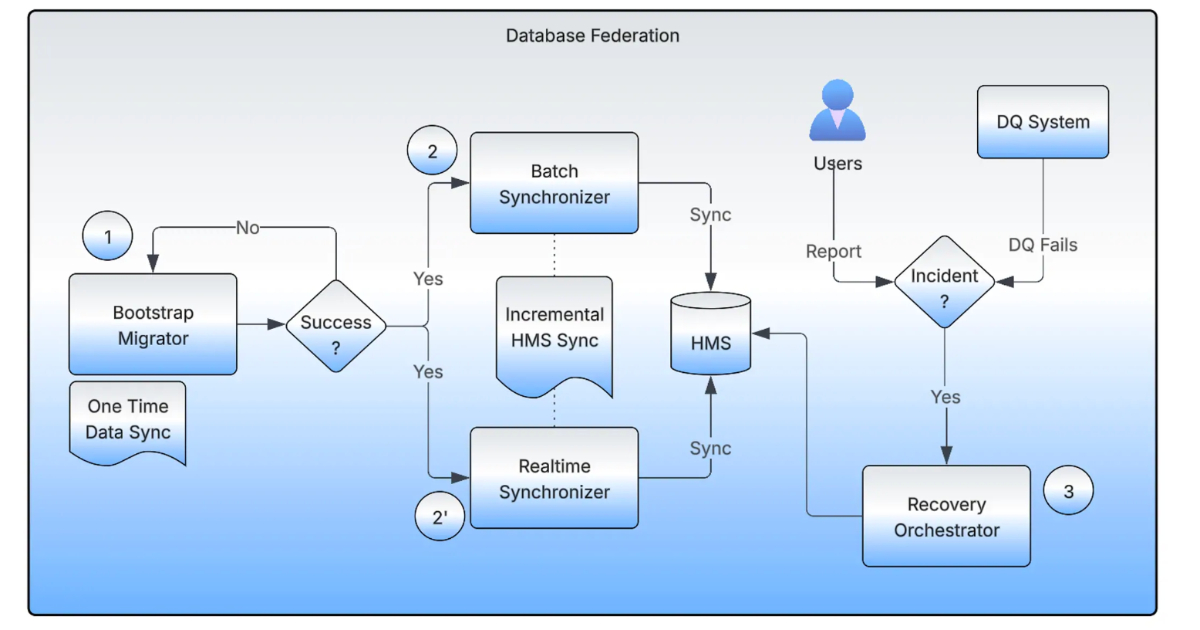
Uber has decentralized its Hive data warehouse, migrating 16,000 datasets totaling over 10 petabytes using pointer-based federation. The migration ensures zero downtime, strict ACL enforcement, improved governance, and scalable, domain-specific datasets for analytics and machine learning workloads.

By Leela Kumili
  • ✇AI News
  • AI’s software development success and central management needs Joe Green
    A survey carried out by OutSystems, The State of AI Development 2026 [email wall], argues that AI has moved into early production phase for many enterprises, primarily inside the IT function. The survey was based on the responses of 1,879 IT leaders, and warns that adoption of AI is in danger of running ahead of governance and integration. The shortfall is a gap between what IT leaders want agents to do and what their organisations can safely control. The report’s authors urge companies to ad
     

AI’s software development success and central management needs

8 April 2026 at 18:43

A survey carried out by OutSystems, The State of AI Development 2026 [email wall], argues that AI has moved into early production phase for many enterprises, primarily inside the IT function.

The survey was based on the responses of 1,879 IT leaders, and warns that adoption of AI is in danger of running ahead of governance and integration. The shortfall is a gap between what IT leaders want agents to do and what their organisations can safely control. The report’s authors urge companies to address the controls or guardrails on AI systems, and also stress the importance of integrating new, AI technology into an organisation’s existing platforms.

OutSystems says 97% of its respondents are exploring some form of agentic strategy, with 49% of them describing their current abilities as “advanced” or “expert.” Nearly half of those surveyed say that over half of agentic AI projects have moved from pilot into production, with Indian companies most successful in implementing the technology: 50% of Indian companies say their AI projects are 51% to 75% successful.

Companies are considering where agents should be deployed first, and under what controls, but although “cost reduction or efficiency gains” is the most cited expectation for AI’s effects, only 22% found their deployments most effective in that regard. Instead, the most effective area gains in a business stemmed from equipping software developers with AI tools described as “generative AI-assisted.”

The report’s geography and sector data show that transitions to AI agentic workflows are unevenly distributed. India stands out as the market with the highest share of users considering themselves “expert”, while many organisations in Australia, Brazil, Germany, the Netherlands, the UK, and the US still identify as intermediate stage users. France and Germany are the most dubious of AI adoption, with Germany recording the highest share of leaders not using agentic AI in any form.

The sectors and functions invested in AI

Financial services and technology show the most movement from pilot to production, with many implementations in core business functions. The sector can be considered as having the most clear line of sight from automation to measurable returns in terms of income. The practical inference from the report’s findings would be for slower-moving sectors to copy the implementation workflows employed by the fintech industry: Start with narrow, high-volume workflows where performance can be measured and failures can be contained, and focus on the IT function.

According to the survey, generative AI-assisted development is now common in nine of the ten countries surveyed, alongside traditional coding, outsourced development, and SaaS customisation. It undercuts the notion that enterprises are moving into an AI-native or all-AI stack. In fact, most organisations add agents and AI-generated code on top of the processes already proven effective in their development environments.

Fragmented data no roadblock to AI progress

OutSystems finds that 48% of respondents see integration with legacy systems as the most important ability needed to expand agentic AI, and 38% say legacy systems are the main reason projects stall between pilot and production. Of the potential barriers to AI development that were offered as choices to the survey’s participants, more than 40% cited integration difficulties and legacy fragmentation the most problematic.

Organisations considering large data clean-up programmes (which many AI vendors advocate as a reason why deployments fail to reach production) may want to rethink, the report implies. The authors state agents can be built that can work well in complex data environments, as long as governance and integration are strengthened at the same time as AI implementation. Across the board, most sectors express “moderate trust” levels of agentic AI at around 50%, although responses from different business functions were not broken out in the survey results’ figures.

IT operations and software development

The financial returns are manifest mostly in IT functions themselves. The report says the most explored use cases are IT operations, at 55%, and data analysis, at 52%. Workflow automation follows at 36%, then customer experience at 33%. On realised return on investment, IT development and productivity lead by a margin, at 40%, ahead of operational efficiency at 22%. That distribution suggests that the first durable value from agentic AI is internal at developers’ desks rather than in customer-facing environments. Customer-facing deployments may still make sense, but the report indicates they require more trust in system performance, stronger controls, better orchestration, and an ability to create watertight oversight mechanisms.

Trust in and control of agents and governance

Trust in agentic AI, however, is improving. OutSystems reports that 73% of respondents express either high or moderate trust in letting agents to act autonomously, a rise of around 10% compared to a similar survey the company undertook last year. Trust in code or workflows generated by third-party AI tools is slightly lower, at 67%, a substantial increase from the prior year’s figure, when only 40% ‘mostly trusted’ generative AI to write code without human help.

Only 36% of respondents say they have a centralised approach to AI governance, while 64% say they lack such a facility, and 41% rely on rules implemented on a per-project basis. Two-thirds say building human-in-the-loop checkpoints is technically difficult because it requires orchestration that can pause agents – in effect inserting manual braking on operations that might be fully autonomous.

Many organisations appear to be deploying looser oversight models, although it is not clear if that is a result of greater trust in models or whether business functions are under pressure to deploy AI regardless of security or reliability concerns. If the trend to loosen oversight continues, the report’s authors note that agentic AI adoption may advance faster than the methods of accountability that many consider important.

Firms that want to scale agents in regulated or mission-critical settings should treat orchestration and auditability as part of the product, the survey’s findings state. When compliance checks consider a business’s operations, breadcrumb trails in the form of logfiles and defined responsibilities are considered important elements of any agentic AI rollout.

The report says 94% of leaders are concerned about “AI sprawl”, which is not defined, but could be inferred to be a lack of a centralised management platform that oversees all AI deployments in the enterprise. 39% are very or extremely concerned about the issue, and only 12% currently use a centralised platform to keep that sprawl under control.

The full survey can be accessed here.

(Image source: “Relax” by Koijots is licensed under CC BY-SA 2.0. To view a copy of this license, visit https://creativecommons.org/licenses/by-sa/2.0)


Want to learn more about AI and big data from industry leaders? Check out AI & Big Data Expo taking place in Amsterdam, California, and London. The comprehensive event is part of TechEx and co-located with other leading technology events. Click here for more information.

AI News is powered by TechForge Media. Explore other upcoming enterprise technology events and webinars here.

The post AI’s software development success and central management needs appeared first on AI News.

  • ✇AI News
  • Microsoft open-source toolkit secures AI agents at runtime Ryan Daws
    A new open-source toolkit from Microsoft focuses on runtime security to force strict governance onto enterprise AI agents. The release tackles a growing anxiety: autonomous language models are now executing code and hitting corporate networks way faster than traditional policy controls can keep up. AI integration used to mean conversational interfaces and advisory copilots. Those systems had read-only access to specific datasets, keeping humans strictly in the execution loop. Organisations ar
     

Microsoft open-source toolkit secures AI agents at runtime

8 April 2026 at 18:23

A new open-source toolkit from Microsoft focuses on runtime security to force strict governance onto enterprise AI agents. The release tackles a growing anxiety: autonomous language models are now executing code and hitting corporate networks way faster than traditional policy controls can keep up.

AI integration used to mean conversational interfaces and advisory copilots. Those systems had read-only access to specific datasets, keeping humans strictly in the execution loop. Organisations are currently deploying agentic frameworks that take independent action, wiring these models directly into internal application programming interfaces, cloud storage repositories, and continuous integration pipelines.

When an autonomous agent can read an email, decide to write a script, and push that script to a server, stricter governance is vital. Static code analysis and pre-deployment vulnerability scanning just can’t handle the non-deterministic nature of large language models. One prompt injection attack (or even a basic hallucination) could send an agent to overwrite a database or pull out customer records.

Microsoft’s new toolkit looks at runtime security instead, providing a way to monitor, evaluate, and block actions at the moment the model tries to execute them. It beats relying on prior training or static parameter checks.

Intercepting the tool-calling layer in real time

Looking at the mechanics of agentic tool calling shows how this works. When an enterprise AI agent has to step outside its core neural network to do something like query an inventory system, it generates a command to hit an external tool.

Microsoft’s framework drops a policy enforcement engine right between the language model and the broader corporate network. Every time the agent tries to trigger an outside function, the toolkit grabs the request and checks the intended action against a central set of governance rules. If the action breaks policy (e.g. an agent authorised only to read inventory data tries to fire off a purchase order) the toolkit blocks the API call and logs the event so a human can review it.

Security teams get a verifiable, auditable trail of every single autonomous decision. Developers also win here; they can build complex multi-agent systems without having to hardcode security protocols into every individual model prompt. Security policies get decoupled from the core application logic entirely and are managed at the infrastructure level.

Most legacy systems were never built to talk to non-deterministic software. An old mainframe database or a customised enterprise resource planning suite doesn’t have native defenses against a machine learning model shooting over malformed requests. Microsoft’s toolkit steps in as a protective translation layer. Even if an underlying language model gets compromised by external inputs; the system’s perimeter holds.

Security leaders might wonder why Microsoft decided to release this runtime toolkit under an open-source license. It comes down to how modern software supply chains actually work.

Developers are currently rushing to build autonomous workflows using a massive mix of open-source libraries, frameworks, and third-party models. If Microsoft locked this runtime security feature to its proprietary platforms, development teams would probably just bypass it for faster, unvetted workarounds to hit their deadlines.

Pushing the toolkit out openly means security and governance controls can fit into any technology stack. It doesn’t matter if an organisation runs local open-weight models, leans on competitors like Anthropic, or deploys hybrid architectures.

Setting up an open standard for AI agent security also lets the wider cybersecurity community chip in. Security vendors can stack commercial dashboards and incident response integrations on top of this open foundation, which speeds up the maturity of the whole ecosystem. For businesses, they avoid vendor lock-in but still get a universally scrutinised security baseline.

The next phase of enterprise AI governance

Enterprise governance doesn’t just stop at security; it hits financial and operational oversight too. Autonomous agents run in a continuous loop of reasoning and execution, burning API tokens at every step. Startups and enterprises are already seeing token costs explode when they deploy agentic systems.

Without runtime governance, an agent tasked with looking up a market trend might decide to hit an expensive proprietary database thousands of times before it finishes. Left alone, a badly configured agent caught in a recursive loop can rack up massive cloud computing bills in a few hours.

The runtime toolkit gives teams a way to slap hard limits on token consumption and API call frequency. By setting boundaries on exactly how many actions an agent can take within a specific timeframe, forecasting computing costs gets much easier. It also stops runaway processes from eating up system resources.

A runtime governance layer hands over the quantitative metrics and control mechanisms needed to meet compliance mandates. The days of just trusting model providers to filter out bad outputs are ending. System safety now falls on the infrastructure that actually executes the models’ decisions

Getting a mature governance program off the ground is going to demand tight collaboration between development operations, legal, and security teams. Language models are only scaling up in capability, and the organisations putting strict runtime controls in place today are the only ones who will be equipped to handle the autonomous workflows of tomorrow.

See also: As AI agents take on more tasks, governance becomes a priority

Banner for AI & Big Data Expo by TechEx events.

Want to learn more about AI and big data from industry leaders? Check out AI & Big Data Expo taking place in Amsterdam, California, and London. The comprehensive event is part of TechEx and is co-located with other leading technology events including the Cyber Security & Cloud Expo. Click here for more information.

AI News is powered by TechForge Media. Explore other upcoming enterprise technology events and webinars here.

The post Microsoft open-source toolkit secures AI agents at runtime appeared first on AI News.

  • ✇AI News
  • Boomi calls it “data activation” and says it’s the missing step in every AI deployment Dashveenjit Kaur
    The failure mode for enterprise AI in 2026 is not what most people expected. It is not that the models are wrong, or that agents cannot reason, or that the technology is overhyped. The failure mode is that the data feeding those systems is fragmented, inconsistently labelled, and spread across dozens of applications that were never designed to share context.  Boomi calls this the agentic AI data activation problem, and after tracking 75,000 AI agents running in production across its customer
     

Boomi calls it “data activation” and says it’s the missing step in every AI deployment

7 April 2026 at 20:00

The failure mode for enterprise AI in 2026 is not what most people expected. It is not that the models are wrong, or that agents cannot reason, or that the technology is overhyped. The failure mode is that the data feeding those systems is fragmented, inconsistently labelled, and spread across dozens of applications that were never designed to share context. 

Boomi calls this the agentic AI data activation problem, and after tracking 75,000 AI agents running in production across its customer base, the company says solving it comes before everything else. That figure comes from February, when Boomi reported its strongest momentum to date: more than 30,000 customers globally, 75,000 AI agents in production, and a customer base that includes over a quarter of the Fortune 500. 

Yet the consistent pattern across those deployments, according to Steve Lucas, chairman and CEO of Boomi, is that AI value only materialises once the data problem is resolved. “AI only delivers value when data is properly activated, trusted and governed first,” Lucas said when the company announced its latest platform capabilities on March 9.

The fragmentation problem

Enterprise data is not missing; it exists in abundance, distributed across ERP systems, CRMs, data lakes, SaaS platforms, and legacy applications that have accumulated over decades. What is missing is the shared context that allows an AI agent to treat data from one system as reliably compatible with data from another. 

An agent drawing customer records from a CRM and pricing data from an ERP may be working from conflicting definitions of what a customer or a product actually is. The outputs it produces are only as coherent as the data standards beneath them.

Boomi’s answer is Meta Hub, a central system of record announced in its March 9 platform update, designed to standardise business definitions across the enterprise and extend that context to every AI agent operating within it. The goal is to ensure agents reason from a consistent understanding of business logic rather than generating outputs based on fragmented interpretations pulled from disconnected systems.

The same release introduced real-time SAP data extraction via change data capture, addressing one of the most common integration bottlenecks in large enterprises, where SAP data is often inaccessible due to slow, manual export processes that render it effectively unavailable to AI workflows in real-time. 

New governance capabilities for Snowflake Cortex agents within Boomi’s Agent Control Tower added audit trails and session logs, addressing a concern that has moved steadily up enterprise priority lists: AI agents operating as a black box, taking actions with no visible reasoning chain.

What the analyst’s recognition signals

Two independent assessments in March gave Boomi external validation of its positioning. On March 16, Gartner named Boomi a Leader in its 2026 Magic Quadrant for Integration Platform as a Service–the twelfth consecutive time–and positioned it highest for Ability to Execute. 

On March 31, the IDC MarketScape for Worldwide API Management named Boomi a Leader, specifically noting its AI-centric strategy that treats APIs as both the fuel and the control plane for AI workloads. The Gartner framing is pointed. 

The report stated that AI-ready integration is a strategic capability that aligns architecture, integration, and governance to enable AI agents to effectively access enterprise data and operate within business processes. That framing validates the problem Boomi is addressing and signals that iPaaS platforms are now being evaluated on AI readiness rather than traditional integration capabilities alone.

The broader pattern

By now, we are aware that the shift from pilot to production in enterprise AI is stalling in a predictable place. Organisations have models. They have agents. What many do not have is the data infrastructure that makes those agents reliable enough to trust with real business processes.

Data activation–moving data from static storage into live, governed, context-rich flows that agents can actually reason from–is one articulation of what that missing layer needs to look like. Whether that framing becomes the industry standard or gets absorbed into a broader category is a question 2026 will start to answer. 

What is not in question is that the enterprises finding ROI from agentic AI are the ones that sorted the data layer first.

Boomi will be exhibiting at the AI & Big Data Expo at TechEx North America, taking place 18–19 May 2026 at the San Jose McEnery Convention Centre.

(Photo by Boomi)

See also: Autonomous AI systems depend on data governance

Want to learn more about AI and big data from industry leaders? Check out AI & Big Data Expo taking place in Amsterdam, California, and London. The comprehensive event is part of TechEx and is co-located with other leading technology events including the Cyber Security & Cloud Expo. Click here for more information.

AI News is powered by TechForge Media. Explore other upcoming enterprise technology events and webinars here.

The post Boomi calls it “data activation” and says it’s the missing step in every AI deployment appeared first on AI News.

  • ✇AI News
  • As AI agents take on more tasks, governance becomes a priority Muhammad Zulhusni
    AI systems are starting to move beyond simple responses. In many organisations, AI agents are now being tested to plan tasks, make decisions, and carry out actions with limited human input. It is no longer just about whether a model gives the right answer. It is about what happens when that model is allowed to act. Autonomous systems need clear boundaries. They need rules that define what they can access, what they are allowed to do, and how their actions are tracked. Without those controls,
     

As AI agents take on more tasks, governance becomes a priority

6 April 2026 at 18:00

AI systems are starting to move beyond simple responses. In many organisations, AI agents are now being tested to plan tasks, make decisions, and carry out actions with limited human input. It is no longer just about whether a model gives the right answer. It is about what happens when that model is allowed to act.

Autonomous systems need clear boundaries. They need rules that define what they can access, what they are allowed to do, and how their actions are tracked. Without those controls, even well-trained systems can create problems that are hard to detect or reverse.

One company working on this problem is Deloitte. The firm has been developing governance frameworks and advisory approaches to help organisations manage AI systems.

From tools to AI agents

Most AI systems in use today still depend on human prompts. They generate text, analyse data, or make predictions, but a person usually decides what happens next. Agentic AI changes that pattern. These systems can break down a goal into steps, choose actions, and interact with other systems to complete tasks.

That added independence brings new challenges. When a system acts on its own, it may take paths that were not fully expected or use data in ways that were not intended.

Deloitte’s work focuses on helping organisations prepare for these risks. Rather than treating AI as a standalone tool, the firm looks at how it fits into business processes, including how decisions are made and how data flows through systems.

Building governance into the lifecycle

Governance should not be added after deployment. It needs to be built into the full lifecycle of an AI system.

This starts at the design stage. Organisations need to define what a system is allowed to do and where its limits are. This may include setting rules around data use and outlining how the system should respond in uncertain situations.

The next stage is deployment. At this point, governance focuses on access and control, including who can use the system and what it can connect to. Once the system is live, monitoring becomes the main concern. Autonomous systems can change over time as they interact with new data. Without regular checks, they may drift away from their original purpose.

The role of transparency and accountability

As AI systems take on more responsibility, it becomes more difficult to trace how decisions are made. This creates a demand for stronger transparency. Deloitte’s work highlights the importance of keeping track of how systems operate. This includes logging actions and documenting decisions. These records help organisations in determining what happened if something goes wrong. If an autonomous system takes an action, there needs to be clarity about who is responsible.

Research from Deloitte shows that adoption of AI agents is moving faster than the controls needed to manage them. Around 23% of companies already use them, and that figure is expected to reach 74% within two years. Only 21% report having strong safeguards in place to oversee how they behave.

Real-time oversight for AI agents

Once an autonomous system is active, the focus shifts to how it behaves in real-world conditions. Static rules are not always enough, and systems need to be observed as they operate.

Deloitte’s approach includes real-time monitoring, allowing organisations to track what an AI system is doing as it performs tasks. If the system behaves in an unexpected way, teams can step in quickly. This may involve pausing certain actions or adjusting permissions. Real-time oversight also helps with compliance. In regulated industries, companies need to show that systems follow rules and standards.

In practice, these controls are starting to appear in operational settings. Deloitte describes scenarios where AI systems monitor equipment performance across sites. Sensor data can signal early signs of failure, which can trigger maintenance workflows and update internal systems. Governance frameworks define what actions the system can take, when human approval is required, and how decisions are recorded. The process runs across multiple systems, but from a user’s point of view, it appears as a single action.

Governance is part of discussions at AI & Big Data Expo North America 2026, taking place on May 18–19 in Santa Clara, California. Deloitte is listed as a Diamond Sponsor for the event, placing it among the firms contributing to conversations around how autonomous systems are deployed and controlled in practice.

The challenge is not just building smarter systems, but ensuring they behave in ways organisations can understand, manage, and trust over time.

(Photo by Roman)

See also: Autonomous AI systems depend on data governance

Want to learn more about AI and big data from industry leaders? Check out AI & Big Data Expo taking place in Amsterdam, California, and London. The comprehensive event is part of TechEx and is co-located with other leading technology events, click here for more information.

AI News is powered by TechForge Media. Explore other upcoming enterprise technology events and webinars here.

The post As AI agents take on more tasks, governance becomes a priority appeared first on AI News.

❌