Platform Engineering Labs has announced a major update to its open-source Infrastructure-as-Code platform, formae, introducing full Kubernetes support, native Helm integration, direct .tfvars compatibility, and a new public plugin hub aimed at simplifying cloud-native infrastructure management By Craig Risi
Platform Engineering Labs has announced a major update to its open-source Infrastructure-as-Code platform, formae, introducing full Kubernetes support, native Helm integration, direct .tfvars compatibility, and a new public plugin hub aimed at simplifying cloud-native infrastructure management
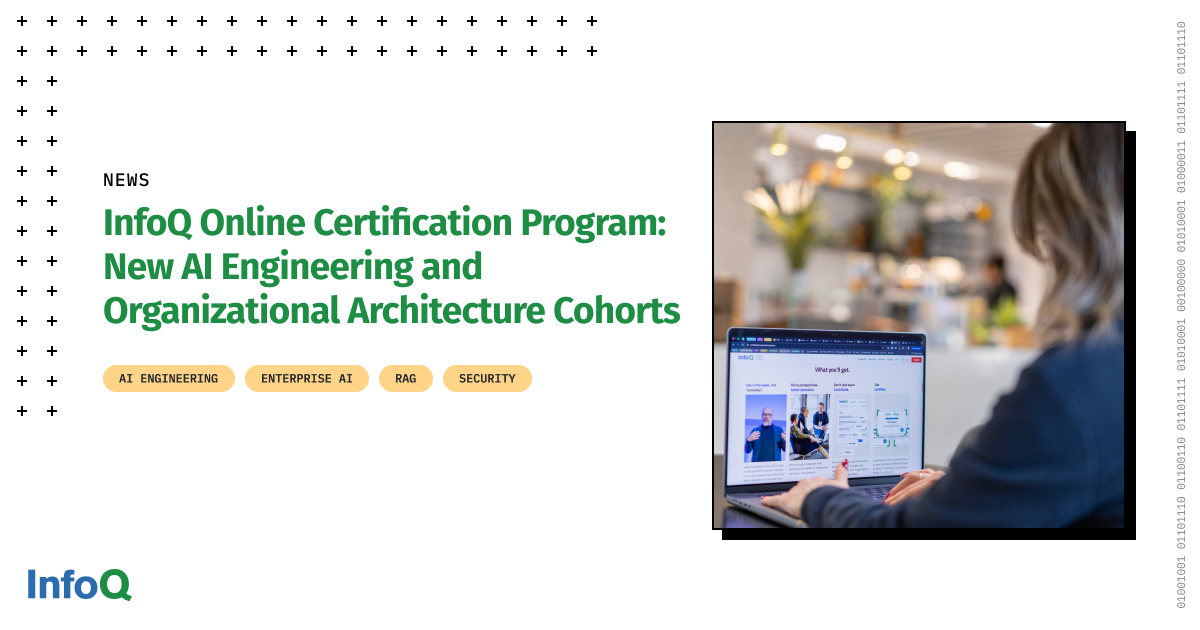
InfoQ expands its online certification portfolio with new AI Engineering and Organizational Architecture cohorts, giving senior practitioners a confidential peer group to pressure-test production AI, platform, team design, and architecture decisions. By Artenisa Chatziou
InfoQ expands its online certification portfolio with new AI Engineering and Organizational Architecture cohorts, giving senior practitioners a confidential peer group to pressure-test production AI, platform, team design, and architecture decisions.
Google's SynthID, designed to embed imperceptible signals into AI-generated content, is adding a new Content Detection API on Google Cloud's Gemini Enterprise Agent Platform, after gaining adoption by several industry players including Nvidia and OpenAI. By Sergio De Simone
Google's SynthID, designed to embed imperceptible signals into AI-generated content, is adding a new Content Detection API on Google Cloud's Gemini Enterprise Agent Platform, after gaining adoption by several industry players including Nvidia and OpenAI.
The call to action “to make 2026 the year of Java in the terminal” was quickly responded to by the launch of TamboUI. Inspired by Ratatui, the library used in Claude CLI, it promises support ranging from low-level terminal drawing to high-level APIs such as components and event handling. Currently at version 0.3.0, it has already been adopted by major projects such as Maven and Spring. By Olimpiu Pop
The call to action “to make 2026 the year of Java in the terminal” was quickly responded to by the launch of TamboUI. Inspired by Ratatui, the library used in Claude CLI, it promises support ranging from low-level terminal drawing to high-level APIs such as components and event handling. Currently at version 0.3.0, it has already been adopted by major projects such as Maven and Spring.
This week's Java roundup for May 18th, 2026, features news highlighting: GA releases of WildFly 40, Micronaut 5.0, Maven Embedded GlassFish Plugin 8.0 and Apache Fory 1.0; the May 2026 edition of Open Liberty; point releases of Gatherers4j, Apache and Kafka; and the seventh milestone release of Spring AI 2.0. By Michael Redlich
This week's Java roundup for May 18th, 2026, features news highlighting: GA releases of WildFly 40, Micronaut 5.0, Maven Embedded GlassFish Plugin 8.0 and Apache Fory 1.0; the May 2026 edition of Open Liberty; point releases of Gatherers4j, Apache and Kafka; and the seventh milestone release of Spring AI 2.0.
Microsoft has introduced a new AI-driven vulnerability discovery system called MDASH, a multi-model agentic security platform designed to automate large-scale code auditing across Windows and other Microsoft software environments. The system combines more than 100 specialized AI agents that work together to scan, validate, debate, and prove vulnerabilities across complex codebases. By Robert Krzaczyński
Microsoft has introduced a new AI-driven vulnerability discovery system called MDASH, a multi-model agentic security platform designed to automate large-scale code auditing across Windows and other Microsoft software environments. The system combines more than 100 specialized AI agents that work together to scan, validate, debate, and prove vulnerabilities across complex codebases.
Gemma 4 can be paired with multi-token prediction (MTP) drafters that use speculative decoding to generate multiple tokens in parallel, allowing the model to verify them in a single pass and achieve up to ~3× faster inference without quality loss. By Sergio De Simone
Gemma 4 can be paired with multi-token prediction (MTP) drafters that use speculative decoding to generate multiple tokens in parallel, allowing the model to verify them in a single pass and achieve up to ~3× faster inference without quality loss.
Matteo Collina has proposed a Virtual File System (VFS) for Node.js core through the node:vfs module. The proposal includes about 19,000 lines of code and addresses common workflow challenges. While it has community support, concerns have arisen regarding the use of AI in its development, prompting debates about its implications for code verification and necessity in the Node.js ecosystem. By Daniel Curtis
Matteo Collina has proposed a Virtual File System (VFS) for Node.js core through the node:vfs module. The proposal includes about 19,000 lines of code and addresses common workflow challenges. While it has community support, concerns have arisen regarding the use of AI in its development, prompting debates about its implications for code verification and necessity in the Node.js ecosystem.
There was a flurry of activity in the OpenJDK ecosystem during the week of May 18th, 2026, highlighting three JEPs elevated from Proposed to Target to Targeted and three JEPs elevated from Candidate to Proposed to Target for JDK 27. The proposed release schedule has also been finalized. By Michael Redlich
There was a flurry of activity in the OpenJDK ecosystem during the week of May 18th, 2026, highlighting three JEPs elevated from Proposed to Target to Targeted and three JEPs elevated from Candidate to Proposed to Target for JDK 27. The proposed release schedule has also been finalized.
Google has introduced Middleware for Genkit, its open-source framework for building AI-powered and agentic applications. The update adds a programmable interception layer around model calls, tool execution, and generation loops, giving developers more control over reliability, safety, and orchestration inside production AI systems. By Robert Krzaczyński
Google has introduced Middleware for Genkit, its open-source framework for building AI-powered and agentic applications. The update adds a programmable interception layer around model calls, tool execution, and generation loops, giving developers more control over reliability, safety, and orchestration inside production AI systems.
GitHub has launched Copilot CLI into general availability, bringing generative AI directly to the terminal. Integrated with the GitHub CLI, it offers natural language command suggestions and code explanations. Recent updates introduce "agentic" workflows with Autopilot mode and GPT-5.4 support, alongside new enterprise telemetry for tracking usage across development teams. By Mark Silvester
GitHub has launched Copilot CLI into general availability, bringing generative AI directly to the terminal. Integrated with the GitHub CLI, it offers natural language command suggestions and code explanations. Recent updates introduce "agentic" workflows with Autopilot mode and GPT-5.4 support, alongside new enterprise telemetry for tracking usage across development teams.
The Etsy engineering team recently described how the company migrated its long-running MySQL sharding infrastructure to Vitess. The transition moved shard routing from Etsy’s internal systems to Vitess using vindexes, enabling capabilities such as resharding data and sharding previously unsharded tables. By Renato Losio
The Etsy engineering team recently described how the company migrated its long-running MySQL sharding infrastructure to Vitess. The transition moved shard routing from Etsy’s internal systems to Vitess using vindexes, enabling capabilities such as resharding data and sharding previously unsharded tables.
The Food and Drug Administration on Friday rejected — again — an experimental treatment for advanced skin cancer developed by Replimune Group.
Replimune’s treatment, an engineered virus designed to rev up the immune system against melanoma, has been a flashpoint in a simmering debate over shifting standards at the agency.
The drug was initially rejected in July, just two months after Vinay Prasad was appointed the FDA’s head of biologics. As an academic oncologist, Prasad criticized regul
The Food and Drug Administration on Friday rejected — again — an experimental treatment for advanced skin cancer developed by Replimune Group.
Replimune’s treatment, an engineered virus designed to rev up the immune system against melanoma, has been a flashpoint in a simmering debate over shifting standards at the agency.
The drug was initially rejected in July, just two months after Vinay Prasad was appointed the FDA’s head of biologics. As an academic oncologist, Prasad criticized regulators for approving drugs with limited data, and the Replimune decision was viewed as a possible sign of the stricter stance he might take at the agency.
To protect enterprise margins, business leaders must invest in robust AI governance to securely manage AI infrastructure.
When evaluating enterprise software adoption, a recurring pattern dictates how technology matures across industries. As Rob Thomas, SVP and CCO at IBM, recently outlined, software typically graduates from a standalone product to a platform, and then from a platform to foundational infrastructure, altering the governing rules entirely.
At the initial product stage, exert
To protect enterprise margins, business leaders must invest in robust AI governance to securely manage AI infrastructure.
When evaluating enterprise software adoption, a recurring pattern dictates how technology matures across industries. As Rob Thomas, SVP and CCO at IBM, recently outlined, software typically graduates from a standalone product to a platform, and then from a platform to foundational infrastructure, altering the governing rules entirely.
At the initial product stage, exerting tight corporate control often feels highly advantageous. Closed development environments iterate quickly and tightly manage the end-user experience. They capture and concentrate financial value within a single corporate entity, an approach that functions adequately during early product development cycles.
However, IBM’s analysis highlights that expectations change entirely when a technology solidifies into a foundational layer. Once other institutional frameworks, external markets, and broad operational systems rely on the software, the prevailing standards adapt to a new reality. At infrastructure scale, embracing openness ceases to be an ideological stance and becomes a highly practical necessity.
AI is currently crossing this threshold within the enterprise architecture stack. Models are increasingly embedded directly into the ways organisations secure their networks, author source code, execute automated decisions, and generate commercial value. AI functions less as an experimental utility and more as core operational infrastructure.
The recent limited preview of Anthropic’s Claude Mythos model brings this reality into sharper focus for enterprise executives managing risk. Anthropic reports that this specific model can discover and exploit software vulnerabilities at a level matching few human experts.
In response to this power, Anthropic launched Project Glasswing, a gated initiative designed to place these advanced capabilities directly into the hands of network defenders first. From IBM’s perspective, this development forces technology officers to confront immediate structural vulnerabilities. If autonomous models possess the capability to write exploits and shape the overall security environment, Thomas notes that concentrating the understanding of these systems within a small number of technology vendors invites severe operational exposure.
With models achieving infrastructure status, IBM argues the primary issue is no longer exclusively what these machine learning applications can execute. The priority becomes how these systems are constructed, governed, inspected, and actively improved over extended periods.
As underlying frameworks grow in complexity and corporate importance, maintaining closed development pipelines becomes exceedingly difficult to defend. No single vendor can successfully anticipate every operational requirement, adversarial attack vector, or system failure mode.
Implementing opaque AI structures introduces heavy friction across existing network architecture. Connecting closed proprietary models with established enterprise vector databases or highly sensitive internal data lakes frequently creates massive troubleshooting bottlenecks. When anomalous outputs occur or hallucination rates spike, teams lack the internal visibility required to diagnose whether the error originated in the retrieval-augmented generation pipeline or the base model weights.
Integrating legacy on-premises architecture with highly gated cloud models also introduces severe latency into daily operations. When enterprise data governance protocols strictly prohibit sending sensitive customer information to external servers, technology teams are left attempting to strip and anonymise datasets before processing. This constant data sanitisation creates enormous operational drag.
Furthermore, the spiralling compute costs associated with continuous API calls to locked models erode the exact profit margins these autonomous systems are supposed to enhance. The opacity prevents network engineers from accurately sizing hardware deployments, forcing companies into expensive over-provisioning agreements to maintain baseline functionality.
Why open-source AI is essential for operational resilience
Restricting access to powerful applications is an understandable human instinct that closely resembles caution. Yet, as Thomas points out, at massive infrastructure scale, security typically improves through rigorous external scrutiny rather than through strict concealment.
This represents the enduring lesson of open-source software development. Open-source code does not eliminate enterprise risk. Instead, IBM maintains it actively changes how organisations manage that risk. An open foundation allows a wider base of researchers, corporate developers, and security defenders to examine the architecture, surface underlying weaknesses, test foundational assumptions, and harden the software under real-world conditions.
Within cybersecurity operations, broad visibility is rarely the enemy of operational resilience. In fact, visibility frequently serves as a strict prerequisite for achieving that resilience. Technologies deemed highly important tend to remain safer when larger populations can challenge them, inspect their logic, and contribute to their continuous improvement.
Thomas addresses one of the oldest misconceptions regarding open-source technology: the belief that it inevitably commoditises corporate innovation. In practical application, open infrastructure typically pushes market competition higher up the technology stack. Open systems transfer financial value rather than destroying it.
As common digital foundations mature, the commercial value relocates toward complex implementation, system orchestration, continuous reliability, trust mechanics, and specific domain expertise. IBM’s position asserts that the long-term commercial winners are not those who own the base technological layer, but rather the organisations that understand how to apply it most effectively.
We have witnessed this identical pattern play out across previous generations of enterprise tooling, cloud infrastructure, and operating systems. Open foundations historically expanded developer participation, accelerated iterative improvement, and birthed entirely new, larger markets built on top of those base layers. Enterprise leaders increasingly view open-source as highly important for infrastructure modernisation and emerging AI capabilities. IBM predicts that AI is highly likely to follow this exact historical trajectory.
Looking across the broader vendor ecosystem, leading hyperscalers are adjusting their business postures to accommodate this reality. Rather than engaging in a pure arms race to build the largest proprietary black boxes, highly profitable integrators are focusing heavily on orchestration tooling that allows enterprises to swap out underlying open-source models based on specific workload demands. Highlighting its ongoing leadership in this space, IBM is a key sponsor of this year’s AI & Big Data Expo North America, where these evolving strategies for open enterprise infrastructure will be a primary focus.
This approach completely sidesteps restrictive vendor lock-in and allows companies to route less demanding internal queries to smaller and highly efficient open models, preserving expensive compute resources for complex customer-facing autonomous logic. By decoupling the application layer from the specific foundation model, technology officers can maintain operational agility and protect their bottom line.
The future of enterprise AI demands transparent governance
Another pragmatic reason for embracing open models revolves around product development influence. IBM emphasises that narrow access to underlying code naturally leads to narrow operational perspectives. In contrast, who gets to participate directly shapes what applications are eventually built.
Providing broad access enables governments, diverse institutions, startups, and varied researchers to actively influence how the technology evolves and where it is commercially applied. This inclusive approach drives functional innovation while simultaneously building structural adaptability and necessary public legitimacy.
As Thomas argues, once autonomous AI assumes the role of core enterprise infrastructure, relying on opacity can no longer serve as the organising principle for system safety. The most reliable blueprint for secure software has paired open foundations with broad external scrutiny, active code maintenance, and serious internal governance.
As AI permanently enters its infrastructure phase, IBM contends that identical logic increasingly applies directly to the foundation models themselves. The stronger the corporate reliance on a technology, the stronger the corresponding case for demanding openness.
If these autonomous workflows are truly becoming foundational to global commerce, then transparency ceases to be a subject of casual debate. According to IBM, it is an absolute, non-negotiable design requirement for any modern enterprise architecture.
Want to learn more about AI and big data from industry leaders? Check out AI & Big Data Expo taking place in Amsterdam, California, and London. The comprehensive event is part of TechEx and is co-located with other leading technology events including the Cyber Security & Cloud Expo. Click here for more information.
AI News is powered by TechForge Media. Explore other upcoming enterprise technology events and webinars here.
The Cloud Native Computing Foundation (CNCF) and Kusari have announced a new collaboration aimed at strengthening software supply chain security across cloud-native projects, providing free access to Kusari's AI-powered security tooling for CNCF-hosted projects. By Craig Risi
The Cloud Native Computing Foundation (CNCF) and Kusari have announced a new collaboration aimed at strengthening software supply chain security across cloud-native projects, providing free access to Kusari's AI-powered security tooling for CNCF-hosted projects.
Google Cloud has outlined its recent technical contributions to PostgreSQL, emphasizing improvements in logical replication, upgrade processes, and overall system stability. The update reflects ongoing collaboration with the upstream community and focuses on enhancements to the core engine aimed at addressing scalability, replication, and operational challenges. By Robert Krzaczyński
Google Cloud has outlined its recent technical contributions to PostgreSQL, emphasizing improvements in logical replication, upgrade processes, and overall system stability. The update reflects ongoing collaboration with the upstream community and focuses on enhancements to the core engine aimed at addressing scalability, replication, and operational challenges.
Safari's release of version 26.2 in December introduced support for the scrollend event, completing its alignment with major browsers. This event signals when scrolling has definitively ended, enabling more reliable interactions without the need for workarounds. It improves performance for developers managing UI updates and data fetching based on scroll completion. By Daniel Curtis
Safari's release of version 26.2 in December introduced support for the scrollend event, completing its alignment with major browsers. This event signals when scrolling has definitively ended, enabling more reliable interactions without the need for workarounds. It improves performance for developers managing UI updates and data fetching based on scroll completion.
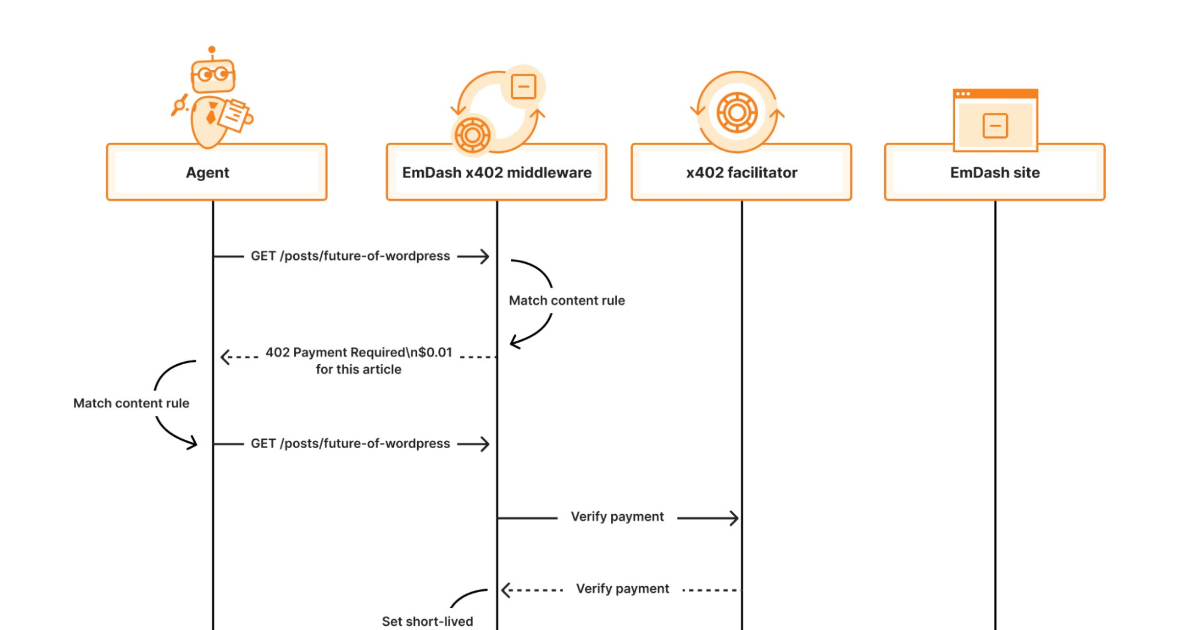
Cloudflare recently announced the preview of EmDash, a new open-source CMS it describes as a “spiritual successor to WordPress.” Designed to rebuild the CMS model around a serverless, developer-focused architecture, EmDash includes AI-native features, developer tooling, and migration paths from WordPress, sparking debate across the WordPress and broader CMS community. By Renato Losio
Cloudflare recently announced the preview of EmDash, a new open-source CMS it describes as a “spiritual successor to WordPress.” Designed to rebuild the CMS model around a serverless, developer-focused architecture, EmDash includes AI-native features, developer tooling, and migration paths from WordPress, sparking debate across the WordPress and broader CMS community.
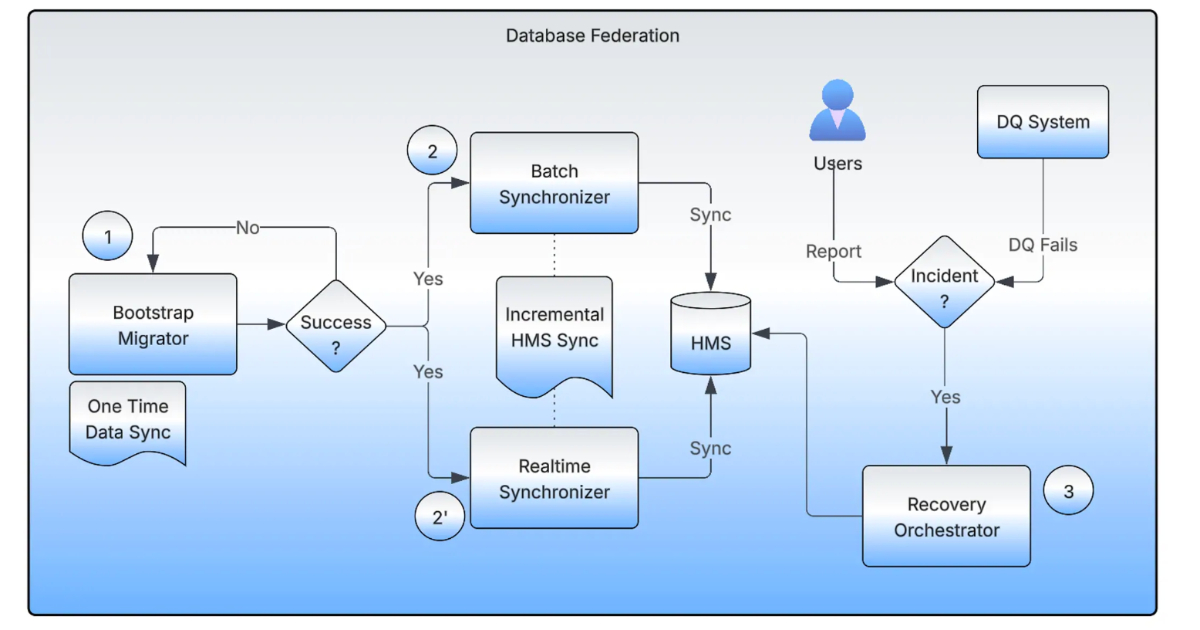
Uber has decentralized its Hive data warehouse, migrating 16,000 datasets totaling over 10 petabytes using pointer-based federation. The migration ensures zero downtime, strict ACL enforcement, improved governance, and scalable, domain-specific datasets for analytics and machine learning workloads. By Leela Kumili
Uber has decentralized its Hive data warehouse, migrating 16,000 datasets totaling over 10 petabytes using pointer-based federation. The migration ensures zero downtime, strict ACL enforcement, improved governance, and scalable, domain-specific datasets for analytics and machine learning workloads.
The MCP Dev Summit North America 2026, held on April 2-3 at the New York Marriott Marquis, gathered about 1,200 attendees. Hosted by the Linux Foundation's Agentic AI Foundation, discussions focused on the Model Context Protocol's evolution and enterprise adoption, particularly by Amazon and Uber, emphasizing security, interoperability, and scaling for production. By Andrew Hoblitzell
The MCP Dev Summit North America 2026, held on April 2-3 at the New York Marriott Marquis, gathered about 1,200 attendees. Hosted by the Linux Foundation's Agentic AI Foundation, discussions focused on the Model Context Protocol's evolution and enterprise adoption, particularly by Amazon and Uber, emphasizing security, interoperability, and scaling for production.

 Login
Login