Normal view
-
Journal of Medical Internet Research
-
Depictions of Depression in Generative AI Video Models: Mixed Methods Study of OpenAI’s Sora 2
Background: Generative AI video models are increasingly capable of producing complex depictions of mental health experiences, yet little is known about how these systems represent conditions such as depression. Because AI-generated content may reach people during vulnerable periods, understanding what visual narratives these models produce for sensitive concepts carries clinical relevance. Objective: This study aimed to characterize how OpenAI’s Sora 2 generative AI video model depicts depressio
-
Journal of Medical Internet Research
-
Design Guidelines for Online Health Forums: User-Centered Design Approach
Background: Online health forums are used widely, yet evidence of their effectiveness is inconsistent. Evidence-based forum design guidance grounded in theory and lived experience could improve the efficacy and outcomes of these forums for the many people using them worldwide. Objective: This study aimed to draw on the experience of online forum users and staff, and insights from existing research on technology design and self-determination theory, to generate a set of theoretically grounded gui
Design Guidelines for Online Health Forums: User-Centered Design Approach
-
Journal of Medical Internet Research
-
Anonymization of Portuguese Clinical Notes Using Large Language Models and Quantum-Enhanced Hybrid Architectures: Comparative Evaluation Study
Background: The widespread adoption of electronic health records (EHRs) has generated large-scale repositories of highly sensitive clinical information, emphasizing the need for robust anonymization strategies to enable secondary use for research while safeguarding patient privacy. Conventional rule-based and machine learning approaches for deidentifying medical text face limitations with the linguistic complexity, variability, and context dependence inherent to clinical documentation. Recent ad
Anonymization of Portuguese Clinical Notes Using Large Language Models and Quantum-Enhanced Hybrid Architectures: Comparative Evaluation Study
-
InfoQ

-
Java News Roundup: New OpenJDK JEPs, CDI 5.0, Spring, Open Liberty, RefactorFirst, ADK for Kotlin
This week's Java roundup for September 7th, 2026, features news highlighting: new JEPs for ahead-of-time compilation and structured concurrency; GA releases of Jakarta CDI 5.0 and ADK for Kotlin 1.0; the September 2026 edition of Open Liberty; point releases of TornadoVM and RefactorFirst; a maintenance release of Micronaut; and first releases candidates of Groovy 6.0 and Gradle 9.8. By Michael Redlich
Java News Roundup: New OpenJDK JEPs, CDI 5.0, Spring, Open Liberty, RefactorFirst, ADK for Kotlin
This week's Java roundup for September 7th, 2026, features news highlighting: new JEPs for ahead-of-time compilation and structured concurrency; GA releases of Jakarta CDI 5.0 and ADK for Kotlin 1.0; the September 2026 edition of Open Liberty; point releases of TornadoVM and RefactorFirst; a maintenance release of Micronaut; and first releases candidates of Groovy 6.0 and Gradle 9.8.
By Michael Redlich-
Journal of Medical Internet Research
-
Evaluation of the Square Eyes Model as a Screening Tool for Identifying Digital Technologies in Wearable Camera Images Among Children: Laboratory Study
Background: Accurate measurements of children’s digital technology use are essential for understanding its potential implications on health and well-being. Wearable cameras can provide such measurements, but image coding is a high burden for researchers. Machine learning–based object-recognition models have the potential to reduce this burden by identifying images containing technology. Objective: This study aims to evaluate the performance of an object recognition model, the Square Eyes model,
Evaluation of the Square Eyes Model as a Screening Tool for Identifying Digital Technologies in Wearable Camera Images Among Children: Laboratory Study
-
Journal of Medical Internet Research
-
Digitally Adapting LGBTQ-Affirmative Cognitive Behavioral Therapy for Chinese Men Who Have Sex With Men Living With HIV: User-Centered Design Approach
Background: Chinese men who have sex with men living with HIV (MSMLWH) experience substantial psychological distress driven by minority stress and HIV-related challenges. However, culturally tailored digital mental health interventions that address HIV-specific maladaptive cognitive schemas and culturally specific psychosocial stressors remain scarce in China. Objective: This study aimed to systematically adapt an evidence-based cognitive behavioral therapy (CBT) intervention Effective Skills to
Digitally Adapting LGBTQ-Affirmative Cognitive Behavioral Therapy for Chinese Men Who Have Sex With Men Living With HIV: User-Centered Design Approach
-
InfoQ

-
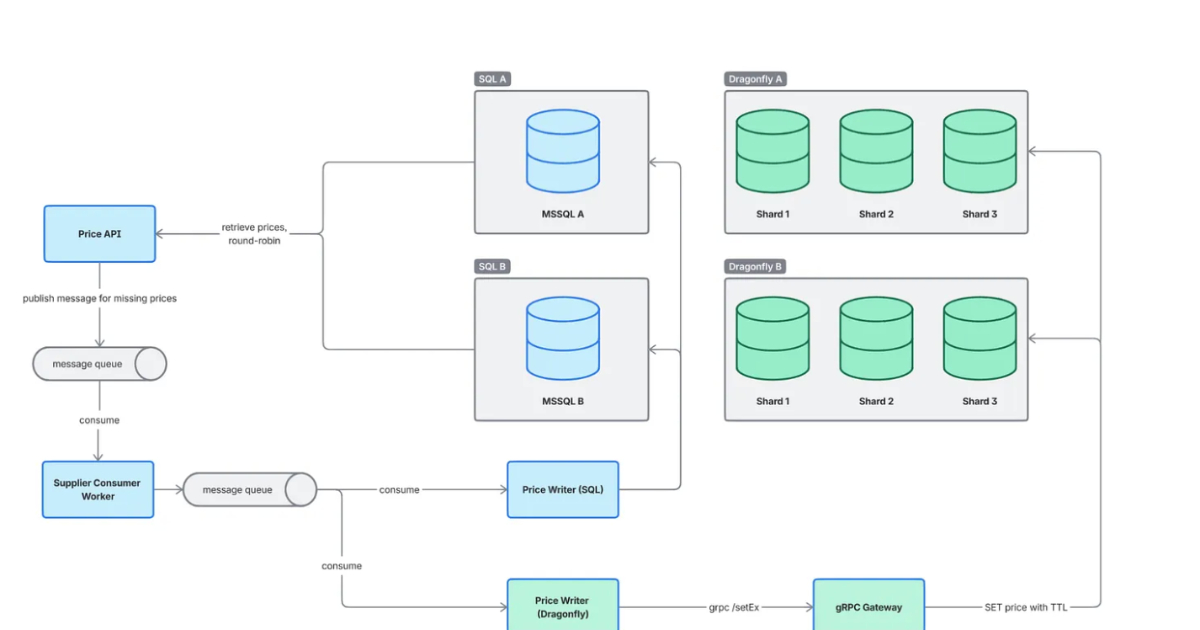
Agoda Replaces 72-Shard SQL Server Price Cache with DragonflyDB
Agoda migrated its 1.5 TB hotel Price Cache from 72 SQL Server shards to DragonflyDB to handle growing read and write volumes. The migration used staged dual reads, parity validation, gradual traffic shifting, and decentralized failover detection. Agoda reports an approximately eightfold reduction in P99 read latency, with two DragonflyDB clusters providing high availability. By Leela Kumili
Agoda Replaces 72-Shard SQL Server Price Cache with DragonflyDB
Agoda migrated its 1.5 TB hotel Price Cache from 72 SQL Server shards to DragonflyDB to handle growing read and write volumes. The migration used staged dual reads, parity validation, gradual traffic shifting, and decentralized failover detection. Agoda reports an approximately eightfold reduction in P99 read latency, with two DragonflyDB clusters providing high availability.
By Leela Kumili-
InfoQ

-
Presentation: Decision Models in Agentic Architectures: From Production to Agent Skills
Alex Porcelli discusses the critical gap in enterprise AI: non-deterministic output and lack of accountability in high-stakes decisions. He shares how integrating DMN decision models with LLMs, agent skills, and NeMo guardrails creates auditable, deterministic agentic architectures - allowing business leaders to own decision logic while engineers maintain robust architectural governance. By Alex Porcelli
Presentation: Decision Models in Agentic Architectures: From Production to Agent Skills
Alex Porcelli discusses the critical gap in enterprise AI: non-deterministic output and lack of accountability in high-stakes decisions. He shares how integrating DMN decision models with LLMs, agent skills, and NeMo guardrails creates auditable, deterministic agentic architectures - allowing business leaders to own decision logic while engineers maintain robust architectural governance.
By Alex Porcelli-
AI News
-
How Vox Group’s AI-Powered Technology Is Solving Real-Time Translation for Group Travel
Live translation has long been one of travel’s hardest unsolved problems: a single guide speaking to a mixed-language group, with no way to be understood by everyone at once. Vox Group, a 25-year-old guiding technology company operating in over 150 countries, has spent the past year rebuilding its AI-powered technology, Aura, to close that gap, now supporting simultaneous translation in up to 200 languages, live accessibility subtitles, and an AI companion designed to support guides rather than
How Vox Group’s AI-Powered Technology Is Solving Real-Time Translation for Group Travel
Live translation has long been one of travel’s hardest unsolved problems: a single guide speaking to a mixed-language group, with no way to be understood by everyone at once. Vox Group, a 25-year-old guiding technology company operating in over 150 countries, has spent the past year rebuilding its AI-powered technology, Aura, to close that gap, now supporting simultaneous translation in up to 200 languages, live accessibility subtitles, and an AI companion designed to support guides rather than replace them. The update arrives as Vox celebrates its 25th Anniversary this month.
WHO IS VOX GROUP
Few outside the travel industry have heard of Vox Group, yet its technology underpins how millions of people experience a guided tour, powering cruise lines, tour operators, DMCs and destination experience partners in more than 150 countries. Founded 25 years ago on a simple radio link that let one guide be heard clearly by an entire group, the company has spent the years since expanding that idea, first into group guiding hardware, and more recently into Aura, its AI-powered guiding technology. Vox remains privately, family-led, an increasingly unusual profile among travel technology providers operating at this scale.
“Twenty-five years ago, we put a radio into a guide’s hand so that every guest could hear them,” says Elio Epifani, founder of Vox Group. “That principle has not changed. Aura begins with the guide and stays with the guide. What has changed is how much it can carry for them.”
THE TRANSLATION PROBLEM AI IS NOW SOLVING
Group tours have traditionally handled multiple languages in one of two ways: splitting visitors into separate language groups or adding a dedicated interpreter alongside the guide. Both add cost and complexity, and neither scale well for operators running mixed-nationality departures, increasingly the norm on cruise excursions and city tours. Aura’s translation library has grown from 50 to 200 languages over the past year, with live simultaneous translation now running in up to four languages at once on a single tour. Guests need no smartphone, app or download to take part, audio reaches them over the same radio infrastructure Vox has used for 25 years.
AN AI COMPANION BUILT TO SUPPORT GUIDES, NOT REPLACE THEM
Aura’s most significant update is its AI companion, a system designed to sit alongside the guide rather than in front of them. Rather than generating commentary from the open internet, it draws only on operator-approved content and verified sources, surfacing answers the moment a guest asks something unexpected, along with local context such as place names or regional sayings. It reflects a wider question the artificial intelligence sector is grappling with well beyond travel: where automation adds genuine value, and where it risks replacing the human expertise it was meant to support. Vox’s approach has been to keep the guide as the primary voice, using AI to extend what one person can reasonably be expected to know, rather than to generate the tour itself.
“One guide speaks once, and every guest receives a tour made for them in their own language, run from a single app,” says Fabio Primerano, Chief Executive Officer of Vox Group. “It gives guides more to work with and operators more to sell.”
ACCESSIBILITY BUILT IN, NOT BOLTED ON
Aura also addresses a gap much of the guiding technology on the market has overlooked. For guests who are deaf or hard of hearing, live subtitles are sent directly to their own phone as the guide speaks, letting them follow the tour in real time alongside the rest of the group rather than reading a summary afterwards. No separate equipment is issued, and no guest is visibly marked out as needing extra support, an accessibility approach built into the core product rather than offered as an add-on.
MULTIPLE CHANNELS, ONE DEPARTURE
Aura runs multiple commentary channels in parallel on a single tour, standard commentary, a historical deep dive, a children’s version, or a translated feed, so a family, a subject specialist and a first-time visitor can each follow a version suited to them without the guide repeating themselves. For operators, that means one departure can now carry visitors who would previously have needed splitting into separate language groups, with the tour adapting to each guest as it runs.
WHAT IT SIGNALS FOR AI IN TRAVEL
Aura’s evolution mirrors a pattern playing out across natural language processing applications more broadly: real-time translation and accessibility tools that once required specialist hardware or dedicated staff are increasingly built into existing infrastructure. For an industry still working out where AI adds value without eroding the human interactions travellers pay for, Vox’s approach, extending the guide rather than replacing them, offers one working answer.
Aura is available now for cruise lines, tour operators, DMCs and destination experience partners. voxtours.com/aura.
The post How Vox Group’s AI-Powered Technology Is Solving Real-Time Translation for Group Travel appeared first on AI News.

-
InfoQ

-
ESP32 Bit Pirate: Bridging Modern Microcontrollers and Browser-Based Hardware Debugging
ESP32 Bit Pirate project integrates multi-protocol debugging within a browser environment using HTML5 APIs. It enables users to install firmware and interact with microcontrollers like the ESP32-S3 directly from the browser. The platform supports various digital and wireless protocols while providing hands-on guidance through practical recipes for tasks such as memory dumping and signal analysis. By Olimpiu Pop
ESP32 Bit Pirate: Bridging Modern Microcontrollers and Browser-Based Hardware Debugging
ESP32 Bit Pirate project integrates multi-protocol debugging within a browser environment using HTML5 APIs. It enables users to install firmware and interact with microcontrollers like the ESP32-S3 directly from the browser. The platform supports various digital and wireless protocols while providing hands-on guidance through practical recipes for tasks such as memory dumping and signal analysis.
By Olimpiu Pop-
cs.AI, q-bio.NC updates on arXiv.org
-
Occamy-1.0: Open Pareto-frontier 35B Intelligence for Co-work
arXiv:2609.11977v1 Announce Type: new Abstract: Co-work agents execute complex workflows that combine information gathering, tool use, coding, and file manipulation across many model invocations. Because cost and latency accumulate over the full episode, their practical value depends not only on peak capability but also on how efficiently that capability is delivered. Yet many steps in everyday work emphasize state tracking, coordination, recovery, and follow-through rather than frontier-scale
Occamy-1.0: Open Pareto-frontier 35B Intelligence for Co-work
-
cs.AI, q-bio.NC updates on arXiv.org
-
Reading the Whole Heart: Latent-Attention Masked Autoencoders for Multimodal Cardiac Representation Learning
arXiv:2609.12035v1 Announce Type: new Abstract: Cardiovascular diagnosis rests on integrating complementary modalities, like ECG, echocardiography, chest radiographs, and clinical variables, each capturing distinct but correlated aspects of cardiac physiology. Yet most medical foundation models remain modality-specific, combining modalities only for finetuning or post-training. This discards the cross-modal evidence clinicians naturally integrate and ignores the structure within each modality.
Reading the Whole Heart: Latent-Attention Masked Autoencoders for Multimodal Cardiac Representation Learning
-
cs.AI, q-bio.NC updates on arXiv.org
-
DU-NO: A Parameter-Efficient Double U-Shaped Neural Operator for Phase-Resolving Wave Modeling
arXiv:2609.12115v1 Announce Type: new Abstract: Phase-resolving wave models such as FUNWAVE-TVD are the accuracy standard for nearshore dynamics, resolving the shoaling, refraction, and breaking of individual waves, but their cost rules them out for the ensembles, uncertainty quantification, and real-time warning that operational forecasting demands. Neural operators promise solver-level accuracy at a fraction of that cost, yet on wave-dominated fields the accurate ones are large: hybrid spectr
DU-NO: A Parameter-Efficient Double U-Shaped Neural Operator for Phase-Resolving Wave Modeling
-
cs.AI, q-bio.NC updates on arXiv.org
-
When Successful Knowledge Graph Edits Displace Correct Answers: Rank-Level Locality beyond Parameter Support
arXiv:2609.12116v1 Announce Type: new Abstract: Editing a knowledge graph embedding (KGE) model to promote a desired answer can displace correct answers from the returned list. Locality tests based only on facts that reuse the edited parameter can miss this ranking effect. We introduce a common rank-displacement audit at three scopes: facts supported by the edited parameter, other correct answers to the target query, and correct answers across queries with the same relation. We also derive dime
When Successful Knowledge Graph Edits Displace Correct Answers: Rank-Level Locality beyond Parameter Support
-
cs.AI, q-bio.NC updates on arXiv.org
-
GTA: Graph Theory Agent and Benchmark for Algorithmic Graph Reasoning with LLMs
arXiv:2609.12265v1 Announce Type: new Abstract: Large Language Models (LLMs) are increasingly asked to reason over structured data such as graphs, yet how reliably they can carry out multi-step graph algorithms in language remains unclear. Existing evaluations tend to use simple tasks on small graphs, to score code generation rather than reasoning over the graph itself, or to fix a single input format. We introduce Graph Theory Bench (GT Bench), a benchmark covering 24 classical graph problems
GTA: Graph Theory Agent and Benchmark for Algorithmic Graph Reasoning with LLMs
-
cs.AI, q-bio.NC updates on arXiv.org
-
Learning Symbolic Constraint Representations from Examples: A Neuro-Symbolic Approach
arXiv:2609.12267v1 Announce Type: new Abstract: Learning user-defined concepts as constraint networks has been extensively studied in the constraint acquisition (CA) literature. However, existing approaches typically rely on intensive interactions with a human oracle, making the learning process costly in terms of time and number of queries. In this paper, we propose a neuro-symbolic framework for automatic CA that significantly reduces user involvement by introducing neural Oracle Transformer
Learning Symbolic Constraint Representations from Examples: A Neuro-Symbolic Approach
-
cs.AI, q-bio.NC updates on arXiv.org
-
AIM: A Privacy-Aware Interoperable Memory Framework for Multi-Agent Multi-User LLM Systems
arXiv:2609.12320v1 Announce Type: new Abstract: Traditional large language models (LLMs) are scoped to individual user sessions, limiting their knowledge to a single conversation and preventing them from learning user preferences that evolve over time. Existing agentic memory systems address this limitation but generally operate at the individual-user level, restricting the public knowledge that could be shared across users to improve downstream responses. We introduce AIM (Agentic Interoperabl
AIM: A Privacy-Aware Interoperable Memory Framework for Multi-Agent Multi-User LLM Systems
-
cs.AI, q-bio.NC updates on arXiv.org
-
Toward Robust Personalized Alignment for LLMs: Mitigating Persona Drift in Multi-Turn Dialogue
arXiv:2609.12373v1 Announce Type: new Abstract: Persona drift remains a central challenge for personalized language models, as user profiles evolve over long interactions rather than remain permanently fixed. Models must therefore revise persistent persona states when preferences genuinely change, while avoiding updates driven by transient, ambiguous, or unresolved observations. We propose CORE, which separates turn-local evidence from persistent persona-state revision and selectively updates g
Toward Robust Personalized Alignment for LLMs: Mitigating Persona Drift in Multi-Turn Dialogue
-
cs.AI, q-bio.NC updates on arXiv.org
-
BlueLM-GUI Technical Report: A Real-Device-Centric Flywheel for Self-Improving Mobile GUI Agents
arXiv:2609.12394v1 Announce Type: new Abstract: Mobile GUI agents are shifting from multi-module frameworks to native models trained end-to-end, yet industrial deployment faces three persistent gaps. Sandbox training produces a distribution mismatch with production environments; expensive real-device failures remain underutilized; and fixed benchmarks saturate, losing the power to guide iteration. We present BlueLM-GUI, a 35B-A3B mobile GUI agent built as a real-device-centric flywheel that clo
BlueLM-GUI Technical Report: A Real-Device-Centric Flywheel for Self-Improving Mobile GUI Agents
-
cs.AI, q-bio.NC updates on arXiv.org
-
OneLA: Scaling Linear-Attention Decoding to Large Beams in Generative Recommendation
arXiv:2609.12399v1 Announce Type: new Abstract: Generative recommendation (GR) relies on large-beam decoding to generate hundreds of candidate items, creating a new scaling challenge for recurrent linear attention. Existing linear attention serving systems either materialize a full recurrent state for every beam or repeatedly replay shared history, incurring substantial memory and traffic overhead. To address this, we present OneLA, a linear-attention decoding framework that exploits the shared