
❌

Normal view

  • ✇MIT Technology Review
  • The Download: gig workers training humanoids, and better AI benchmarks Thomas Macaulay
    This is today’s edition of The Download, our weekday newsletter that provides a daily dose of what’s going on in the world of technology. The gig workers who are training humanoid robots at home  When Zeus, a medical student in Nigeria, returns to his apartment from a long day at the hospital, he straps his iPhone to his forehead and records himself doing chores.  Zeus is a data recorder for Micro1, which sells the data he collects to robotics firms. As these companies race to build hum
     

The Download: gig workers training humanoids, and better AI benchmarks

1 April 2026 at 20:10

This is today’s edition of The Download, our weekday newsletter that provides a daily dose of what’s going on in the world of technology.

The gig workers who are training humanoid robots at home 

When Zeus, a medical student in Nigeria, returns to his apartment from a long day at the hospital, he straps his iPhone to his forehead and records himself doing chores. 

Zeus is a data recorder for Micro1, which sells the data he collects to robotics firms. As these companies race to build humanoids, videos from workers like Zeus have become the hottest new way to train them.  

Micro1 has hired thousands of them in more than 50 countries, including India, Nigeria, and Argentina. The jobs pay well locally, but raise thorny questions around privacy and informed consent. The work can be challenging—and weird. Read the full story. 

—Michelle Kim 

Our readers recently voted humanoid robots the “11th breakthrough” to add to our 2026 list of 10 Breakthrough Technologies. Check out what else officially made the cut. 

AI benchmarks are broken. Here’s what we need instead. 

For decades, AI has been evaluated based on whether it can outperform humans on isolated problems. But it’s seldom used this way in the real world. 

While AI is assessed in a vacuum, it operates in messy, complex, multi-person environments over time. This misalignment leads us to misunderstand its capabilities, risks, and impacts. 

We need new benchmarks that assess AI’s performance over longer horizons within human teams, workflows, and organizations. Here’s a proposal for one such approach: Human–AI, Context-Specific Evaluation.  

—Angela Aristidou, professor at University College London and faculty fellow at the Stanford Digital Economy Lab and the Stanford Human-Centered AI Institute. 

MIT Technology Review Narrated: can quantum computers now solve health care problems? We’ll soon find out. 

In a laboratory on the outskirts of Oxford, a quantum computer built from atoms and light awaits its moment. The device is small but powerful—and also very valuable. Infleqtion, the company that owns it, is hoping its abilities will win $5 million at a competition.  

The prize will go to the quantum computer that can solve real health care problems that “classical” computers cannot. But there can be only one big winner—if there is a winner at all. 

—Michael Brooks 

This is our latest story to be turned into an MIT Technology Review Narrated podcast, which we’re publishing each week on Spotify and Apple Podcasts. Just navigate to MIT Technology Review Narrated on either platform, and follow us to get all our new content as it’s released. 

The must-reads 

I’ve combed the internet to find you today’s most fun/important/scary/fascinating stories about technology. 

1 OpenAI just closed the biggest funding round in Silicon Valley history 
It raised $122 billion ahead of its blockbuster IPO, which is expected later this year. (WSJ $) 
+ It’s also prepping a push to “rethink the social contract.” (Vanity Fair $) 
+ Campaigners are urging people to quit ChatGPT. (MIT Technology Review)   

2 Iran has threatened to attack 18 US tech companies  
It’s eyeing their operations in the Middle East. (Politico) 
+ Targets include Nvidia, Apple, Microsoft, and Google. (Engadget) 
+ Iran struck AWS data centers earlier this month. (Reuters $) 

3 Artemis II is about to fly humans to the Moon. Here’s the science they’ll do 
Their experiments will set the stage for future explorers. (Nature) 
+ You can watch the launch attempt today. (Engadget)  

4 Putin is trying to take full control of Russia’s internet 
New outages and blockages are cutting the country off from the world. (NYT $) 
+ Can we repair the internet? (MIT Technology Review) 

5 A robotaxi outage in China left passengers stranded on highways  
Baidu vehicles froze on the streets of Wuhan. (Bloomberg $) 
+ Police are blaming a “system failure.” (Reuters $) 

6 US government requests for social media user data are soaring 
They’ve skyrocketed by 770% in the past decade. (Bloomberg $) 
+ Is the Pentagon allowed to surveil Americans with AI? (MIT Technology Review) 

7 Tesla has admitted that humans sometimes drive its robotaxis 
Remote drivers occasionally control them completely. (Wired $) 

8 A satellite-smashing chain reaction could spiral out of control 
This data visualization captures the dangers of space collisions. (Guardian) 
+ Here’s all the stuff we’ve put into space. (MIT Technology Review) 

9 Meta’s smartglasses can turn you into a creep 
According to one journalist who wore them for a month. (Guardian) 

10 A Claude Code leak has exposed plans for a virtual pet  
We could be getting a Tamagotchi for the GenAI era. (The Verge) 

Quote of the day 

“From now on, for every assassination, an American company will be destroyed.” 

—Iran’s Islamic Revolutionary Guard Corps (IRGC) threatens US tech firms in an affiliated Telegram, per CNBC. 

One More Thing 

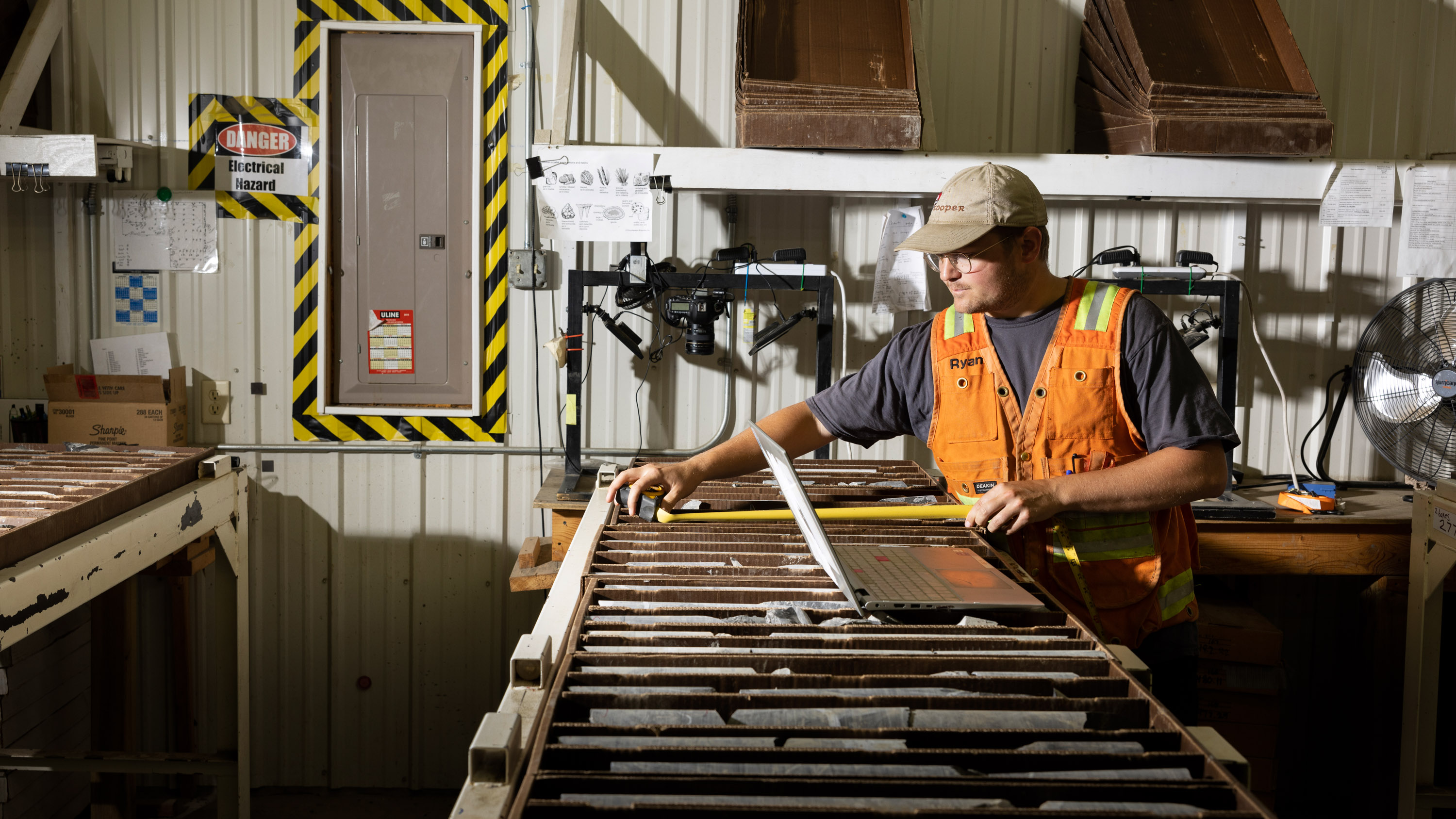
Ryan Willgosh of Talon Metals logs samples
ACKERMAN + GRUBER

How one mine could unlock billions in EV subsidies 

In a pine farm north of the tiny town of Tamarack, Minnesota, Talon Metals has uncovered one of America’s densest nickel deposits. Now it wants to begin mining the ore. 

Products made from the nickel could net more than $26 billion in subsidies through the Inflation Reduction Act (IRA), which is starting to transform the US economy. To understand how, we tallied up the potential tax credits available. Read the full story to find out what we discovered. 

—James Temple 

We can still have nice things 

A place for comfort, fun and distraction to brighten up your day. (Got any ideas? Drop me a line.) 

+ A selfless group of gluttons tried to taste-test every potato chip in the world.  
+ Get romantic inspiration from these penguins’ engagement pebbles. 
+ Good news: global terrorism has hit a 15-year low. 
+ Enjoy endless new views through these windows around the world.  

  • ✇MIT Technology Review
  • The Download: AI health tools and the Pentagon’s Anthropic culture war Thomas Macaulay
    This is today’s edition of The Download, our weekday newsletter that provides a daily dose of what’s going on in the world of technology. There are more AI health tools than ever—but how well do they work?  In the last few months alone, Microsoft, Amazon, and OpenAI have all launched medical chatbots.  There’s a clear demand for these tools, given how hard it is for many people to access advice through the existing medical system—and they could make safe and useful recommendations. But
     

The Download: AI health tools and the Pentagon’s Anthropic culture war

31 March 2026 at 20:10

This is today’s edition of The Download, our weekday newsletter that provides a daily dose of what’s going on in the world of technology.

There are more AI health tools than ever—but how well do they work? 

In the last few months alone, Microsoft, Amazon, and OpenAI have all launched medical chatbots. 

There’s a clear demand for these tools, given how hard it is for many people to access advice through the existing medical system—and they could make safe and useful recommendations. But concerns have surfaced about how little external evaluation they undergo before being released to the public.  

Read the full story to understand what’s at stake. 

—Grace Huckins 

The Pentagon’s culture war tactic against Anthropic has backfired 

A judge has temporarily blocked the Pentagon from labeling Anthropic a supply chain risk and ordering government agencies to stop using its AI. Her intervention suggests that the feud never needed to reach such a frenzy. 

It did so because the government disregarded the existing process for such disputes—and fueled the fire on social media. Find out how it happened and what comes next. 

—James O’Donnell 

This story is from The Algorithm, our weekly newsletter giving you the inside track on all things AI. Sign up to receive it in your inbox every Monday. 

The must-reads 

I’ve combed the internet to find you today’s most fun/important/scary/fascinating stories about technology. 

1 California has defied Trump to impose new AI regulations 
Governor Newsom signed off on the new standards yesterday.  (Guardian) 
+ Firms seeking state contracts will need extra safeguards. (Reuters $) 
+ States are installing guardrails despite Trump’s order to stop. (NYT $)  
+ An AI regulation war is brewing in the US. (MIT Technology Review)  

2 Experiments have verified quantum simulations for the first time 
It’s a breakthrough for quantum computing applications. (Nature) 
+ Which could one day help solve healthcare problems. (MIT Technology Review) 

3 The new White House app is a security and privacy nightmare 
It extensively tracks users and relies on external code. (Gizmodo) 
+ The new app promises “unparalleled access” to Trump. (CNET) 
+ It also invites users to report people to ICE. (The Verge) 

4 Big Tech’s $635 billion AI spending faces an energy shock test 
The Middle East crisis is clouding prospects for growth. (Reuters $) 
+ Here are three big unknowns about AI’s energy burden. (MIT Technology Review) 

5 Meta and Google have been accused of breaking child safety rules 
Australia suspects they flouted a social media ban. (Bloomberg $) 
+ Indonesia is also investigating non-compliance. (Reuters $) 

6 Nebius is building a $10 billion AI data center in Finland 
The company is rapidly expanding Europe’s AI infrastructure. (CNBC) 

7 South Korea’s chipmakers’ helium stocks will last until June 
Beyond that? Who knows. (Reuters $) 
+ Shortages caused by the Iran war threaten the chip industry. (NYT $)  

8 Another Starlink satellite has inexplicably exploded  
SpaceX suffered a similar episode in December. (The Verge) 
+ We went inside Ukraine’s largest Starlink repair shop. (MIT Technology Review) 

9 Bluesky’s new AI tool is already its most blocked account—after JD Vance 
About 83 times as many users have blocked it as have followed it. (TechCrunch) 

10 An AI agent banned from Wikipedia has lashed out in angry blogs 
The bot accused its human editors of “uncivil behavior.” (404 Media)  

Quote of the day 

“Is any of this illegal? Probably not. Is it what you’d expect from an official government app? Probably not either.” 

—Security researcher Thereallo reviews the White House’s new app.

One More Thing 

CHANTAL JAHCHAN

Inside Amsterdam’s high-stakes experiment to create fair welfare AI 

When Hans de Zwart, a digital rights advocate, saw Amsterdam’s plan to have an algorithm evaluate every welfare applicant for potential fraud, he nearly fell out of his chair. He believed the system had “unfixable problems.”  

Meanwhile, Paul de Koning, a consultant to the city, was excited. He saw immense potential to improve efficiencies and remove biases. 

These opposing viewpoints epitomize a global debate about whether algorithms can ever make fair decisions that shape people’s lives. Read the full story.  

—Eileen Guo, Gabriel Geiger, and Justin-Casimir Braun 

We can still have nice things 

A place for comfort, fun and distraction to brighten up your day. (Got any ideas? Drop me a line.) 

+ A newly authenticated Rembrandt had been hiding in plain sight for years. 
+ This debunking of guitar legends is musical enlightenment for strummers. 
+ Smoking into bubbles looks oddly satisfying. 
+ The man who made the front page twice exposes the thin line between heroes and villains. 

  • ✇MIT Technology Review
  • The Download: brainless human clones and the first uterus kept alive outside a body Thomas Macaulay
    This is today’s edition of The Download, our weekday newsletter that provides a daily dose of what’s going on in the world of technology. Inside the stealthy startup that pitched brainless human clones  After operating in secrecy for years, R3 Bio, a California-based startup, suddenly revealed last week that it had raised money to create nonsentient monkey “organ sacks” as an alternative to animal testing. But there is more to the story. And R3 doesn’t want that story told.  MIT Tec
     

The Download: brainless human clones and the first uterus kept alive outside a body

30 March 2026 at 20:10

This is today’s edition of The Download, our weekday newsletter that provides a daily dose of what’s going on in the world of technology.

Inside the stealthy startup that pitched brainless human clones 

After operating in secrecy for years, R3 Bio, a California-based startup, suddenly revealed last week that it had raised money to create nonsentient monkey “organ sacks” as an alternative to animal testing. But there is more to the story. And R3 doesn’t want that story told. 

MIT Technology Review discovered that founder John Schloendorn also pitched a startling, ethically charged vision: “brainless clones” that serve as backup human bodies. Find out all the details on the radical proposal. 

—Antonio Regalado 

A woman’s uterus has been kept alive outside the body for the first time 

Ten months ago, reproductive health researchers placed a freshly donated human uterus inside a new device they call “Mother.” They connected the organ to the machine’s plastic veins and arteries and pumped in modified human blood. 

The device kept the uterus alive for a day, a new feat that could lead to longer-term maintenance of wombs outside the body. Future versions of the technology could shine new light on pregnancies—and potentially even grow a human fetus. Read the full story. 

—Jessica Hamzelou 

The must-reads 

I’ve combed the internet to find you today’s most fun/important/scary/fascinating stories about technology. 

1 AI data centers can significantly warm up surrounding areas  
The “heat islands” may already affect 340 million people. (New Scientist) 
+ Mistral has raised $830M to build Nvidia-powered AI centers in Europe. (FT $) 
+ But nobody wants a data center in their backyard. (MIT Technology Review) 

2 Elon Musk reportedly joined Trump’s call with Modi about the Iran War 
It remains unclear what Musk was doing during the conversation. (NYT $)  
+ India has disputed the report. (Independent) 
+ The war poses a grave threat to the EV market. (Rest of World) 

3 Eli Lilly has struck a deal to bring AI-developed drugs to the market 
It’s secured a $2.75 billion drug collaboration with Insilico Medicine. (Reuters $) 
+ A I-designed compounds can kill drug-resistant bacteria. (MIT Technology Review) 

4 More and more countries are curbing children’s social media access 
Austria is the latest to pursue a ban. (Engadget) 
+ Indonesia has rolled out the first one in Southeast Asia. (DW) 
+ UK Prime Minister Keir Starmer said he will also “have to act.” (Guardian)  

5 Tech stocks just had their worst week in nearly a year 
Thanks to a combination of the Iran war and legal disputes. (CNBC) 
+ Tech insiders are split over the AI bubble. (MIT Technology Review) 

6 Meta is launching new smart glasses for prescription wearers 
It plans to debut them next week. (Bloomberg $) 

7 Taiwan is probing 11 Chinese firms for illegal poaching of tech talent 
Its semiconductors are entangled in the tensions with Beijing. (Reuters) 

8 Bluesky has built an AI app for customizing social media feeds 
It uses Anthropic’s Claude. (TechCrunch) 

9 A psychologist is making music with his brain implant 
He believes enjoyment is a prerequisite for BCI success. (Wired $) 

10 The world’s smallest QR code could store data for centuries 
It’s smaller than bacteria. (Science Daily) 

Quote of the day 

“We should be thinking about protecting young people in the digital world as opposed to protecting them from the digital world.” 

—YouTube CEO Neal Mohan gives the New York Times his take on the debate around children’s safety online. 

One More Thing 

AJ PICS / ALAMY STOCK PHOTO

AI’s growth needs the right interface 

You’d have to be pudding-brained to believe that chatbots are the best way to use computers. The real opportunity is a system built atop the visual interfaces we already know, but navigated through a natural mix of voice and touch. 

Crucially, this won’t just be a computer that we can use. It’ll be one we can break and remake to suit whatever uses we want. Instead of merely consuming technology like the gelatinous humans in Wall-E, we should be able to architect it to suit our own ends 

This idea is already lurching to life. Read the full story to find out how. 

—Cliff Kuang 

We can still have nice things 

A place for comfort, fun and distraction to brighten up your day. (Got any ideas? Drop me a line.) 
 
+ These floating designs will elevate your perspective on architecture. 
+ Uğur Gallenkuş’s portraits of two worlds in one image beautifully build bridges. 
+ This is the anti-Karen that the world needs right now. 
+ If only we could all find a love as pure as this kitty clinging to its favorite toy. 

❌