❌

Reading view

FUSION: a web-based application for in-depth exploration of multi-omics data with brightfield histology

Nat Commun. 2025 Sep 25;16(1):8388. doi: 10.1038/s41467-025-63050-9.

ABSTRACT

Spatial technologies examining the cell and tissue microenvironment at near single-cell resolution are revealing important molecular insights. However, few tools enable integrated, interactive analysis of spatial-omics with tissue morphology in the same functional tissue unit. Here, we present FUSION (Functional Unit State Identification in Whole Slide Images), a web-based platform for visualizing and analyzing spatial-omics data with high-resolution histology. FUSION provides workflows for assessing cell compositions, quantitative morphometrics, and comparative tissue analyses. We demonstrate applicability across spatial assays, including 10x Visium, Visium HD, 10x Xenium, Cell DIVE, and PhenoCycler, applied to healthy and diseased tissues from kidney, small intestine, lung, and skin in the Human BioMolecular Atlas Program. FUSION is cloud-based, open-source, and accessible at https://fusion.hubmapconsortium.org/ , hosting over 50 paired datasets and tutorials. In a series of use cases, we show its capacity to distinguish renal glomeruli injury states, quantify morphometric changes, and characterize fibrosis with immune infiltration.

PMID:40998789 | PMC:PMC12462499 | DOI:10.1038/s41467-025-63050-9

  •  

Application of Nudges to Design Clinical Decision Support Tools: Systematic Approach Guided by Implementation Science

Background: Clinical decision support (CDS) is one strategy to increase evidence-based practices by clinicians. Despite its potential, CDS tools have had mixed results and are often disliked by clinicians. Principles from behavioral economics, including “nudges,” may improve the effectiveness and clinician satisfaction of CDS tools. Objective: This paper outlines a pragmatic approach grounded in implementation science to identify and prioritize how to incorporate different types of nudges into CDS tools. Methods: We applied the Messenger, Incentives, Norms, Defaults, Salience, Priming, Affect, Commitments and Ego (MINDSPACE) nudge framework and the Practical, Robust Implementation and Sustainability Model (PRISM) implementation science framework to systematically and pragmatically identify and prioritize different types of nudges for CDS tools. A case example of a CDS tool to improve guideline-concordant prescribing for patients with heart failure was used to illustrate how these frameworks can be applied in real-life scenarios. We describe a process of how these frameworks can be used pragmatically by clinicians and informaticists or more technical CDS builders to apply nudge theory to CDS tools. Results: Four iterative steps guided by PRISM were defined: 1) engage partners for user-centered design, 2) develop a shared understanding of the nudge types, 3) determine the nudge type for the overarching CDS format, and 4) brainstorm and prioritize nudge types and forms to address each modifiable contextual issue. These steps are iterative and intended to be adapted to align with the local resources and needs of various clinical scenarios and settings. We provide illustrative examples of how this approach was applied to the case example, including who we engaged, details of nudge design decisions, and lessons learned. Conclusions: We present a pragmatic approach to guide the selection and prioritization of nudges, informed by implementation science. This approach can be used to comprehensively and systematically consider key issues in designing CDS to optimize clinician satisfaction, effectiveness, equity, and sustainability while minimizing the potential for unintended consequences. The findings can be adapted and generalized to other health settings and clinical situations, advancing the goals of learning health systems to expedite the translation of evidence into practice.
  •  

Multimodal foundation model and benchmark for comprehensive retinal OCT image analysis

npj Digital Medicine, Published online: 25 September 2025; doi:10.1038/s41746-025-01852-3

Multimodal foundation model and benchmark for comprehensive retinal OCT image analysis
  •  

Quality safety and disparity of an AI chatbot in managing chronic diseases: simulated patient experiments

npj Digital Medicine, Published online: 25 September 2025; doi:10.1038/s41746-025-01956-w

Quality safety and disparity of an AI chatbot in managing chronic diseases: simulated patient experiments
  •  

Ophthalmic drug discovery and development using artificial intelligence and digital health technologies

npj Digital Medicine, Published online: 25 September 2025; doi:10.1038/s41746-025-01954-y

Ophthalmic drug discovery and development using artificial intelligence and digital health technologies
  •  

What top VCs want from AI founders: Inside the investor lens with Jon McNeill, Aileen Lee, and Steve Jang at TechCrunch Disrupt 2025

Jon McNeill (DVx Ventures), Aileen Lee (Cowboy Ventures), and Steve Jang (Kindred Ventures) share what AI founders need to know now: from defensibility to term sheets. TechCrunch Disrupt 2025 takes place October 27–29 in San Francisco. Register before tomorrow ends to save up to $668.
  •  
  •  

Expanding care coordination in an integrated health system through causal machine learning

npj Digital Medicine, Published online: 24 September 2025; doi:10.1038/s41746-025-01925-3

Expanding care coordination in an integrated health system through causal machine learning
  •  

Diabetic Foot Ulcer Classification Models Using Artificial Intelligence and Machine Learning Techniques: Systematic Review

Background: Diabetes-related foot ulceration (DFU) is a common complication of diabetes, with a significant impact on survival, health care costs, and health-related quality of life. The prognosis of DFU varies widely among individuals. The International Working Group on the Diabetic Foot recently updated their guidelines on how to classify ulcers using “classical” classification and scoring systems. No system was recommended for individual prognostication, and the group considered that more detail in ulcer characterization was needed and that machine learning (ML)–based models may be the solution. Despite advances in the field, no assessment of available evidence was done. Objective: This study aimed to identify and collect available evidence assessing the ability of ML-based models to predict clinical outcomes in people with DFU. Methods: We searched the MEDLINE database (PubMed), Scopus, Web of Science, and IEEE Xplore for papers published up to July 2023. Studies were eligible if they were anterograde analytical studies that examined the prognostic abilities of ML models in predicting clinical outcomes in a population that included at least 80% of adults with DFU. The literature was screened independently by 2 investigators (MMS and DAR or EH in the first phase, and MMS and MAS in the second phase) for eligibility criteria and data extracted. The risk of bias was evaluated using the Quality In Prognosis Studies tool and the Prediction model Risk Of Bias Assessment Tool by 2 investigators (MMS and MAS) independently. A narrative synthesis was conducted. Results: We retrieved a total of 2412 references after removing duplicates, of which 167 were subjected to full-text screening. Two references were added from searching relevant studies’ lists of references. A total of 11 studies, comprising 13 papers, were included focusing on 3 outcomes: wound healing, lower extremity amputation, and mortality. Overall, 55 predictive models were created using mostly clinical characteristics, random forest as the developing method, and area under the receiver operating characteristic curve (AUROC) as a discrimination accuracy measure. AUROC varied from 0.56 to 0.94, with the majority of the models reporting an AUROC equal or superior to 0.8 but lacking 95% CIs. All studies were found to have a high risk of bias, mainly due to a lack of uniform variable definitions, outcome definitions and follow-up periods, insufficient sample sizes, and inadequate handling of missing data. Conclusions: We identified several ML-based models predicting clinical outcomes with good discriminatory ability in people with DFU. Due to the focus on development and internal validation of the models, the proposal of several models in each study without selecting the “best one,” and the use of nonexplainable techniques, the use of this type of model is clearly impaired. Future studies externally validating explainable models are needed so that ML models can become a reality in DFU care. Trial Registration: PROSPERO CRD42022308248; https://www.crd.york.ac.uk/PROSPERO/view/CRD42022308248

  •  

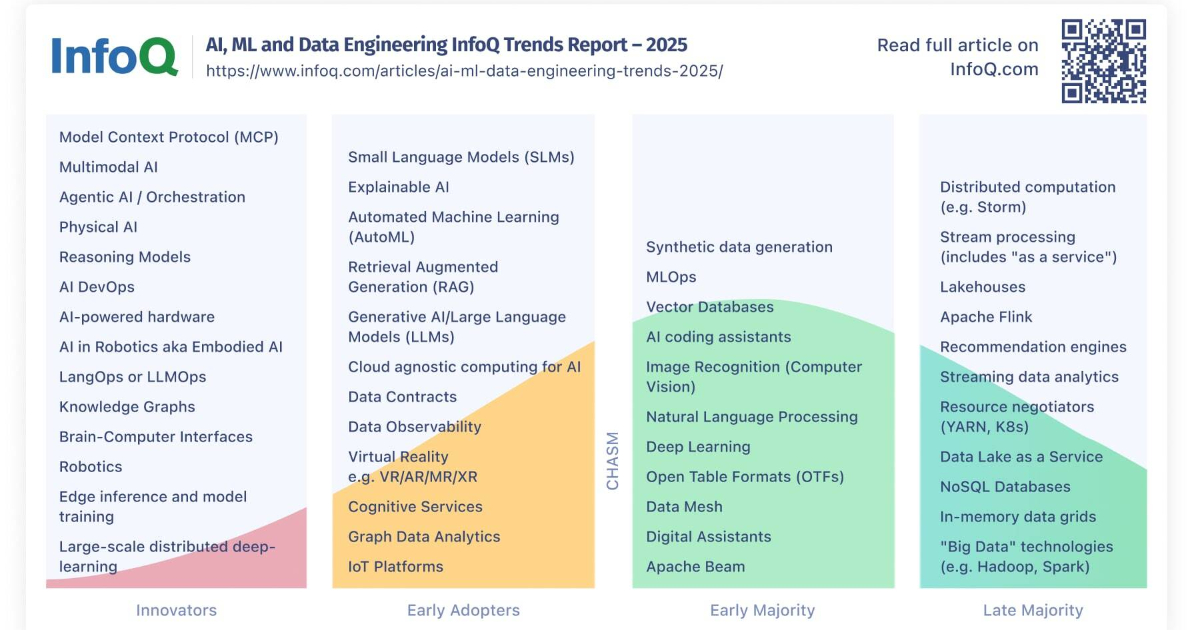
Article: InfoQ AI, ML and Data Engineering Trends Report - 2025

This InfoQ Trends Report offers readers a comprehensive overview of emerging trends and technologies in the areas of AI, ML, and Data Engineering. This report summarizes the InfoQ editorial team’s and external guests' view on the current trends in AI and ML technologies and what to look out for in the next 12 months.

By Srini Penchikala, Savannah Kunovsky, Anthony Alford, Daniel Dominguez, Vinod Goje
  •  

Fine-Tuning Methods for Large Language Models in Clinical Medicine by Supervised Fine-Tuning and Direct Preference Optimization: Comparative Evaluation

Background: Large language model (LLM) fine tuning is the process of adjusting out-of-the-box model weights using a dataset of interest. Fine tuning can be a powerful technique to improve model performance in fields like medicine, where data access is restricted and LLMs may have poor out-of-the-box performance. Objective: In this study we investigated the benefits of fine tuning with supervised fine tuning (SFT) and direct preference optimization (DPO) across a range of LLM applications for medicine Methods: We use Llama3 7B and Mistral 7B v2 to compare the performance of SFT and DPO across four datasets for common natural language tasks in medicine. The tasks evaluated were simple classification, clinical reasoning, summarization, and clinical triage. Results: Clinical Reasoning accuracy increased 8% and 7% with DPO over SFT for Llama3 (p value 0.003) and Mistral2 (p value 0.004) respectively. Summarization quality, graded on a five point Likert scale, increased 0.13 and 0.10 for Llama3 and Mistral2 (p values
  •  

Comparative Evaluation of a Medical Large Language Model in Answering Real-World Radiation Oncology Questions: Multicenter Observational Study

Background: Large language models (LLMs) hold promise for supporting clinical tasks, particularly in data-driven and technical disciplines such as radiation oncology. While prior evaluation studies have focused on examination-style settings for evaluating LLMs, their performance in real-life clinical scenarios remains unclear. In the future, LLMs might be used as general AI assistants to answer questions arising in clinical practice. It is unclear how well a modern LLM, locally executed within the infrastructure of a hospital, would answer such questions compared with clinical experts. Objective: This study aimed to assess the performance of a locally deployed, state-of-the-art medical LLM in answering real-world clinical questions in radiation oncology compared with clinical experts. The aim was to evaluate the overall quality of answers, as well as the potential harmfulness of the answers if used for clinical decision-making. Methods: Physicians from 10 departments of European hospitals collected questions arising in the clinical practice of radiation oncology. Fifty of these questions were answered by 3 senior radiation oncology experts with at least 10 years of work experience, as well as the LLM Llama3-OpenBioLLM-70B (Ankit Pal and Malaikannan Sankarasubbu). In a blinded review, physicians rated the overall answer quality on a 5-point Likert scale (quality), assessed whether an answer might be potentially harmful if used for clinical decision-making (harmfulness), and determined if responses were from an expert or the LLM (recognizability). Comparisons between clinical experts and LLMs were then made for quality, harmfulness, and recognizability. Results: There were no significant differences between the quality of the answers between LLM and clinical experts (mean scores of 3.38 vs 3.63; median 4.00, IQR 3.00-4.00 vs median 3.67, IQR 3.33-4.00; P=.26; Wilcoxon signed rank test). The answers were deemed potentially harmful in 13% of cases for the clinical experts compared with 16% of cases for the LLM (P=.63; Fisher exact test). Physicians correctly identified whether an answer was given by a clinical expert or an LLM in 78% and 72% of cases, respectively. Conclusions: A state-of-the-art medical LLM can answer real-life questions from the clinical practice of radiation oncology similarly well as clinical experts regarding overall quality and potential harmfulness. Such LLMs can already be deployed within the local hospital environment at an affordable cost. While LLMs may not yet be ready for clinical implementation as general AI assistants, the technology continues to improve at a rapid pace. Evaluation studies based on real-life situations are important to better understand the weaknesses and limitations of LLMs in clinical practice. Such studies are also crucial to define when the technology is ready for clinical implementation. Furthermore, education for health care professionals on generative AI is needed to ensure responsible clinical implementation of this transforming technology.
  •  

Deciphering the Heterogeneity of Pancreatic Cancer: DNA Methylation-Based Cell Type Deconvolution Unveils Distinct Subgroups and Immune Landscapes

Epigenomes. 2025 Sep 5;9(3):34. doi: 10.3390/epigenomes9030034.

ABSTRACT

Background: Pancreatic ductal adenocarcinoma (PDAC) is a highly heterogeneous malignancy, characterized by low tumor cellularity, a dense stromal response, and intricate cellular and molecular interactions within the tumor microenvironment (TME). Although bulk omics technologies have enhanced our understanding of the molecular landscape of PDAC, the specific contributions of non-malignant immune and stromal components to tumor progression and therapeutic response remain poorly understood. Methods: We explored genome-wide DNA methylation and transcriptomic data from the Cancer Genome Atlas Pancreatic Adenocarcinoma cohort (TCGA-PAAD) to profile the immune composition of the TME and uncover gene co-expression networks. Bioinformatic analyses included DNA methylation profiling followed by hierarchical deconvolution, epigenetic age estimation, and a weighted gene co-expression network analysis (WGCNA). Results: The unsupervised clustering of methylation profiles identified two major tumor groups, with Group 2 (n = 98) exhibiting higher tumor purity and a greater frequency of KRAS mutations compared to Group 1 (n = 87) (p < 0.0001). The hierarchical deconvolution of DNA methylation data revealed three distinct TME subtypes, termed hypo-inflamed (immune-deserted), myeloid-enriched, and lymphoid-enriched (notably T-cell predominant). These immune clusters were further supported by co-expression modules identified via WGCNA, which were enriched in immune regulatory and signaling pathways. Conclusions: This integrative epigenomic-transcriptomic analysis offers a robust framework for stratifying PDAC patients based on the tumor immune microenvironment (TIME), providing valuable insights for biomarker discovery and the development of precision immunotherapies.

PMID:40981070 | PMC:PMC12452622 | DOI:10.3390/epigenomes9030034

  •  

Cancer in a drop: Liquid biopsy highlights from the American Society of Clinical Oncology (ASCO) 2025 annual congress

J Liq Biopsy. 2025 Aug 6;9:100320. doi: 10.1016/j.jlb.2025.100320. eCollection 2025 Sep.

ABSTRACT

Over the past decade, liquid biopsy has progressively expanded its role in oncology, supported by mounting evidence demonstrating an increasing number of clinical applications. At the 2025 American Society of Clinical Oncology (ASCO) Annual Meeting, liquid biopsy emerged as a central theme across multiple sessions, with more than 700 abstracts, investigating the clinical utility of liquid biopsy across a wide range of tumor types and disease stages. Applications presented included cancer screening, minimal residual disease (MRD) detection, management of metastatic disease, and potential use for matching patients to clinical trials. This editorial, authored on the behalf of the Young Committee of the International Society of Liquid Biopsy (ISLB) highlights the result of selected studies, grouped by tumor type.

PMID:40980343 | PMC:PMC12447415 | DOI:10.1016/j.jlb.2025.100320

  •  

Circulating tumor DNA in patients with cancer: insights from clinical laboratory

Adv Lab Med. 2025 Jun 16;6(3):259-276. doi: 10.1515/almed-2025-0010. eCollection 2025 Sep.

ABSTRACT

Blood-based circulating tumor DNA (ctDNA) analysis has emerged as a highly relevant non-invasive method for molecular profiling of solid tumors, offering valuable information about the genetic landscape of cancer. Somatic mutation analysis of ctDNA is now used clinically to guide targeted therapies for advanced cancers. Recent advancements have also revealed its potential in early detection, prognosis, minimal residual disease assessment, and prediction/monitoring of therapeutic response. In recent years, significant progress has been made with the development of various PCR and NGS-based methods designed for assessing gene variants in ctDNA of patients with cancer. However, despite the transformative possibilities that ctDNA analysis presents, challenges persist. Standardization of preanalytical and analytical protocols, assay sensitivity, and the interpretation of results remain critical hurdles that need to be addressed for the widespread clinical implementation of ctDNA testing. In addition to somatic mutations, emerging studies on DNA methylation (epigenomics) and fragment size patterns (fragmentomics) in several types of biological fluids are yielding promising results as non-invasive biomarkers for effective cancer management. This review addresses the clinical applications of somatic gene variants in ctDNA, emphasizes their potential as cancer biomarkers, and highlights essential factors for successful implementation in clinical laboratories and cancer management.

PMID:40977813 | PMC:PMC12446922 | DOI:10.1515/almed-2025-0010

  •  

A statistical physics approach to integrating multi-omics data for disease-module detection

Cell Rep Methods. 2025 Sep 19:101183. doi: 10.1016/j.crmeth.2025.101183. Online ahead of print.

ABSTRACT

Genes associated with the same disease frequently engage in mutual biological interactions, e.g., perturbation within a specific neighborhood in the molecular interactome, often referred to as the disease module. This has propelled the advancement of network-based approaches toward elucidating the molecular bases of human diseases. Although many computational methods have been developed to integrate the molecular interactome and omics profiles to extract such context-dependent disease modules, approaches that leverage multi-omics for disease-module detection are still lacking. Here, we developed a statistical physics approach based on the random-field O(n) model (RFOnM) to fill this gap. We applied the RFOnM approach to integrate gene-expression data and genome-wide association studies or mRNA data and DNA methylation for several complex diseases with the human interactome. We found that the RFOnM approach outperforms existing single omics methods in most of the complex diseases considered in this study.

PMID:40975055 | DOI:10.1016/j.crmeth.2025.101183

  •  
❌