Reading view
Association of HTR1F with Prognosis, Tumor Immune Microenvironment, and Drug Sensitivity in Cancer: A Multi-Omics Perspective
Biomedicines. 2025 Sep 11;13(9):2238. doi: 10.3390/biomedicines13092238.
ABSTRACT
Background:HTR1F (5-Hydroxytryptamine Receptor 1F) encodes a G protein-coupled receptor involved in serotonin signaling. Although dysregulated HTR1F expression has been implicated in certain malignancies, its biological functions and clinical significance across cancer types remain largely unexplored. Methods: We performed an integrative pan-cancer analysis of transcriptomic and pharmacogenomic datasets covering 34 cancer types (PAN-CAN cohort, N = 19,131; normal tissues, G = 60,499). Drug sensitivity and molecular docking analyses were conducted using the GSCALite database. The protein-protein interaction (PPI) network of HTR1F was constructed via the STRING database. Additionally, we evaluated the effects of HTR1F overexpression on proliferation and invasion in human lung squamous cell carcinoma (LUSC) cell lines NCI-H520 and NCI-H226. Results:HTR1F expression was significantly upregulated in 17 cancer types and was associated with poor prognosis, with LUSC showing an AUC of 0.912 for 1-year survival prediction. In LUSC, 695 genes were upregulated and 67 downregulated in response to HTR1F overexpression. HTR1F expression correlated with immune-related genes, immune checkpoints, tumor-infiltrating immune cells, tumor mutation burden (TMB), microsatellite instability (MSI), and drug responses. Genomic alterations, including amplification and deletion, were positively associated with HTR1F expression. Drug sensitivity analysis identified compounds such as sotrastaurin (-10.2 kcal/mol), austocystin D (-9.7 kcal/mol), and tivozanib (-9.3 kcal/mol) as potentially effective inhibitors based on predicted binding affinity. Functional enrichment analyses (GO, KEGG) and GSEA revealed that HTR1F is primarily involved in cell cycle regulation, DNA replication, cellular senescence, and immune-related pathways. Functional validation showed that HTR1F overexpression promotes proliferation of LUSC cells via the MAPK signaling pathway. Conclusions: Our integrative analysis highlights HTR1F as a potential biomarker associated with prognosis, immune modulation, and drug sensitivity across multiple cancer types. These findings provide a foundation for future experimental and clinical studies to explore HTR1F-targeted therapies.
PMID:41007799 | PMC:PMC12467612 | DOI:10.3390/biomedicines13092238
Application of the Supportive Accountability Model in Digital Health Interventions: Scoping Review
Using Large Language Models to Assess the Consistency of Randomized Controlled Trials on AI Interventions With CONSORT-AI: Cross-Sectional Survey
The Impact of Digital Health Interventions on Psychological Health, Self-Efficacy, and Quality of Life in Patients With End-Stage Kidney Disease: Systematic Review and Meta-Analysis
Integrative Spatial Omics for Systems-Level Mapping of Pathological Niches
bioRxiv [Preprint]. 2025 Sep 17:2025.09.12.675904. doi: 10.1101/2025.09.12.675904.
ABSTRACT
Spatial 'omics technologies are a powerful tool for mapping the relationship between cellular organization and molecular distributions in healthy and diseased tissue microenvironments. Here, we describe a novel multimodal pipeline that represents experimental and computational advances for spatiomolecular analysis of tissue samples across molecular classes. This adaptable method integrates matrix-assisted laser desorption/ionization (MALDI) imaging mass spectrometry (IMS) lipidomics, spatial transcriptomics (ST), multiplexed immunofluorescence microscopy (MxIF), and histopathological staining to uncover spatiomolecular profiles associated with unique cellular niches and pathological features. We demonstrate the power of this approach using two different complex human disease systems: Alzheimer's disease in human brain tissue and type 2 diabetes mellitus in the human pancreas. By identifying molecular markers associated with disease pathology in the pancreas and brain, we shed light on biologically significant pathways that are impacted in these two spatially complex diseases and highlight the powerful potential of accurate, high-resolution multimodal integration approaches.
PMID:41000710 | PMC:PMC12458195 | DOI:10.1101/2025.09.12.675904
FUSION: a web-based application for in-depth exploration of multi-omics data with brightfield histology
Nat Commun. 2025 Sep 25;16(1):8388. doi: 10.1038/s41467-025-63050-9.
ABSTRACT
Spatial technologies examining the cell and tissue microenvironment at near single-cell resolution are revealing important molecular insights. However, few tools enable integrated, interactive analysis of spatial-omics with tissue morphology in the same functional tissue unit. Here, we present FUSION (Functional Unit State Identification in Whole Slide Images), a web-based platform for visualizing and analyzing spatial-omics data with high-resolution histology. FUSION provides workflows for assessing cell compositions, quantitative morphometrics, and comparative tissue analyses. We demonstrate applicability across spatial assays, including 10x Visium, Visium HD, 10x Xenium, Cell DIVE, and PhenoCycler, applied to healthy and diseased tissues from kidney, small intestine, lung, and skin in the Human BioMolecular Atlas Program. FUSION is cloud-based, open-source, and accessible at https://fusion.hubmapconsortium.org/ , hosting over 50 paired datasets and tutorials. In a series of use cases, we show its capacity to distinguish renal glomeruli injury states, quantify morphometric changes, and characterize fibrosis with immune infiltration.
PMID:40998789 | PMC:PMC12462499 | DOI:10.1038/s41467-025-63050-9
Application of Nudges to Design Clinical Decision Support Tools: Systematic Approach Guided by Implementation Science
Multimodal foundation model and benchmark for comprehensive retinal OCT image analysis
npj Digital Medicine, Published online: 25 September 2025; doi:10.1038/s41746-025-01852-3
Multimodal foundation model and benchmark for comprehensive retinal OCT image analysisQuality safety and disparity of an AI chatbot in managing chronic diseases: simulated patient experiments
npj Digital Medicine, Published online: 25 September 2025; doi:10.1038/s41746-025-01956-w
Quality safety and disparity of an AI chatbot in managing chronic diseases: simulated patient experimentsOphthalmic drug discovery and development using artificial intelligence and digital health technologies
npj Digital Medicine, Published online: 25 September 2025; doi:10.1038/s41746-025-01954-y
Ophthalmic drug discovery and development using artificial intelligence and digital health technologiesWhat top VCs want from AI founders: Inside the investor lens with Jon McNeill, Aileen Lee, and Steve Jang at TechCrunch Disrupt 2025
The Biodiversity Cell Atlas: mapping the tree of life at cellular resolution
Nature, Published online: 24 September 2025; doi:10.1038/s41586-025-09312-4
The Biodiversity Cell Atlas aims to create comprehensive single-cell molecular atlases across the eukaryotic tree of life, which will be phylogenetically informed, rely on high-quality genomes and use shared standards to facilitate comparisons across species.Boosting immune cells to combat cancer using CRISPR engineering and large-scale <i>in vivo</i> testing
Nature, Published online: 24 September 2025; doi:10.1038/d41586-025-02595-7
Immune cells can target cancer in the clinic. The ability to test a gene-editing technology in mice on a large scale should improve such immunotherapies.Step into the future: The full AI Stage agenda at TechCrunch Disrupt 2025
Expanding care coordination in an integrated health system through causal machine learning
npj Digital Medicine, Published online: 24 September 2025; doi:10.1038/s41746-025-01925-3
Expanding care coordination in an integrated health system through causal machine learningDiabetic Foot Ulcer Classification Models Using Artificial Intelligence and Machine Learning Techniques: Systematic Review
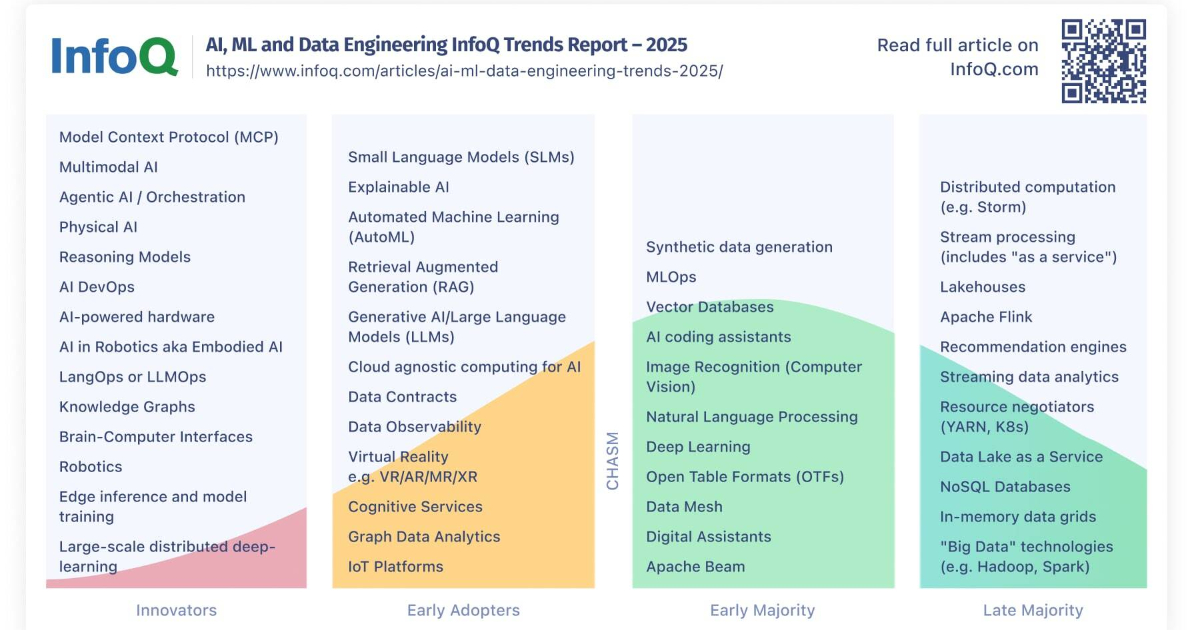
Article: InfoQ AI, ML and Data Engineering Trends Report - 2025

This InfoQ Trends Report offers readers a comprehensive overview of emerging trends and technologies in the areas of AI, ML, and Data Engineering. This report summarizes the InfoQ editorial team’s and external guests' view on the current trends in AI and ML technologies and what to look out for in the next 12 months.
By Srini Penchikala, Savannah Kunovsky, Anthony Alford, Daniel Dominguez, Vinod Goje