
❌

Reading view

The Download: an exclusive Jeff VanderMeer story and AI models too scary to release

This is today’s edition of The Download, our weekday newsletter that provides a daily dose of what’s going on in the world of technology.

Constellations 

—Constellations is a short story by Jeff VanderMeer, the author of the critically acclaimed, bestselling Southern Reach series.  

A spacecraft has crash-landed on a hostile planet. The only survivors are three members of the exploration team and the ship’s AI mind.  

Little exists on the planet except deserts of snow. But alien artifacts lie nearby, in the form of 13 domes, spread across the terrain. Linked by cables threaded through metal posts, the domes form a series of paths—the only hope for life support. 

As the team treks across the frozen hellscape, they discover the remains of countless astronauts from unknown species who followed the same route before them. Is their trail a path to salvation, or a cosmic trap?

Read the rest of this short story in full. 

This story is from the next issue of our print magazine, packed with stories all about nature. Subscribe now to read the full thing when it lands on Wednesday, April 22. 

The must-reads 

I’ve combed the internet to find you today’s most fun/important/scary/fascinating stories about technology. 

1 OpenAI has joined Anthropic in curbing an AI release over security fears 
Only select partners will get its new cybersecurity tool. (Axios)  
+ Anthropic said only yesterday that its new AI is too dangerous for the public. (NBC News) 
+ Top models may not be so public going forward. (Bloomberg $)  
+ The US has summoned bank CEOs to discuss the risks. (FT $)  
 
2 Florida is investigating OpenAI over an alleged role in a shooting  
ChatGPT may have helped someone plan a mass shooting in Florida. (WSJ $)  
+ OpenAI has backed a bill that would limit AI liability for deaths. (Wired $)  
+ The family of a victim plans to sue the company. (Guardian)  
+ AI’s role in delusions is dividing opinion. (MIT Technology Review)  
 
3 Volkswagen is ditching EV production for more gasoline models  
The carmaker will stop making its top electric vehicle in the US. (NYT $)  
+ Instead, it will concentrate on developing a new SUV. (Ars Technica)  
+ Western carmakers are retreating from electric vehicles. (Guardian) 
 
4 Elon Musk’s xAI has sued Colorado over an AI anti-discrimination law  
It’s the first state bill of its kind. (Bloomberg $)  
+ xAI says it will force the firm to “promote the state’s ideological views.” (FT $) 

5 A fifth of US employees say AI now does parts of their job  
The survey found half of US adults used AI in the past week. (NBC News)  
+ Missing data could shed light on AI’s job impact. (MIT Technology Review)  
 
6 Google DeepMind’s CEO wants to automate drug design  
He hopes to develop AI capable of curing all diseases. (The Economist)  
+ A scientist is using AI to hunt for antibiotics. (MIT Technology Review) 

7 China’s Unitree is launching a viral robot on the international market
R1, its cheapest humanoid, will go on sale outside China next week. (SCMP)
+ Gig workers are training humanoids at home. (MIT Technology Review)

8 An experiment on Artemis II astronauts could reshape space medicine
Chips containing their cells will model spaceflight’s effects. (WP $)

9 A pro-Iran meme machine is trolling Trump with AI Lego cartoons
The videos have racked up millions of views. (Wired $) 
+ You can learn to love AI slop. (MIT Technology Review)

10 Short breaks could erase 10 years of social media brain damage 
Studies show that a two-week detox could have a dramatic benefit. (WP $) 

Quote of the day 

“AI should advance mankind, not destroy it. We’re demanding answers on OpenAI’s activities that have hurt kids, endangered Americans, and facilitated the recent FSU mass shooting.”

—Florida Attorney General James Uthmeier explains on X why he’s probing OpenAI. 

One More Thing 

girl holding a cell phone seen in a cracked glass
TOM HUMBERSTONE

It’s time to retire the term “user” 

People have been called “users” for a long time. Often, it’s the right word to describe people who use software. But “users” is also unspecific enough to refer to just about everyone. It can accommodate almost any big idea or long-term vision. 

We use—and are used by—computers and platforms and companies. The label “user” suggests these interactions are deeply transactional, but they’re frequently quite personal. Is it time for a more human vocabulary? Read the full story. 

—Taylor Majewski 

We can still have nice things 

A place for comfort, fun and distraction to brighten up your day. (Got any ideas? Drop me a line.) 

+ This flawless levitation trick will leave you questioning the laws of physics.
+ The World Press Photo winners expose the beauty (and brutality) of our planet.
+ Over 3 million pink flamingos gathered to create a stunning pink horizon.
+ Behold the galaxy’s enormity in this comparison of its largest known star to Earth
  •  

The Download: AstroTurf wars and exponential AI growth

This is today’s edition of The Download, our weekday newsletter that provides a daily dose of what’s going on in the world of technology.

Is fake grass a bad idea? The AstroTurf wars are far from over. 

In 2001, Americans installed just over 7 million square meters of synthetic turf. By 2024, that number was 79 million square meters—enough to carpet all of Manhattan and then some. The increase worries folks who study microplastics and environmental pollution.  

While the plastic-making industry insists that synthetic fields are safe if properly installed, lots of researchers think that isn’t so. Find out why AstroTurf has ignited heated debates.

—Douglas Main 

This story is from the next issue of our print magazine, packed with stories all about nature. Subscribe now to read the full thing when it lands on Wednesday, April 22. 

Mustafa Suleyman: AI development won’t hit a development wall anytime soon—here’s why 

—Mustafa Suleyman, Microsoft AI CEO and Google DeepMind co-founder 

The skeptics keep predicting that AI compute will soon hit a wall—and keep getting proven wrong. To understand why that is, you need to look at the forces driving the AI explosion.  

Three advances are enabling exponential progress: faster basic calculators, high-bandwidth memory, and technologies that turn disparate GPUs into enormous supercomputers. Where does all this get us? Read the full op-ed on the future of AI development to learn more. 
 

Desalination technology, by the numbers 

—Casey Crownhart 

When I started digging into desalination technology for a new story, I couldn’t help but obsess over the numbers. 

I knew on some level that desalination—pulling salt out of seawater to produce fresh water—was an increasingly important technology, especially in water-stressed regions including the Middle East. But just how much some countries rely on desalination, and how big a business it is, still surprised me.

Here are the extraordinary numbers behind the crucial water source. 

This story is from The Spark, our weekly newsletter on the tech that could combat the climate crisis. Sign up to receive it in your inbox every Wednesday. 

The must-reads 

I’ve combed the internet to find you today’s most fun/important/scary/fascinating stories about technology. 

1 Meta has launched the first AI model from its Superintelligence Labs
Muse Spark is the company’s first model in a year. (Reuters $) 
+ The closed model brings reasoning capabilities to the Meta AI app. (Engadget) 
+ It’s built by Meta’s Superintelligence Labs, the unit led by Alexandr Wang. (TechCrunch) 

2 Anthropic has lost a bid to pause the Pentagon’s blacklisting 
An appeals court in Washington, DC denied the request. (CNBC) 
+ A California judge had temporarily blocked the blacklisting in March. (NPR) 
+ The mixed rulings leave Anthropic in a legal limbo. (Wired $) 
+ And open doors for smaller AI rivals. (Reuters $) 

3 New evidence suggests Adam Back invented Bitcoin 
The British cryptographer may be the real Satoshi Nakamoto. (NYT $) 
+ Back denies the claims. (BBC) 
+ There’s a dark side to crypto’s permissionless dream. (MIT Technology Review) 

4 Gen Z is cooling on AI 
The share feeling angry about it has risen from 22% to 31% in a year. (Axios) 
+ Anti-AI protests are also growing. (MIT Technology Review) 

5 War in the Gulf could tilt the cloud race toward China 
Huawei is pitching “multi-cloud” resilience to Gulf clients. (Rest of World) 

6 Meta has killed a leaderboard of its AI token users 
It showed the top 250 users. (The Information $) 
+ Meta blamed data leaks for the shutdown. (Fortune) 
+ It encouraged “tokenmaxxing,” a growing phenomenon in Big Tech. (NYT $) 

7 Did Artemis II really tell us anything new about space? 
Or was it primarily a PR exercise? (Ars Technica) 

8 Israeli attacks have brutally exposed Lebanon’s digital infrastructure 
It’s managing a modern crisis without modern technology. (Wired $) 

9 AI models could offer mathematicians a common language 
They hope it will simplify the process of verifying proofs. (Economist)  

10 A “self-doxing’ rave is helping trans people stay safe online 
It’s among a series of digital self-defenses. (404 Media) 

Quote of the day 

“I feel like anything that I’m interested in has the potential of maybe getting replaced, even in the next few years.” 

—Sydney Gill, a freshman at Rice University, tells the New York Times why she’s soured on AI. 

One More Thing 

""
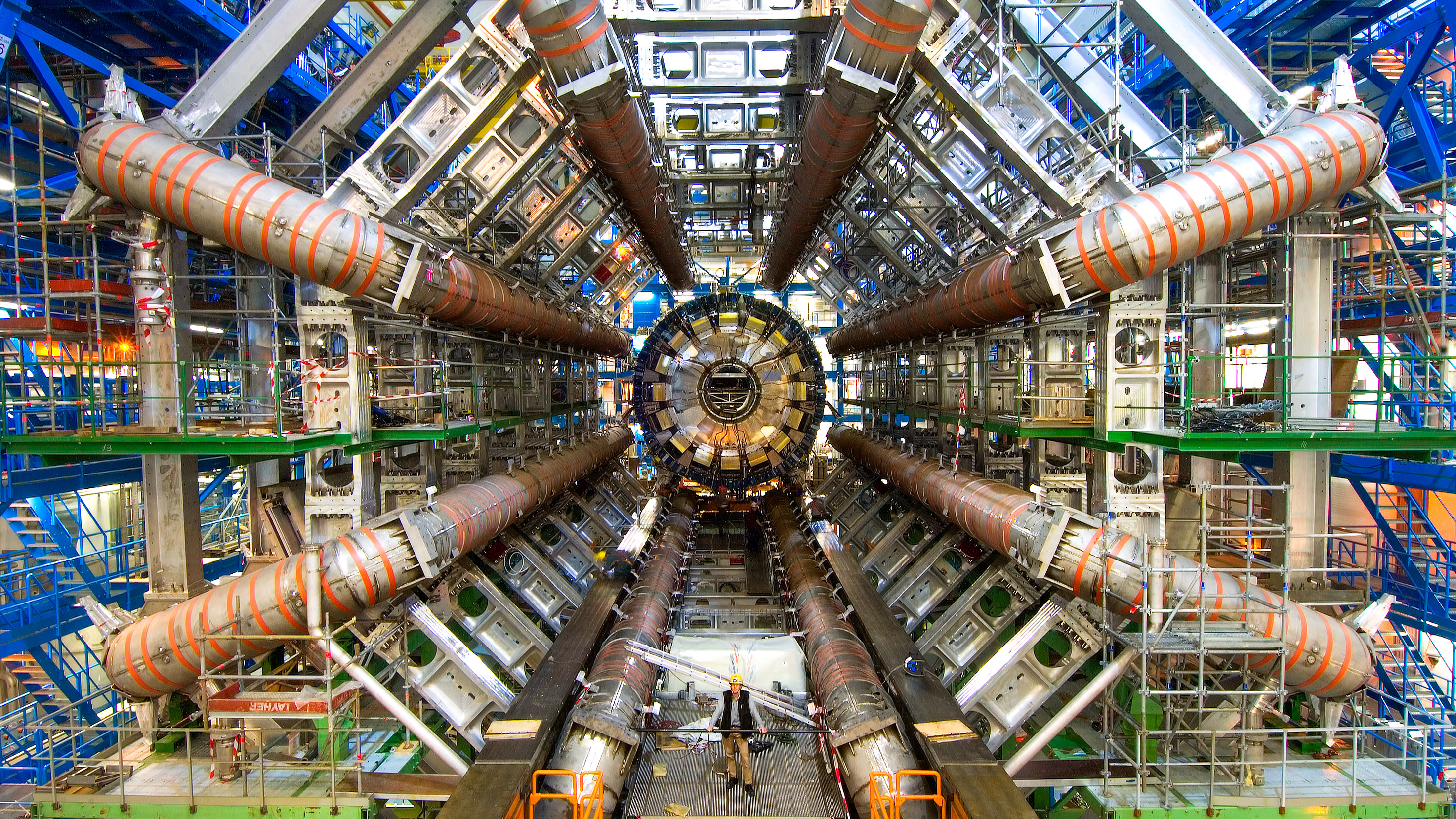
A view inside ATLAS,
one of two general-purpose detectors at the Large Hadron Collider.
MAXIMILIEN BRICE/CERN

Inside the hunt for new physics at the world’s largest particle collider 

In 2012, data from CERN’s Large Hadron Collider (LHC) unearthed a particle called the Higgs boson. The discovery answered a nagging question: where do fundamental particles, such as the ones that make up all the protons and neutrons in our bodies, get their mass?

But now particle physicists have reached an impasse in their quest to discover, produce, and study new particles at colliders. Find out what they’re trying to do about it.

—Dan Garisto 

We can still have nice things 

A place for comfort, fun and distraction to brighten up your day. (Got any ideas? Drop me a line.) 

+ Enjoy this tale of the “joke” sound that accidentally defined 90s rave culture. 
+ Take a nostalgic trip through the websites of the early 00s. 
+ One for animal lovers: sperm whales have teamed up to support a newborn. 
+ Here’s a long overdue answer to a vital question: can the world’s largest mousetrap catch a limousine? 

  •  

The Download: water threats in Iran and AI’s impact on what entrepreneurs make

This is today’s edition of The Download, our weekday newsletter that provides a daily dose of what’s going on in the world of technology.

Desalination plants in the Middle East are increasingly vulnerable 

As the conflict in Iran has escalated, a crucial resource is under fire: the desalinization technology that supplies water in the region. 
 
President Donald Trump has threatened to destroy “possibly all desalinization plants” in Iran if the Strait of Hormuz is not reopened. The impact on farming, industry, and—crucially—drinking in the Middle East could be severe. Find out why. 

—Casey Crownhart 

This story is part of MIT Technology Review Explains, our series untangling the complex, messy world of technology to help you understand what’s coming next. You can read more from the series here. 

AI is changing how small online sellers decide what to make 

For small entrepreneurs, deciding what to sell and where to make it has traditionally been a slow, labor-intensive process. Now that work is increasingly being done by AI.   

Tools like Alibaba’s Accio compress weeks of product research and supplier hunting into a single chat. Business owners and e-commerce experts say they’re making sourcing more accessible—and slashing the time from product idea to launch.  

Read the full story on how AI is leveling the path to global manufacturing. 

—Caiwei Chen 

The gig workers who are training humanoid robots at home 

When Zeus, a medical student in Nigeria, returns to his apartment from a long day at the hospital, he straps his iPhone to his forehead and records himself doing chores.  
 
Zeus is a data recorder for Micro1, which sells the data he collects to robotics firms. As these companies race to build humanoids, videos from workers like Zeus have become the hottest new way to train them.   
 
Micro1 has hired thousands of them in more than 50 countries, including India, Nigeria, and Argentina. The jobs pay well locally, but raise thorny questions around privacy and informed consent. The work can be challenging—and weird. Read the full story.  

—Michelle Kim 

This is our latest story to be turned into an MIT Technology Review Narrated podcast, which we’re publishing each week on Spotify and Apple Podcasts. Just navigate to MIT Technology Review Narrated on either platform, and follow us to get all our new content as it’s released. 

The must-reads 

I’ve combed the internet to find you today’s most fun/important/scary/fascinating stories about technology. 

1 Anthropic’s new model found security problems in every OS and browser 
Claude Mythos has been heralded as a cybersecurity “reckoning.” (The Verge)  
+ Anthrophic is limiting the rollout over hacking fears. (CNBC) 
+ It’s also launching a project that lets Mythos flag vulnerabilities. (Gizmodo) 
+ Apple, Google, and Microsoft have joined the initiative. (ZDNET) 

2 Iranian hackers are targeting American critical infrastructure 
Their focus is on energy and water infrastructure. (Wired) 
+ They’re targeting industrial control devices. (TechCrunch)  

3 Google’s AI Overviews deliver millions of incorrect answers per hour 
Despite a 90% accuracy rate. (NYT $) 
+ AI means the end of internet search as we’ve known it. (MIT Technology Review) 

4 Elon Musk is trying to oust OpenAI CEO Sam Altman in a lawsuit 
As remedies for Altman allegedly defrauding him. (CNBC) 
+ Musk wants any damages given to OpenAI’s nonprofit arm. (WSJ $) 

5 ICE has admitted it’s using powerful spyware 
The tools that can intercept encrypted messages. (NPR) 
+ Immigration agencies are also weaponizing AI videos. (MIT Technology Review) 

6 Greece has joined the countries banning kids from social media 
Under-15s will be blocked from 2027. (Reuters) 
+ Australia introduced the world’s first social media ban for children. (Guardian) 
+ Indonesia recently rolled out the first one in Southeast Asia. (DW)  
+ Experts say they’re a lazy fix. (CNBC) 

7 Intel will help Elon Musk build his Terafab in Texas 
They aim to manufacture chips for AI projects. (Engadget) 
+ Musk says it will be the largest-ever semiconductor factory. (Engadget) 
+ Future AI chips could be built on glass. (MIT Technology Review)  

8 TikTok is building a second billion-euro data center in Finland 
It’s moving data storage for European users. (Reuters) 
+ Finland has become a magnet for data centers. (Bloomberg $) 
+ But nobody wants one in their backyard. (MIT Technology Review) 

9 Plans for Canada’s first “virtual gated community” have sparked a row 
The AI-powered surveillance system has divided neighbors. (Guardian) 
+ Is the Pentagon allowed to surveil Americans with AI? (MIT Technology Review) 

10 The high-tech engineering of the “space toilet” has been revealed 
Artemis II is the first mission to carry one around the world. (Vox) 

Quote of the day 

“This case has always been about Elon generating more power and more money for what he wants. His lawsuit remains nothing more than a harassment campaign that’s driven by ego, jealousy and a desire to slow down a competitor.” 

—OpenAI criticizes Musk’s legal action in an X post. 

One More Thing 

USWDS

Inside the US government’s brilliantly boring websites 

You may not notice it, but your experience on every US government website is carefully crafted. 

Each site aligns an official web design and a custom typeface. They aim to make government websites not only good-looking but accessible and functional for all. 

MIT Technology Review dug into the system’s history and features. Find out what we discovered. 

—Jon Keegan 

We can still have nice things 

A place for comfort, fun and distraction to brighten up your day. (Got any ideas? Drop me a line.) 

+ Rejoice in the splendor of the “Earthset” image captured by Artemis II. 
+ Meet the fearless cat chasing off bears. 
+ This document vividly explains what makes the octopus so unique. 
+ Revealed: the rhythmic secret that makes emo music so angsty. 

  •  
❌