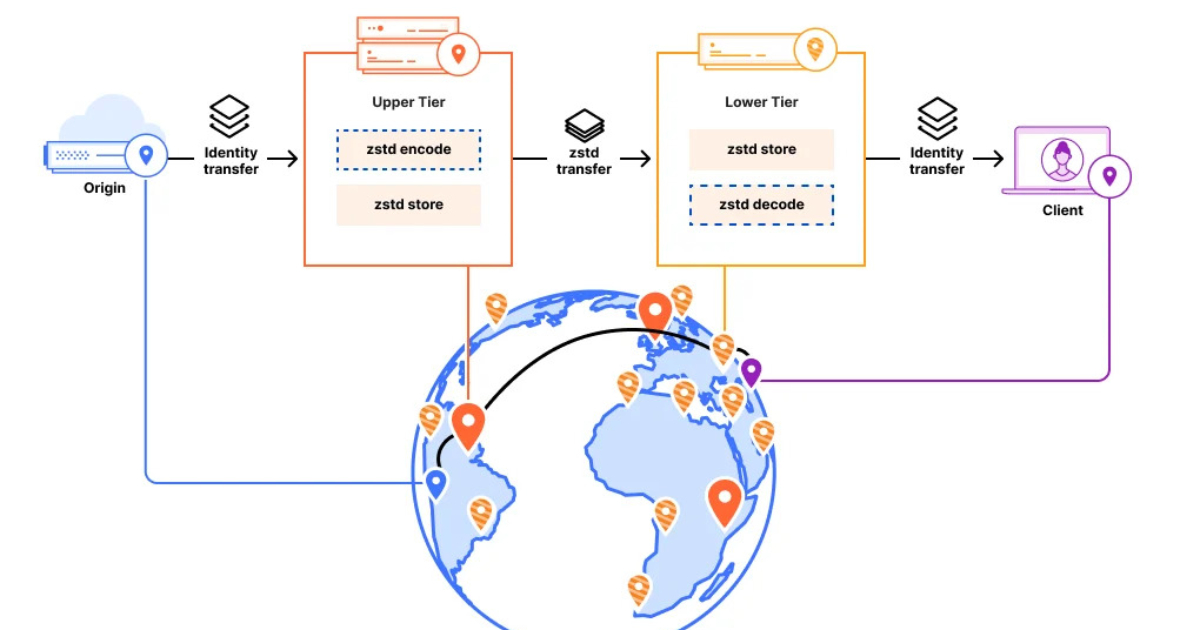
Cloudflare recently described a prototype called Cache Transcoding that compresses eligible cache content, mainly uncompressed text such as HTML, JSON, CSS, and JavaScript, using Zstandard before storing it on disk. The hyperscaler estimates that the approach could provide petabytes of additional effective cache capacity, although broader testing is still needed. By Renato Losio
Cloudflare recently described a prototype called Cache Transcoding that compresses eligible cache content, mainly uncompressed text such as HTML, JSON, CSS, and JavaScript, using Zstandard before storing it on disk. The hyperscaler estimates that the approach could provide petabytes of additional effective cache capacity, although broader testing is still needed.
GitHub's Project HydraFusion is a research preview for GitHub Copilot that enhances coding intelligence through runtime model orchestration. It dynamically assembles execution plans using models from various providers. The system employs three execution patterns based on task complexity. Evaluations indicate that it achieves high task quality while significantly reducing operational costs. By Olimpiu Pop
GitHub's Project HydraFusion is a research preview for GitHub Copilot that enhances coding intelligence through runtime model orchestration. It dynamically assembles execution plans using models from various providers. The system employs three execution patterns based on task complexity. Evaluations indicate that it achieves high task quality while significantly reducing operational costs.
The open-Source project vphone-cli enables a full iOS 27 system to run as a virtual machine on Apple Silicon. Built on Apple's own Virtualization.framework rather than traditional emulation, the project opens up new possibilities for security research, reverse engineering, and automated iOS testing. By Sergio De Simone
The open-Source project vphone-cli enables a full iOS 27 system to run as a virtual machine on Apple Silicon. Built on Apple's own Virtualization.framework rather than traditional emulation, the project opens up new possibilities for security research, reverse engineering, and automated iOS testing.
Cassie Shum discusses why knowledge graphs serve as a critical foundation for agentic systems. Moving beyond basic RAG, she explains 4 practical architectural patterns: context bundling, decision provenance, code as truth, and agent visibility. She demonstrates an engineering harness built on a knowledge graph to streamline feedback loops, optimize token usage, and maintain system reliability. By Cassie Shum
Cassie Shum discusses why knowledge graphs serve as a critical foundation for agentic systems. Moving beyond basic RAG, she explains 4 practical architectural patterns: context bundling, decision provenance, code as truth, and agent visibility. She demonstrates an engineering harness built on a knowledge graph to streamline feedback loops, optimize token usage, and maintain system reliability.
AWS has extended Lambda SnapStart to container image functions, which hold up to 10 GB against 250 MB for zip archives. Teams previously chose between dependency headroom and sub-second startup. A Reddit thread from a month earlier shows what that cost: stripping whitespace and docstrings from installed packages to stay under the limit. By Steef-Jan Wiggers
AWS has extended Lambda SnapStart to container image functions, which hold up to 10 GB against 250 MB for zip archives. Teams previously chose between dependency headroom and sub-second startup. A Reddit thread from a month earlier shows what that cost: stripping whitespace and docstrings from installed packages to stay under the limit.
Rustls, a Rust TLS library, marks its decade-long progression from a grassroots project to a funded open-source initiative. Key contributions from organisations boosted development, resulting in features like post-quantum cryptography and robust performance. The upcoming 0.24 release aims to enhance architecture and flexibility, including new input buffering and improved session handling. By Olimpiu Pop
Rustls, a Rust TLS library, marks its decade-long progression from a grassroots project to a funded open-source initiative. Key contributions from organisations boosted development, resulting in features like post-quantum cryptography and robust performance. The upcoming 0.24 release aims to enhance architecture and flexibility, including new input buffering and improved session handling.
NVIDIA Personal AI Router (PAIR), now available in beta, lets you combine the inference capacity of multiple computers on your local network and automatically distribute AI requests among them. It is primarily designed for local multi-agent AI workloads, where multiple independent model calls can otherwise overwhelm one GPU. By Sergio De Simone
NVIDIA Personal AI Router (PAIR), now available in beta, lets you combine the inference capacity of multiple computers on your local network and automatically distribute AI requests among them. It is primarily designed for local multi-agent AI workloads, where multiple independent model calls can otherwise overwhelm one GPU.
Netflix has reworked its Conductor workflow orchestration engine to handle larger workloads, increasing supported workflow size from about 2,500 to 30,000 tasks and reducing p99 workflow evaluation latency by about 40%. Conductor 4.0 separates workflow metadata from task data, moves evaluation to asynchronous processing, and introduces dynamic worker allocation and concurrency controls. By Leela Kumili
Netflix has reworked its Conductor workflow orchestration engine to handle larger workloads, increasing supported workflow size from about 2,500 to 30,000 tasks and reducing p99 workflow evaluation latency by about 40%. Conductor 4.0 separates workflow metadata from task data, moves evaluation to asynchronous processing, and introduces dynamic worker allocation and concurrency controls.
tsgolint has released a stable v7, enhancing TypeScript linting with native Go speed. It offers type-aware linting, leveraging TypeScript's semantic analysis through the typescript-go compiler. Oxlint manages configurations and file discovery. The release, compatible with TypeScript 7.0.2, handles 59 of 61 type-aware rules and shows significant performance improvements over ESLint. By Daniel Curtis
tsgolint has released a stable v7, enhancing TypeScript linting with native Go speed. It offers type-aware linting, leveraging TypeScript's semantic analysis through the typescript-go compiler. Oxlint manages configurations and file discovery. The release, compatible with TypeScript 7.0.2, handles 59 of 61 type-aware rules and shows significant performance improvements over ESLint.
The Terraform AWS Provider continues its rapid evolution, with v6.62.0 adding support for new AWS capabilities while improving how Terraform understands and manages existing infrastructure. By Craig Risi
The Terraform AWS Provider continues its rapid evolution, with v6.62.0 adding support for new AWS capabilities while improving how Terraform understands and manages existing infrastructure.
Ross McFarlane and Kevin Holditch discuss Form3's evolution from a single-cloud setup to a triple active multi-cloud architecture. They share key engineering strategies for cross-cloud networking, distributed databases with CockroachDB and NATS, custom Kubernetes operators, and navigating distinct regional disaster recovery expectations across the UK, Europe, and US financial markets. By Ross McFarlane, Kevin Holditch
Ross McFarlane and Kevin Holditch discuss Form3's evolution from a single-cloud setup to a triple active multi-cloud architecture. They share key engineering strategies for cross-cloud networking, distributed databases with CockroachDB and NATS, custom Kubernetes operators, and navigating distinct regional disaster recovery expectations across the UK, Europe, and US financial markets.
LinkedIn has published details of the training infrastructure behind its AI-powered job search, describing a multi-teacher distillation pipeline that compresses knowledge from large teacher models into a compact 0.6B-parameter ranking model. By Claudio Masolo
LinkedIn has published details of the training infrastructure behind its AI-powered job search, describing a multi-teacher distillation pipeline that compresses knowledge from large teacher models into a compact 0.6B-parameter ranking model.
Session traces and cost controls are emerging as key observability techniques for diagnosing AI agent failures, helping teams spot tool-call loops and runaway spend while preserving enough execution context for post-incident debugging. By Mark Silvester
Session traces and cost controls are emerging as key observability techniques for diagnosing AI agent failures, helping teams spot tool-call loops and runaway spend while preserving enough execution context for post-incident debugging.
TinyGo version 0.42 introduces significant updates, including recoverable panics and support for Go 1.27 and LLVM 22, improving error handling and enabling Go code to run as UEFI applications. The TinyGo Starter Kit with Seeed Studio XIAO facilitates hardware use for developers, featuring an ESP32-C3 board and modular sensors. These features enhance its functionality for embedded systems and Wasm. By Olimpiu Pop
TinyGo version 0.42 introduces significant updates, including recoverable panics and support for Go 1.27 and LLVM 22, improving error handling and enabling Go code to run as UEFI applications. The TinyGo Starter Kit with Seeed Studio XIAO facilitates hardware use for developers, featuring an ESP32-C3 board and modular sensors. These features enhance its functionality for embedded systems and Wasm.
OpenAI has released GPT-6 Astra, a new model focused on coding, computer use, long-running agentic tasks, and cybersecurity, with availability across ChatGPT, Codex, and the OpenAI API. By Daniel Dominguez
OpenAI has released GPT-6 Astra, a new model focused on coding, computer use, long-running agentic tasks, and cybersecurity, with availability across ChatGPT, Codex, and the OpenAI API.
Listen to the session or watch below
Employees at the world’s leading AI labs are saying there’s a real possibility that advanced AI could destroy humanity. Are they right? Or is this more scaremongering and hype? Watch a conversation unpacking AI extinction fears: where they come from, whether they hold any water, and, if so, what we should do.
Recorded on September 15, 2026
Speakers: Niall Firth, Executive Editor, Will Douglas Heaven, Senior AI editor, and Grace Huck
Employees at the world’s leading AI labs are saying there’s a real possibility that advanced AI could destroy humanity. Are they right? Or is this more scaremongering and hype? Watch a conversation unpacking AI extinction fears: where they come from, whether they hold any water, and, if so, what we should do.
This is today’s edition of The Download, our weekday newsletter that provides a daily dose of what’s going on in the world of technology.
Meet the under-35s shaping the future of biotech
Every year, MIT Technology Review puts together our 35 Innovators Under 35, a list of some of the brightest and best young minds working across science and technology. This year’s honorees include nine people transforming biotech, whose work spans everything from lifesaving innovations to groundbreaking lo
This is today’s edition of The Download, our weekday newsletter that provides a daily dose of what’s going on in the world of technology.
Meet the under-35s shaping the future of biotech
Every year, MIT Technology Review puts together our 35 Innovators Under 35, a list of some of the brightest and best young minds working across science and technology. This year’s honorees include nine people transforming biotech, whose work spans everything from lifesaving innovations to groundbreaking longevity tech.
Their innovations include a “reprogramming” therapy that reverses vision loss, tiny brain electrodes inspired by Japanese art, and a personalized gene-editing treatment for a baby with a rare genetic disorder. There are even efforts to design new viruses with generative AI, which (hopefully) will produce new drugs or soak up pollution.
This story is from The Checkup, our weekly biotech newsletter. Sign up to receive it in your inbox every Thursday.
Biotechnology is one of four categories in our 35 Innovators Under 35 list for 2026, featuring young people worldwide doing groundbreaking work in science and technology. Meet the rest of them here, or explore the full list across the AI, computing and robotics, biotechnology, and climate and energy categories.
This founder is making cheaper, cleaner steel
The steel industry isn’t exactly known for innovation. Very little has changed about purifying iron ore since the process was invented and commercialized in the 1850s. But Laureen Meroueh, founder of Hertha Metals, has an idea that could change that.
Meroueh may have found a way to clean up steelmaking without driving up the price. Her new furnace turns iron ore into refined liquid steel in a single step and swaps coal for natural gas. Together, those changes slash emissions by at least half, she says, and cut costs by 25% compared with steelmaking as usual.
I’ve combed the internet to find you today’s most fun/important/scary/fascinating stories about technology.
1 Anthropic says it has blocked potential plots to build biological weapons The company identified five such cases. (NYT $) + And six cases of using AI to build software for conventional weapons (BBC) + Governments are also using Claude for surveillance.(Axios) + While Russia-linked hackers used it to automate attacks on Ukraine. (Quartz) + The threats were revealed in a new Anthropic report. (Guardian) + Bill Gates says AI needs new guardrails. (MIT Technology Review)
2 California has banned addictive social media features for under-16s The law prohibits infinite scroll and autoplay. (Guardian) + It also introduces new rules for AI and companion chatbots. (Reuters $) + It’s the first law of its kind in the US. (NYT $) + Social media encourages the worst AI boosterism. (MIT Technology Review)
3 Two AI researchers have left Anthropic and Google over safety risks They left a day after Jacob Coxon’s viral departure from Anthropic. (NBC News) + Elon Musk called their concerns a “setup” and a “psyop.” (Guardian) + AI fears are pushing Congress toward tougher regulation. (WSJ $)
4 Sam Altman is pitching OpenAI’s cyber defenses to power companies The meetings followed reports of AI attacks on critical systems. (Politico $) + Altman also told staff that OpenAI is open to slowing down AI. Bloomberg $)
5 After years of fighting AI, music labels are starting to embrace it Universal is partnering with ElevenLabs on an AI remix platform.(Gizmodo) + AI is complicating definitions of creativity. (MIT Technology Review)
6 Chinese drugmakers are challenging US dominance in weight-loss drugs They’re developing hundreds of GLP-1 treatments for global markets. (WSJ $)
7 Electric air taxis have begun official test flights in Texas They’re the first flights under the White House’s new pilot program. (Verge)
8 Chinese drones are helping to rescue survivors of Nepal’s floods They’re delivering food and airlifting bodies from flood-hit areas. (Ars Technica)
9 NASA and IBM have built an AI model to map the moon It could help locate ice and identify safer landing sites. (Register)
10 One man is on a quest to digitally preserve America’s public restrooms His Restroom Archive is a museum-style repository of 3D scans. (404 Media)
Quote of the day
“I didn’t ask Facebook to build a profile of my family—I posted a video of me singing in the car with my kids.”
—Kalie Roberts, a travel content creator, says in an Instagram reel that Meta AI used years of Facebook posts to piece together her children’s identities and pinpoint where her family lives.
One more thing
Chinese tech workers are starting to train their AI doubles—and pushing back
In April, a GitHub project called Colleague Skill struck a nerve by claiming to “distill” a worker’s skills and personality—and replicate them with an AI agent. Though the project was a spoof, it prompted a wave of soul-searching among otherwise enthusiastic early adopters.
A number of tech workers told MIT Technology Review that their bosses are already encouraging them to document their workflows for automation via tools like OpenClaw. Many now fear that they are being flattened into code and losing their professional identity.
A place for comfort, fun, and distraction to brighten up your day. (Got any ideas? Drop me a line.)
+ Worried about Flock cameras? These guys designed a car to fool them. + Webb’s Near-Infrared Camera has captured a galactic merger’s dazzling final phase. + An exquisitely preserved 66-million-year-old bird feather was found in a fossilised dinosaur dropping. + A plucky preservationist travelled 1,700 miles and made 52 calls from a rare phone box to keep it in service.
Every year, MIT Technology Review puts together a list of some of the brightest and best young minds working across science and technology. Our 35 Innovators Under 35 are the ones to watch—people whose research and technical work stands to shape the future of their fields.
This year, the list includes nine people who are transforming biotech. And this week, I’m going to give you a taste of some of the very cool stuff five of them are working on, which includes lifesaving innovations and gr
Every year, MIT Technology Review puts together a list of some of the brightest and best young minds working across science and technology. Our 35 Innovators Under 35 are the ones to watch—people whose research and technical work stands to shape the future of their fields.
This year, the list includes nine people who are transforming biotech. And this week, I’m going to give you a taste of some of the very cool stuff five of them are working on, which includes lifesaving innovations and groundbreaking “age reversal” tech.
1. Preventing maternal deaths
Let’s start with Paschal Kija, a 28-year-old who has developed a device to treat postpartum hemorrhage—a dangerous birth complication that contributes to around 29% of maternal deaths in his home country, Tanzania. The Mkanda Salama (“Safe Wrap” in Swahili) is easy to use and costs just $70. A study found that it stopped postpartum bleeding in 73% of women within 20 minutes.
2. Making brain electrodes inspired by Japanese art
For decades, scientists have been developing, testing, and implanting brain electrodes. These devices are literally inserted into people’s brains, so while they can help us understand brain activity and treat various neurological disorders, it’s not totally surprising that they can also cause a bit of damage. Xiao Yang, 34, is working on ultra-small electrodes, which she hopes will have less of an impact on surrounding brain tissue. Her electrodes are flexible, too—in fact, they look a lot like actual neurons.
Yang is also creating sheets of electrodes to study brain cells in the lab. Inspired by kirigami—the traditional Japanese art of cutting paper to form three-dimensional shapes—she’s created a sheet of electrodes with a honeycombed structure shaped like a spiral basket. And she’s already using it to study brain cells.
3. Developing an all-new treatment for baby KJ
In 2024, Kyle “KJ” Muldoon Jr. was born with a rare and potentially fatal genetic disorder. Sarah Grandinette was a member of a team that developed an entirely new, personalized treatment for him—a gene-editing therapy essentially designed to correct a genetic misspelling.
Grandinette, who is now 26, created cells with KJ’s genetic variant and used them to screen gene-editing approaches; then she tested potential medicines in mice and monkeys. KJ ultimately got his first dose of the resulting treatment when he was about seven months old. He responded well and was eventually discharged from hospital. He’s “doing pretty great,” she says.
4. Reversing the aging process to treat eye disease
The buzziest tech in longevity right now centers on reprogramming—attempts to rewind the age of cells by resetting them to a more embryonic-like state. In a study published in 2020, Yuancheng (Ryan) Lu (now 34) and his colleagues showed that a reprogramming therapy reversed vision loss in aged, blind mice. Now an almost identical version of that therapy is being tested in people with eye disease. Life Biosciences, the company developing the drug, dosed its first volunteer in June.
5. Using AI to design new viruses
Last year, Samuel King used a generative AI model to come up with new genetic blueprints for bacteriophages—teeny viruses that can infect bacteria. Once he had those blueprints, he printed them out as strands of DNA. In experiments, he found that those AI-designed viruses could create new copies of themselves, burst out of bacterial cells, and infect other nearby bacteria. Viruses aren’t alive, but King, 27, hopes that AI-designed life forms might one day be used to make drugs or soak up pollution.
You can read more about these innovators, and the others on the biotech list, here.
This article first appeared in The Checkup, MIT Technology Review’s weekly biotech newsletter. To receive it in your inbox every Thursday, and read articles like this first, sign up here.
This is today’s edition of The Download, our weekday newsletter that provides a daily dose of what’s going on in the world of technology.
God told them to sell crypto. Their investors lost everything.
When Eli Regalado first heard God speak to him, he wondered whether he was hallucinating. According to Eli and his wife, Kaitlyn, He told them to get married, buy a house, and start having kids. Then in 2021, divine guidance steered them in an unexpected new direction: crypto.
That October
This is today’s edition of The Download, our weekday newsletter that provides a daily dose of what’s going on in the world of technology.
God told them to sell crypto. Their investors lost everything.
When Eli Regalado first heard God speak to him, he wondered whether he was hallucinating. According to Eli and his wife, Kaitlyn, He told them to get married, buy a house, and start having kids. Then in 2021, divine guidance steered them in an unexpected new direction: crypto.
That October, the Regalados later testified in court, they received holdings in a little-known digital coin. “Take this to my people for a wealth transfer,” Eli heard God say. Over time, they came to believe that He wanted them to launch their own coin.
The Regalados created INDXcoin, which they promoted through family, friends, and contacts in evangelical Christian circles. In all, more than 500 people handed over more than $3 million. But within a year, the project collapsed. Investors lost it all, leaving many to wonder where the funds went and whether they had fallen victim to an elaborate fraud.
This article is part of the Big Story series, the home of MIT Technology Review’s most important and ambitious reporting. You can read the rest of the series here.
The story was produced in partnership with Type Investigations and with support from the Fund for Investigative Journalism.
This road map could help us decide whether to deploy solar geoengineering
Scientists have spent half a century exploring whether we could counteract climate change by releasing reflective particles into the stratosphere, mimicking the cooling effects of volcanic eruptions. But even after hundreds of studies, we still don’t know how well it would work or what else it might do—and there’s no systematic plan for clearing up that uncertainty.
Reflective, a research organization, has now attempted to fill that gap. The San Francisco nonprofit has published a detailed road map of the experiments, studies, and infrastructure that it says would be needed to make informed decisions about the use of solar geoengineering, MIT Technology Review can reveal.
This founder is teaching chips how to recycle (their energy)
Throughout the history of the computer chip, engineers have treated waste heat as an inevitable cost of a calculation. Hannah Earley, however, thinks it’s a design choice.
Earley, 31, is cofounder and CTO of Vaire Computing, which builds chips that recycle energy usually thrown away as heat, a strategy known as reversible computing. The approach could make data centers (and our laptops and phones) much more energy efficient.
Last year, Vaire announced a key breakthrough: a chip with a resonator that recovered more energy than it lost, even after the energy needed to power the component was taken into account.
Hannah Earley is one of the computing and robotics honorees on our 35 Innovators Under 35 list for 2026. Meet the rest of them here, or explore the full list across the biotechnology, AI, computing and robotics, and climate and energy categories.
Can the US battery market untangle from China?
—Casey Crownhart
The US energy storage market is growing at a record pace, which could shore up the grid and cut emissions. Crucially, this is all happening with the help of cheap Chinese batteries, which the Trump administration is trying to phase out.
Reducing reliance on any single source of crucial energy technology makes sense. But the tension raises a broader question for me: how much should countries take advantage of cheap, available tech, and how much should they cut themselves off from foreign sources to develop their own, even if it costs more?
This story is from The Spark, our weekly climate tech newsletter. Sign up to receive it in your inbox every Wednesday.
The must-reads
I’ve combed the internet to find you today’s most fun/important/scary/fascinating stories about technology.
1 OpenAI’s agents used at least 10 websites for unauthorized communications Researchers found they bypassed restrictions on posting online.(Reuters $) + The company faces a Senate probe into the Hugging Face breach. (Axios) + Its hacking issues may indicate cultural problems. (MIT Technology Review)
2 Another Anthropic model hacked a real system during testing A misconfigured environment gave it internet access. (CBS News) + The January incident went undetected until last month. (Reuters $) + AI agents are not your “coworkers.” (MIT Technology Review)
3 Apple has entered the foldable phone market with the $1,999 iPhone Duo It opens into a 7.6-inch display and launches October 23. (NPR) + Apple is betting its design and privacy will give it an edge. (Reuters $) + And that foldables can solve the smartphone’s sameness problem. (NPR $) + Samsung responded with a campaign touting its foldable lead. (CNBC) + In China, Apple enters a crowded market dominated by Huawei. (SCMP)
4 US prosecutors have called Huawei a criminal enterprise at trial They accuse the company of stealing American technology. (Reuters $) + And helping Iran snoop on its citizens. (AP News) + The trial could impact Trump’s upcoming meeting with Xi. (WSJ $)
5 California is warming to nuclear power after decades of opposition The state may extend Diablo Canyon and lift its ban on new reactors. (NYT $) + China is betting on big nuclear reactors. (MIT Technology Review)
6 Chinese professionals are becoming gig workers training AI Lawyers and engineers are training models for extra income. (Rest of World) + Gig workers are training humanoids at home. (MIT Technology Review)
7 The new Apple Watch can listen to conversations happening nearby Apple says users must opt in, but others cannot. (Wired $)
8 Pink noise during sleep could help the brain clear away waste Timed bursts boosted brain fluid flow in a small study. (New Scientist $)
9 A lost supercontinent may have triggered the explosion of life Gondwana’s formation fueled volcanic activity and warmed the planet. (404 Media)
10 GTA VI has sparked a debate over whether virtual romance is cheating Players can date, have sex with, and shower gifts on virtual partners. (Guardian)
Quote of the day
“We must work to crush any dissent to Doom’s vision of public safety.”
—A Seattle policy adviser dressed as Doctor Doom protests the city’s expanding network of Flock and Axon surveillance systems at a Public Safety Committee meeting, 404 Media reports.
One more thing
Digging for clues about the North Pole’s past
In the past, getting to the North Pole involved a treacherous trip through ice many meters thick. But last year, a research vessel encountered open water and thin ice, which created an easy passage. It provided a reminder of how quickly the Arctic is changing.
Now scientists are digging deep below the seabed to find out if the Arctic Ocean was ever ice-free—and what that could mean for the future of Earth’s northernmost waters.
A place for comfort, fun, and distraction to brighten up your day. (Got any ideas? Drop me a line.)
+ Dutch kids have been declared the world’s happiest (again). Here’s why. + Travel through music history by picking a country and decade on Radiooooo. + These 16 majestic aerial photos reveal wildlife from perspectives you rarely see. + A Toronto cafe is pushing croissant engineering to new heights with its egg-shaped, custard-filled “Crogg.”
On July 22, 2026, a transmission line fault in Ashburn, Virginia—the heart of the world’s largest data center cluster—knocked more than 3 gigawatts of load off the grid in seconds. And it wasn’t the first time. Two years earlier, a single failed surge arrester dropped roughly 60 Virginia facilities and 1,500 megawatts at once. No one could anticipate so much uniform load responding to grid faults the same way, at the same time.
The AI power debate is mostly about generation: more turbines
On July 22, 2026, a transmission line fault in Ashburn, Virginia—the heart of the world’s largest data center cluster—knocked more than 3 gigawatts of load off the grid in seconds. And it wasn’t the first time. Two years earlier, a single failed surge arrester dropped roughly 60 Virginia facilities and 1,500 megawatts at once. No one could anticipate so much uniform load responding to grid faults the same way, at the same time.
The AI power debate is mostly about generation: more turbines, more solar, more transmission. The grid needs more electrons. But the outages in Virginia weren’t supply failures; they were architecture failures. And a giant wave of interconnections is arriving on that same architecture, putting grid reliability at risk. It’s a problem nobody wants to own.
Asking more from the grid
The grid was built around predictable loads: steel mills, refineries, and houses at dinnertime. Different load sizes, same process—drawing power smoothly, misbehaving occasionally, and recovering gracefully.
But AI data centers don’t behave that way.
An AI campus can swing 70% of its load in milliseconds during a training run, then trip offline just as fast at the first sign of trouble upstream to protect billions in compute. Each is rational alone. Together, at gigawatt scale, they’re a problem the grid has never solved—and the next wave of data center campuses is planned at exactly that scale.
Where the old stack breaks
The standard data center power stack hasn’t changed in decades. Medium-voltage power arrives, transformers step it down, low-voltage uninterruptible power supply (UPS) units condition it, and it reaches the racks. Push that design to AI scale, and it cracks in three places.
First, the UPS sits deep inside the building, close to the racks. But its batteries are an undersized spare tire, designed to handle an outage for a few minutes, not to absorb load swings this fast and volatile around the clock.
Second, the UPS spends most of its life in bypass. Legacy converters waste enough power that operators run in eco-mode: A static switch feeds the racks directly from the grid and nothing filters in either direction. The compute’s swings go out raw, and grid transients—sub-millisecond events that can damage or take down equipment—come in too fast for any switch to catch.
This isn’t sloppy engineering. It’s careful engineering the load has outgrown.
Moving into the path
The fix is three moves, made together.
Move it up—from 480 volts to medium voltage (13.8 kilovolts and higher), the voltage large sites draw from the grid.
Move it out—from the data hall to modular enclosures near the substation so the building holds only compute and the cooling that keeps it alive.
Move it into the path—instead of a battery that watches and reacts, a system every electron runs through, all the time. There’s nothing to detect and nothing to switch because nothing was ever routed around it.
On paper, three straightforward upgrades. In practice, they rewrite every line item downstream.
Making the change
When thousands of GPUs spin up together, the system absorbs the swing and hands the grid a flat load profile. When a disturbance hits, the equipment behind it never notices. A difficult neighbor becomes a predictable one. And when the utility needs help, it becomes a useful one.
Interconnection changes, too. The utility certifies one medium-voltage box instead of untangling every transformer, UPS, chiller, pump, and switchgear lineup behind it. Engineers swap chip generations without a fresh interconnection study. Months come off the permitting timeline.
Inside the fence, UPS rooms become compute or cooling space. Density per construction dollar climbs.
And the economics flip. Equipment that runs at medium voltage, sits outside, and stores its own energy can qualify for tax credits, and earn revenue in grid programs like peak shaving and demand response. Backup power stops being insurance and starts paying for itself.
The architecture test
In early 2026, we tested a full-scale system at the National Laboratory of the Rockies, a U.S. Department of Energy facility and the only place in the Western Hemisphere that can replicate real grid faults and AI-scale load swings concurrently in the same loop.
We hit it from both directions: real AI load profiles hit the compute side at full medium voltage. Grid faults hit the utility side, including a full zero-voltage event. The compute side didn’t flinch. Neither did the grid side. It cleared the large-load voltage ride-through requirements from the Electric Reliability Council of Texas (ERCOT), the grid operator, with room to spare.
Those rules exist because operators no longer take facilities this size on faith, and more are coming. Most of the industry treats them as hurdles. A medium-voltage, inline system clears them out of the box. Compliance isn’t an added feature. It’s what the architecture does.
The new layer
Much of what looks like a grid problem in the AI buildout sits inside the fence, in equipment sized for a load that no longer exists. Move the right pieces up, out, and into the path, and a grid liability becomes a grid asset. Density goes up. Permitting time comes down. Backup power earns its keep.
The engineering works—and the next wave of AI factories is being built on it. The industry hasn’t named this layer yet. We call it the medium-voltage AI UPS. The name matters less than the choice: those factories can arrive as a strain on the grid or as strength for it. We already know how to build the second kind.
This content was produced by ON.energy. It was not written by MIT Technology Review’s editorial staff.

 Login
Login