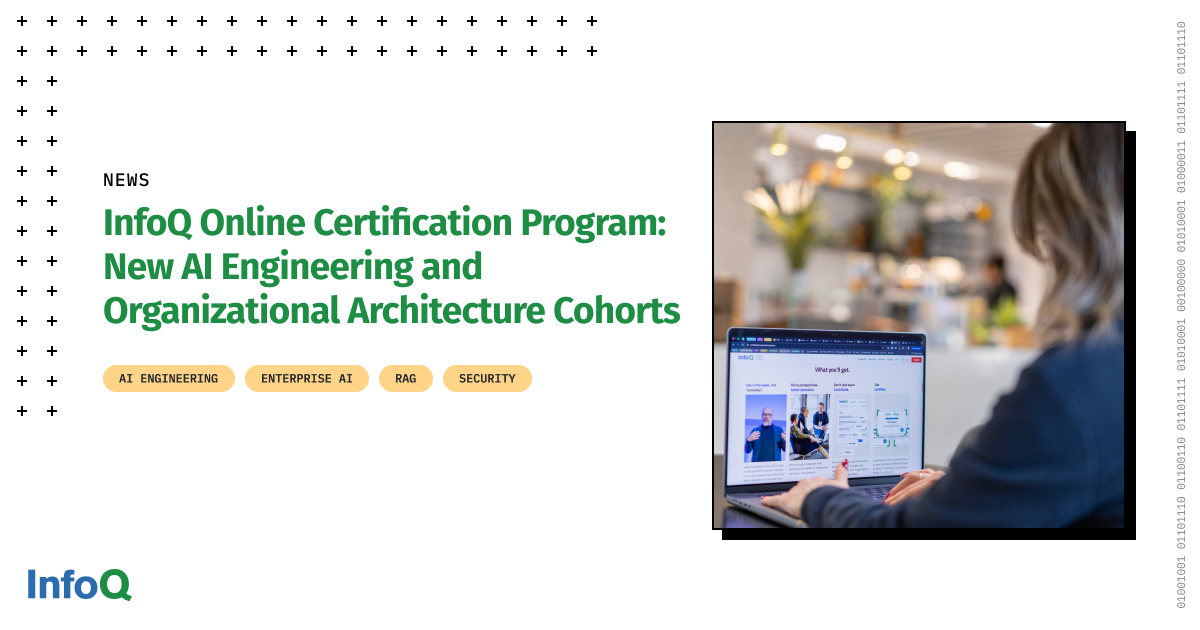
InfoQ expands its online certification portfolio with new AI Engineering and Organizational Architecture cohorts, giving senior practitioners a confidential peer group to pressure-test production AI, platform, team design, and architecture decisions. By Artenisa Chatziou
InfoQ expands its online certification portfolio with new AI Engineering and Organizational Architecture cohorts, giving senior practitioners a confidential peer group to pressure-test production AI, platform, team design, and architecture decisions.
This article explores Kafka's transition toward a cloud-native architecture, examining how tiered storage, FinOps telemetry, elastic consumer scaling, virtual clusters, and Share Groups reshape the operational and economic model of event streaming platforms. It also analyzes emerging diskless-storage proposals and their architectural trade-offs. By Viquar Khan
This article explores Kafka's transition toward a cloud-native architecture, examining how tiered storage, FinOps telemetry, elastic consumer scaling, virtual clusters, and Share Groups reshape the operational and economic model of event streaming platforms. It also analyzes emerging diskless-storage proposals and their architectural trade-offs.
Google's SynthID, designed to embed imperceptible signals into AI-generated content, is adding a new Content Detection API on Google Cloud's Gemini Enterprise Agent Platform, after gaining adoption by several industry players including Nvidia and OpenAI. By Sergio De Simone
Google's SynthID, designed to embed imperceptible signals into AI-generated content, is adding a new Content Detection API on Google Cloud's Gemini Enterprise Agent Platform, after gaining adoption by several industry players including Nvidia and OpenAI.
Microsoft has introduced a new AI-driven vulnerability discovery system called MDASH, a multi-model agentic security platform designed to automate large-scale code auditing across Windows and other Microsoft software environments. The system combines more than 100 specialized AI agents that work together to scan, validate, debate, and prove vulnerabilities across complex codebases. By Robert Krzaczyński
Microsoft has introduced a new AI-driven vulnerability discovery system called MDASH, a multi-model agentic security platform designed to automate large-scale code auditing across Windows and other Microsoft software environments. The system combines more than 100 specialized AI agents that work together to scan, validate, debate, and prove vulnerabilities across complex codebases.
Sergiu Petean discusses the strategic journey of evolving DevOps into platform engineering within heavily regulated enterprise environments. He explains how to maximize efficiency using dynamic reference architectures, align platform KPIs directly with board-level business goals, reduce cognitive load via custom team topologies, and maintain innovation sovereignty through open-source technology. By Sergiu Petean
Sergiu Petean discusses the strategic journey of evolving DevOps into platform engineering within heavily regulated enterprise environments. He explains how to maximize efficiency using dynamic reference architectures, align platform KPIs directly with board-level business goals, reduce cognitive load via custom team topologies, and maintain innovation sovereignty through open-source technology.
Gemma 4 can be paired with multi-token prediction (MTP) drafters that use speculative decoding to generate multiple tokens in parallel, allowing the model to verify them in a single pass and achieve up to ~3× faster inference without quality loss. By Sergio De Simone
Gemma 4 can be paired with multi-token prediction (MTP) drafters that use speculative decoding to generate multiple tokens in parallel, allowing the model to verify them in a single pass and achieve up to ~3× faster inference without quality loss.
Google has introduced Middleware for Genkit, its open-source framework for building AI-powered and agentic applications. The update adds a programmable interception layer around model calls, tool execution, and generation loops, giving developers more control over reliability, safety, and orchestration inside production AI systems. By Robert Krzaczyński
Google has introduced Middleware for Genkit, its open-source framework for building AI-powered and agentic applications. The update adds a programmable interception layer around model calls, tool execution, and generation loops, giving developers more control over reliability, safety, and orchestration inside production AI systems.
OpenAI will open its first Applied AI Lab outside the US in Singapore. The lab is part of a new partnership with the Ministry of Digital Development and Information.
The initiative, called OpenAI for Singapore, was announced at the ATx Summit and is backed by a commitment of more than S$300 million.
The lab will create more than 200 Singapore-based technical roles over the next few years. OpenAI said Singapore will also become one of its global hubs for forward-deployed engineers who will work w
OpenAI will open its first Applied AI Lab outside the US in Singapore. The lab is part of a new partnership with the Ministry of Digital Development and Information.
The initiative, called OpenAI for Singapore, was announced at the ATx Summit and is backed by a commitment of more than S$300 million.
The lab will create more than 200 Singapore-based technical roles over the next few years. OpenAI said Singapore will also become one of its global hubs for forward-deployed engineers who will work with organisations on AI deployment. OpenAI said the lab’s work will be aligned with Singapore’s AI Mission priorities which include public service, finance, and digital infrastructure.
Focus on deployment and talent
The company will work with government agencies and local partners on education and workforce programmes within the Ministry of Education and GovTech. OpenAI also plans to support educators through a Singapore chapter of the OpenAI Academy, participate in the National AI Impact Programme, and run Codex for Teachers hackathons.
The partnership includes plans to work with local partners on accelerator programmes for AI-native startups in the form of workshops for micro-entrepreneurs and small businesses, covering how founders and SMEs can use AI in operations and customer service.
Chng Kai Fong, Permanent Secretary for Digital Development and Information, said Singapore’s response to AI includes growing new sectors, anchoring global frontier companies, and equipping workers with relevant skills.
Singapore updates agentic AI framework
Singapore has also updated its governance framework for agentic AI, which was launched by the Infocomm Media Development Authority at the World Economic Forum in January 2026. The framework builds on Singapore’s earlier Model AI Governance Framework for AI, introduced in 2020, and gives organisations guidance on the responsible deployment of AI agents, including measures to reduce the risks inherent in agentic AI.
IMDA has now updated the framework after seeking feedback and case studies from the industry, with the revised version following input from more than 60 organisations, including AWS, DBS, Google, and Salesforce.
The update adds guidance on risks linked to multi-agent systems, third-party agents, automation bias, and human accountability. The framework now includes more than ten case studies showing how organisations have applied its recommendations.
The case studies were contributed by Singaporean and international organisations, including Ant International, City Developments Limited, Cyber Sierra, Dayos, Google, Knovel, OCBC, PwC, Stability Solutions, Tencent, Terminal 3, Workday, X0PA, and GovTech Singapore.
Case studies show governance controls
One case study focuses on Dayos, a Singapore-headquartered enterprise AI automation company with operations in the US. Dayos built an AI-powered ticketing agent that handles internal IT requests. The agent can resolve some requests automatically and route requests to a human when needed.
Dayos used tiered risk levels to determine what actions the agent could take. Low-risk and reversible actions, like password resets, could be automated and audited biweekly, while moderate-risk actions required human approval before execution. Higher-risk actions, like permission changes with limited reversibility, were excluded from the agent’s authority.
Tencent contributed a case study on CodeBuddy, an agentic AI coding system developed by Tencent Cloud. CodeBuddy can plan, write, and deploy code through natural language instructions and can access filesystems, terminal commands, external APIs, and MCP tools.
CodeBuddy uses preset defaults and configurable permissions. Human approval is required for actions like editing files, running shell commands, making network requests, or using external tools.
The system explains complex commands in plain language before users approve them. Suspicious commands still require human approval, even if similar commands had been pre-approved.
GovTech Singapore’s case study covers the rollout of agentic coding assistants in government. The first phase was limited to GovTech employees, did not allow external tools, and was restricted to low-risk systems. GovTech developed central logging and a framework for connecting approved external tools. The agency also tested the system against potential attacks.
Want to learn more about AI and big data from industry leaders? Check out AI & Big Data Expo taking place in Amsterdam, California, and London. The comprehensive event is part of TechEx and is co-located with other leading technology events, click here for more information.
AI News is powered by TechForge Media. Explore other upcoming enterprise technology events and webinars here.

 Login
Login