
❌

Normal view

  • ✇MIT Technology Review
  • Understanding the thermal ceiling in portable power Shuo Yang
    Plug a phone into a modern charger and the first 10 minutes are impressive. The next 20 are not. This is not a defect. It’s the connected device protecting itself. As temperature rises during charging, a smartphone’s battery management system reduces the current it will accept, because heat accelerates the chemical degradation that permanently reduces battery capacity. The charger may be capable of delivering more, but the device simply stops taking it. For anyone building products in the
     

Understanding the thermal ceiling in portable power

9 September 2026 at 16:18

Plug a phone into a modern charger and the first 10 minutes are impressive. The next 20 are not.

This is not a defect. It’s the connected device protecting itself. As temperature rises during charging, a smartphone’s battery management system reduces the current it will accept, because heat accelerates the chemical degradation that permanently reduces battery capacity. The charger may be capable of delivering more, but the device simply stops taking it.

For anyone building products in the portable power category, this creates an uncomfortable gap between specification and experience. A device rated at 25 watts is accurate in the sense that it can deliver 25 watts. Whether it delivers 25 watts for the duration of a charge is a different question, and one the specification does not answer.

The specification gap

The gap matters commercially because it is invisible at the point of purchase and obvious in use.

Consumers compare wattage figures on packaging. They don’t compare thermal curves, because thermal curves are not published publicly. The result is a category where products differentiate on a number that describes peak output rather than sustained output, and where the actual user experience of two products with identical specifications can diverge substantially.

This is particularly acute in magnetic wireless charging. Inductive power transfer generates heat at both the transmitting and receiving coils, and the magnetic attachment that makes these products convenient also places the heat source in direct contact with the device it is charging. Convenience and thermal performance are working against each other by design.

The industry’s response for the past several years has been materials science. Graphite sheets, thermal interface materials, conductive housings, and heat-spreading layers have all improved how efficiently accumulated heat moves away from the source. Each generation has been incrementally better than the last.

But passive dissipation has a structural limitation: it can only move heat that has already been generated, and only as fast as the surrounding air will accept it. In a sealed, pocket-sized enclosure, that ceiling arrives quickly. Improving the materials slows the rate of temperature rise. It does not prevent the temperature rise.

Moving from dissipation to removal

The alternative is active thermal management, which is standard in stationary electronics and largely absent from portable ones for reasons that are easy to understand. Fans add volume, weight, moving parts, and noise. In a product category defined by portability, each of those is a meaningful cost.

At Anker, which manufactures charging and power products, engineering teams spent the past several development cycles working on whether that tradeoff could be made acceptable rather than eliminated. The approach involves several interacting systems: a micro centrifugal fan, dual airflow channels routed to avoid interference with the magnetic array, a three-layer graphene heat-spreading layer, and a control algorithm that modulates fan speed based on real-time temperature and battery state rather than running at a fixed rate. The result is that the Anker MagGo Power Bank 2 Pro has become the world’s fastest and coolest wireless power bank.

In internal testing, at 77 °F (25 °C) ambient, the back of the power bank stays below 96.8 °F (36 °C) throughout wireless charging, 21.6 °F (12 °C) below the international standard limit of 118.4 °F (48 °C), for a comfortable grip. Comparable magnetic power banks in the same testing typically reached 113 °F (45 °C) or higher within 20 minutes. The functional consequence is that the connected device does not reach the threshold at which it begins reducing charge acceptance, so 25 watts of Qi2.2 magnetic wireless charging is delivered as a working rate rather than an opening rate. In practice, an iPhone 17 Pro reaches 50% charge in 25 minutes. The Anker MagGo Power Bank 2 Pro’s premium performance in both charging speed and thermal management is certified by SGS, an independent testing and certification company.

The same principle applies in reverse. Recharging a power bank generates heat too, which is why devices in this category are often slow to recharge, leaving users with an empty accessory at the moment they need it. Active cooling during input allows the unit to accept 45 watts and reach 80% in 52 minutes.

What this suggests about the category

There is a broader pattern here worth naming, because it is not unique to charging.

When a category improves along a single axis for long enough, the constraint usually migrates somewhere else. Charging spent a decade optimizing power delivery. Power delivery is now, for most practical purposes, solved: the electronics can supply more energy than the receiving device is willing to accept. The binding constraint moved to thermal management, and the industry continued optimizing the axis it had always optimized, because that is the axis the specifications describe.

Recognizing when a constraint has moved is difficult precisely because the old metric keeps improving. Wattage figures have continued to climb. Products have continued to get faster on paper. The measurement stayed valid while quietly ceasing to describe the thing users experience.

For product organizations, the practical question is whether their specifications still measure the constraint or merely measure the capability. The two align until the constraint shifts and specifications rarely shift with it.

The transparency problem

A second implication follows from the first. If sustained performance differs meaningfully from peak performance, and if only peak performance is disclosed, then buyers cannot evaluate the products in front of them.

This is one reason Anker is adding displays on charging products. The Anker MagGo Power Bank 2 Pro shows real-time power, temperature, battery level, and estimated time remaining. Some of that is user convenience. But some of it is a Anker stating a deliberate position—this category deserves to have the complete and accurate data made transparent to all.

Anker expects independent reviewers to test these claims and considers our internal numbers to be the correct outcome. The gap between specification and experience closes faster when the experience is measurable. The Anker MagGo Power Bank 2 Pro will be available in the U.S. on September 17, 2026.

This content was produced by Anker. It was not written by MIT Technology Review’s editorial staff.


  • ✇MIT Technology Review
  • This founder is teaching chips how to recycle (their energy) Eshan Raul
    Throughout the history of the computer chip, engineers have treated waste heat as an inevitable cost of a calculation. Hannah Earley, however, thinks it’s a design choice. Earley, 31, is cofounder and chief technology officer of Vaire Computing, a startup building chips that recycle energy usually thrown away as heat—a strategy known as reversible computing. Ultimately, she thinks, this approach could help make data centers (and our laptops and phones) much more energy efficient.  When conven
     

This founder is teaching chips how to recycle (their energy)

8 September 2026 at 18:36

Throughout the history of the computer chip, engineers have treated waste heat as an inevitable cost of a calculation. Hannah Earley, however, thinks it’s a design choice. Earley, 31, is cofounder and chief technology officer of Vaire Computing, a startup building chips that recycle energy usually thrown away as heat—a strategy known as reversible computing. Ultimately, she thinks, this approach could help make data centers (and our laptops and phones) much more energy efficient. 

When conventional computer chips perform calculations, they erase the information they no longer need along the way, dissipating energy as heat in the process. Earley compares the approach to racing through a city only to pump the brakes at every intersection: The car loses momentum and must burn more fuel to accelerate again. Reversible computing aims to keep the momentum going—instead of erasing information from the intermediate steps in a calculation, the circuit retains it, making it possible to run the computation backward and recover some of the energy.

While the idea was first proposed more than 50 years ago, it proved impractical to implement with existing transistors and circuits. Earley, though, has completely rethought the hardware needed to make energy recovery work. She designed a patent-pending type of resonator—a microscopic chip component that stores recovered energy for later reuse. “It’s really a glorified pendulum,” she says. Last year, Vaire announced a key breakthrough: a chip with a resonator that recovered more energy than it lost, even after the energy needed to power the component was taken into account. For a subfield that has existed mostly in theory, the result was proof of life.

“It’s clear they have something interesting,” says Igor Markov, a researcher in electronic design automation and a former professor at the University of Michigan, Ann Arbor. Still, he says, the technology is quite early stage; the company will need “a series of increasingly realistic and convincing demonstrations to attract the industry support needed for commercialization.” 

She gradually became convinced that the connection between information, energy, and heat could change computers forever.

Earley’s journey into chip design started sooner than most. She began programming around the age of nine, starting with high-level coding for the web before digging into other programming languages like Perl and Java. She continued progressing to more and more abstract layers of computing, until she got all the way down to transistors.

She eventually enrolled in a PhD program at the University of Cambridge under the computational biologist Gos Micklem. She started out studying how materials such as DNA could be used to perform calculations, but a few months in, Micklem sent her the 1999 PhD thesis of Michael Frank, a pioneer in reversible computing. Earley read it once, felt skeptical, read it again, and sat with it for a few weeks. She gradually became convinced that the connection between information, energy, and heat could change computers forever.

The fascination completely redirected her PhD work. Earley studied the physical limits of computation and built software that could turn ordinary programs into reversible ones. “Eventually I wouldn’t let her put my name on any of her papers, because I felt that I couldn’t really stand up and give a proper talk about them,” Micklem recalls. “It was her stuff.”

After completing her degree in 2021, Earley met Rodolfo Rosini, a technology entrepreneur and investor. The pair cofounded Vaire that same year, and the company has since raised more than $12 million, hired Frank as a senior scientist, and begun turning the vision of reversible computing into real hardware.

Innovation, however, doesn’t happen overnight. During the winter of 2022 in Grinnell, Iowa, Earley spent weeks in her now-wife’s basement apartment as the wind chill outside reached roughly −40 °F, covering a whiteboard over and over again with schematics for the core piece of circuitry needed to make reversible logic work. By the time the design finally came together, after the couple had escaped the cold for Las Vegas, it felt less like an aha moment and more like a gradual wave of relief. “I’m not completely out of my depth,” she remembers feeling. 

Earley and her colleagues’ next challenge is making their drastically different chip fit into familiar devices and manufacturing systems. She believes that’s where the future lies—not in further refining existing chips but in rebuilding them from the ground up with an eye toward reversibility. “I want to tackle every part of how computers are built,” Earley says, “and rethink it in these terms.” 

  • ✇InfoQ
  • Netflix Moves toward Open Source Flink Autoscaler for 30,000+ Streaming Jobs Leela Kumili
    Netflix is moving toward the open-source Apache Flink Autoscaler for more than 30,000 streaming jobs across multiple AWS regions. The operator-level approach addresses limitations of Netflix’s cluster level autoscaler for complex, stateful pipelines. Netflix reports a 58% reduction in annualized Flink compute expenditure for one team, saving approximately $1.1 million annually. By Leela Kumili
     

Netflix Moves toward Open Source Flink Autoscaler for 30,000+ Streaming Jobs

7 September 2026 at 22:06

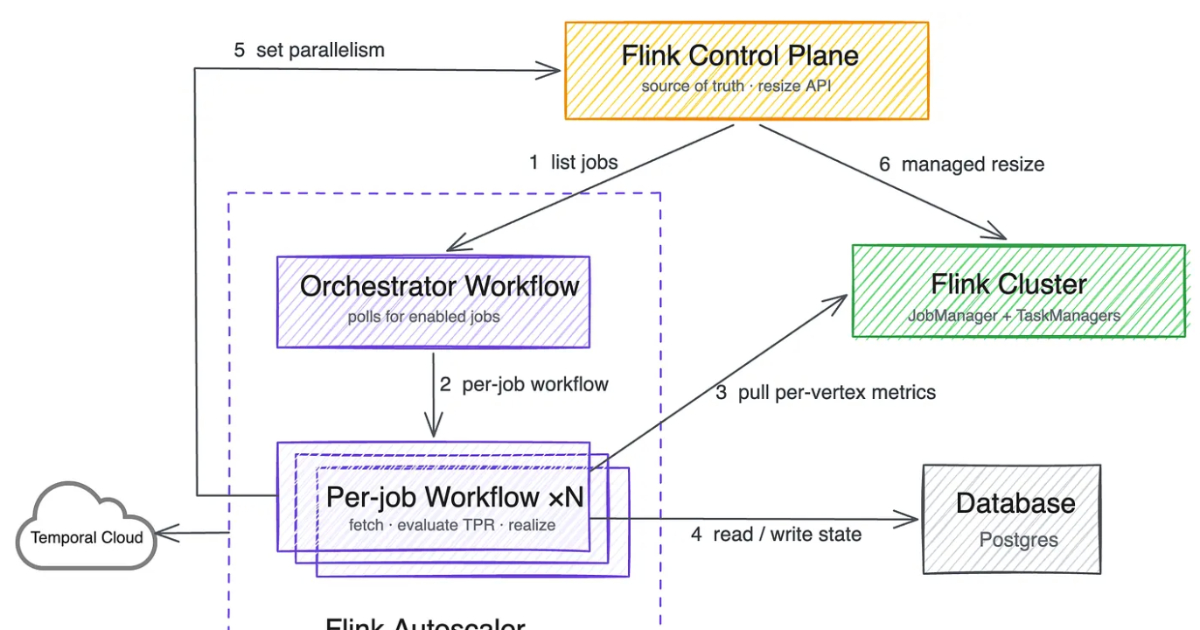
Netflix is moving toward the open-source Apache Flink Autoscaler for more than 30,000 streaming jobs across multiple AWS regions. The operator-level approach addresses limitations of Netflix’s cluster level autoscaler for complex, stateful pipelines. Netflix reports a 58% reduction in annualized Flink compute expenditure for one team, saving approximately $1.1 million annually.

By Leela Kumili
❌