Microsoft has made Azure Virtual Desktop Hybrid generally available. Session hosts run on customer hardware through Azure Arc while brokering stays in Azure. The Hybrid service license is unpriced, Windows Server support requires RDS CALs with Software Assurance, and multi-session Windows is not supported at all.
Standard chaos engineering assumes experiments stop cleanly, blast radius is knowable in advance, and production is fair game. Payment systems violate all three. Salim Adedeji describes ECS-specific failure modes from enterprise deployments: a 60-second DNS TTL that produced 93-second failover, retry logic amplifying database load 2.4x, and AZ rebalancing loops that generic tooling misses.
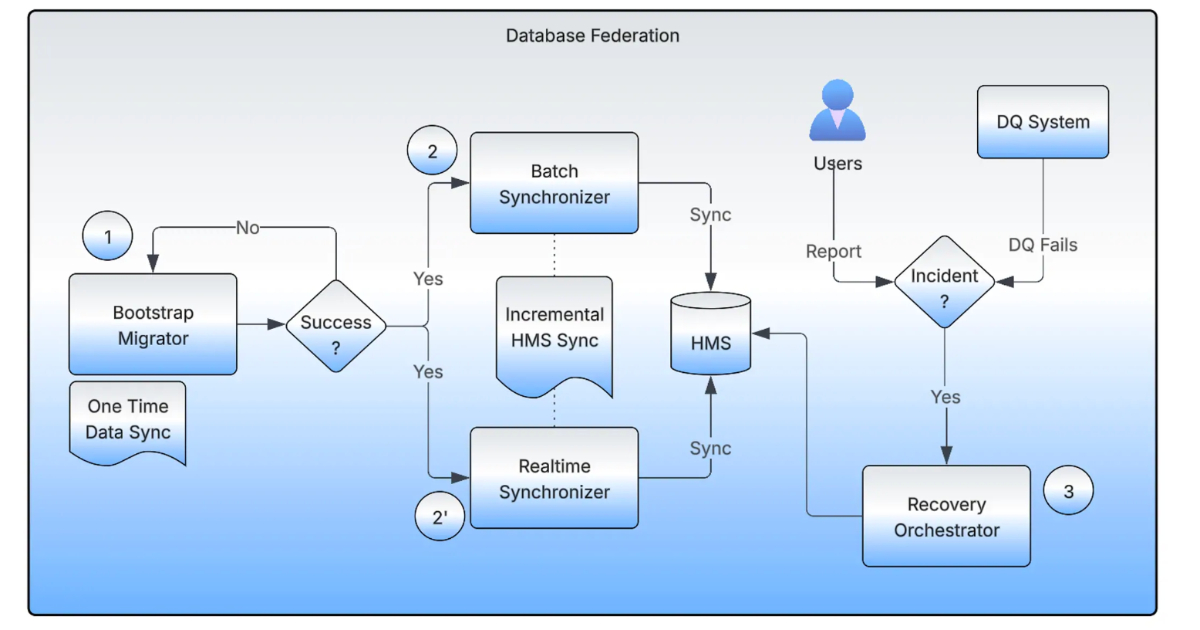
Uber has decentralized its Hive data warehouse, migrating 16,000 datasets totaling over 10 petabytes using pointer-based federation. The migration ensures zero downtime, strict ACL enforcement, improved governance, and scalable, domain-specific datasets for analytics and machine learning workloads.
A new open-source toolkit from Microsoft focuses on runtime security to force strict governance onto enterprise AI agents. The release tackles a growing anxiety: autonomous language models are now executing code and hitting corporate networks way faster than traditional policy controls can keep up.
AI integration used to mean conversational interfaces and advisory copilots. Those systems had read-only access to specific datasets, keeping humans strictly in the execution loop. Organisations are currently deploying agentic frameworks that take independent action, wiring these models directly into internal application programming interfaces, cloud storage repositories, and continuous integration pipelines.
When an autonomous agent can read an email, decide to write a script, and push that script to a server, stricter governance is vital. Static code analysis and pre-deployment vulnerability scanning just can’t handle the non-deterministic nature of large language models. One prompt injection attack (or even a basic hallucination) could send an agent to overwrite a database or pull out customer records.
Microsoft’s new toolkit looks at runtime security instead, providing a way to monitor, evaluate, and block actions at the moment the model tries to execute them. It beats relying on prior training or static parameter checks.
Intercepting the tool-calling layer in real time
Looking at the mechanics of agentic tool calling shows how this works. When an enterprise AI agent has to step outside its core neural network to do something like query an inventory system, it generates a command to hit an external tool.
Microsoft’s framework drops a policy enforcement engine right between the language model and the broader corporate network. Every time the agent tries to trigger an outside function, the toolkit grabs the request and checks the intended action against a central set of governance rules. If the action breaks policy (e.g. an agent authorised only to read inventory data tries to fire off a purchase order) the toolkit blocks the API call and logs the event so a human can review it.
Security teams get a verifiable, auditable trail of every single autonomous decision. Developers also win here; they can build complex multi-agent systems without having to hardcode security protocols into every individual model prompt. Security policies get decoupled from the core application logic entirely and are managed at the infrastructure level.
Most legacy systems were never built to talk to non-deterministic software. An old mainframe database or a customised enterprise resource planning suite doesn’t have native defenses against a machine learning model shooting over malformed requests. Microsoft’s toolkit steps in as a protective translation layer. Even if an underlying language model gets compromised by external inputs; the system’s perimeter holds.
Security leaders might wonder why Microsoft decided to release this runtime toolkit under an open-source license. It comes down to how modern software supply chains actually work.
Developers are currently rushing to build autonomous workflows using a massive mix of open-source libraries, frameworks, and third-party models. If Microsoft locked this runtime security feature to its proprietary platforms, development teams would probably just bypass it for faster, unvetted workarounds to hit their deadlines.
Pushing the toolkit out openly means security and governance controls can fit into any technology stack. It doesn’t matter if an organisation runs local open-weight models, leans on competitors like Anthropic, or deploys hybrid architectures.
Setting up an open standard for AI agent security also lets the wider cybersecurity community chip in. Security vendors can stack commercial dashboards and incident response integrations on top of this open foundation, which speeds up the maturity of the whole ecosystem. For businesses, they avoid vendor lock-in but still get a universally scrutinised security baseline.
The next phase of enterprise AI governance
Enterprise governance doesn’t just stop at security; it hits financial and operational oversight too. Autonomous agents run in a continuous loop of reasoning and execution, burning API tokens at every step. Startups and enterprises are already seeing token costs explode when they deploy agentic systems.
Without runtime governance, an agent tasked with looking up a market trend might decide to hit an expensive proprietary database thousands of times before it finishes. Left alone, a badly configured agent caught in a recursive loop can rack up massive cloud computing bills in a few hours.
The runtime toolkit gives teams a way to slap hard limits on token consumption and API call frequency. By setting boundaries on exactly how many actions an agent can take within a specific timeframe, forecasting computing costs gets much easier. It also stops runaway processes from eating up system resources.
A runtime governance layer hands over the quantitative metrics and control mechanisms needed to meet compliance mandates. The days of just trusting model providers to filter out bad outputs are ending. System safety now falls on the infrastructure that actually executes the models’ decisions
Getting a mature governance program off the ground is going to demand tight collaboration between development operations, legal, and security teams. Language models are only scaling up in capability, and the organisations putting strict runtime controls in place today are the only ones who will be equipped to handle the autonomous workflows of tomorrow.
Want to learn more about AI and big data from industry leaders? Check out AI & Big Data Expo taking place in Amsterdam, California, and London. The comprehensive event is part of TechEx and is co-located with other leading technology events including the Cyber Security & Cloud Expo. Click here for more information.
AI News is powered by TechForge Media. Explore other upcoming enterprise technology events and webinars here.
AI systems are starting to move beyond simple responses. In many organisations, AI agents are now being tested to plan tasks, make decisions, and carry out actions with limited human input. It is no longer just about whether a model gives the right answer. It is about what happens when that model is allowed to act.
Autonomous systems need clear boundaries. They need rules that define what they can access, what they are allowed to do, and how their actions are tracked. Without those controls, even well-trained systems can create problems that are hard to detect or reverse.
One company working on this problem is Deloitte. The firm has been developing governance frameworks and advisory approaches to help organisations manage AI systems.
From tools to AI agents
Most AI systems in use today still depend on human prompts. They generate text, analyse data, or make predictions, but a person usually decides what happens next. Agentic AI changes that pattern. These systems can break down a goal into steps, choose actions, and interact with other systems to complete tasks.
That added independence brings new challenges. When a system acts on its own, it may take paths that were not fully expected or use data in ways that were not intended.
Deloitte’s work focuses on helping organisations prepare for these risks. Rather than treating AI as a standalone tool, the firm looks at how it fits into business processes, including how decisions are made and how data flows through systems.
Building governance into the lifecycle
Governance should not be added after deployment. It needs to be built into the full lifecycle of an AI system.
This starts at the design stage. Organisations need to define what a system is allowed to do and where its limits are. This may include setting rules around data use and outlining how the system should respond in uncertain situations.
The next stage is deployment. At this point, governance focuses on access and control, including who can use the system and what it can connect to. Once the system is live, monitoring becomes the main concern. Autonomous systems can change over time as they interact with new data. Without regular checks, they may drift away from their original purpose.
The role of transparency and accountability
As AI systems take on more responsibility, it becomes more difficult to trace how decisions are made. This creates a demand for stronger transparency. Deloitte’s work highlights the importance of keeping track of how systems operate. This includes logging actions and documenting decisions. These records help organisations in determining what happened if something goes wrong. If an autonomous system takes an action, there needs to be clarity about who is responsible.
Research from Deloitte shows that adoption of AI agents is moving faster than the controls needed to manage them. Around 23% of companies already use them, and that figure is expected to reach 74% within two years. Only 21% report having strong safeguards in place to oversee how they behave.
Real-time oversight for AI agents
Once an autonomous system is active, the focus shifts to how it behaves in real-world conditions. Static rules are not always enough, and systems need to be observed as they operate.
Deloitte’s approach includes real-time monitoring, allowing organisations to track what an AI system is doing as it performs tasks. If the system behaves in an unexpected way, teams can step in quickly. This may involve pausing certain actions or adjusting permissions. Real-time oversight also helps with compliance. In regulated industries, companies need to show that systems follow rules and standards.
In practice, these controls are starting to appear in operational settings. Deloitte describes scenarios where AI systems monitor equipment performance across sites. Sensor data can signal early signs of failure, which can trigger maintenance workflows and update internal systems. Governance frameworks define what actions the system can take, when human approval is required, and how decisions are recorded. The process runs across multiple systems, but from a user’s point of view, it appears as a single action.
Governance is part of discussions at AI & Big Data Expo North America 2026, taking place on May 18–19 in Santa Clara, California. Deloitte is listed as a Diamond Sponsor for the event, placing it among the firms contributing to conversations around how autonomous systems are deployed and controlled in practice.
The challenge is not just building smarter systems, but ensuring they behave in ways organisations can understand, manage, and trust over time.
Want to learn more about AI and big data from industry leaders? Check out AI & Big Data Expo taking place in Amsterdam, California, and London. The comprehensive event is part of TechEx and is co-located with other leading technology events, click here for more information.
AI News is powered by TechForge Media. Explore other upcoming enterprise technology events and webinars here.
GitHub will use Copilot interaction data from Free, Pro, and Pro+ users to train AI models starting April 24, opting in by default. Collected data includes code snippets, inputs, outputs, and navigation patterns from active sessions, including private repos. Business and Enterprise tiers are excluded. Community concerns include dark patterns, IP exposure, and GDPR compliance.

 Login
Login