❌

Reading view

Presentation: A Solopreneur's Journey: From Engineer to Puzzle Master and Storyteller

Joe Cassavaugh shares his journey from software engineer to successful solopreneur with a $2M+ indie franchise. He explains how he scaled production to 10 games in 5 years, adopted Unity to boost velocity 4-6x, optimized content pipelines, and leveraged refactoring patterns. He discusses key trade-offs between corporate engineering and solopreneurship for senior devs and leaders.

By Joe Cassavaugh

  •  

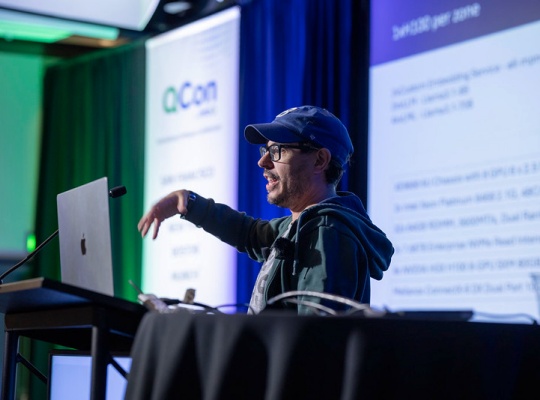
Presentation: Realtime and Batch Processing of GPU Workloads

Joseph Stein discusses engineering an enterprise AI-as-a-Service platform within a private cloud data center. He explains how to maximize underutilized GPU pools via multi-namespace scheduling, leverage Valkey and Lua for atomic priority queuing and backpressure management, mitigate OWASP Top 10 LLM risks via central proxy gateways, and scale batch pipelines using a custom S3-to-Kafka proxy.

By Joseph Stein
  •  

Presentation: Choosing Your AI Copilot: Maximizing Developer Productivity

Sepehr Khosravi discusses the current state of AI-assisted coding, moving beyond basic autocompletion to sophisticated agentic workflows. He explains the technical nuances of Cursor’s "Composer" and Claude Code’s research capabilities, providing tips for managing context windows and MCP integrations. He shares lessons from industry leaders on shrinking process time beyond just writing code.

By Sepehr Khosravi
  •  

Presentation: When Every Bit Counts: How Valkey Rebuilt Its Hashtable for Modern Hardware

Madelyn Olson discusses the evolution of Valkey's data structures, moving away from "textbook" pointer-chasing HashMaps to more cache-aware designs. She explains the implementation of "Swedish" tables to maximize memory density. She shares insights on systems intuition, memory prefetching, and the rigorous testing needed for mission-critical caches.

By Madelyn Olson
  •  

Presentation: Directing a Swarm of Agents for Fun and Profit

Adrian Cockcroft explains the transition from cloud-native to AI-native development. He shares his "director-level" approach to managing swarms of autonomous agents using tools like Cursor and Claude Flow. Discussing real-world experiments in BDD, MCP servers, and language porting, he discusses why the future of engineering lies in building platforms that orchestrate AI-driven development.

By Adrian Cockcroft
  •  
❌