❌

Reading view

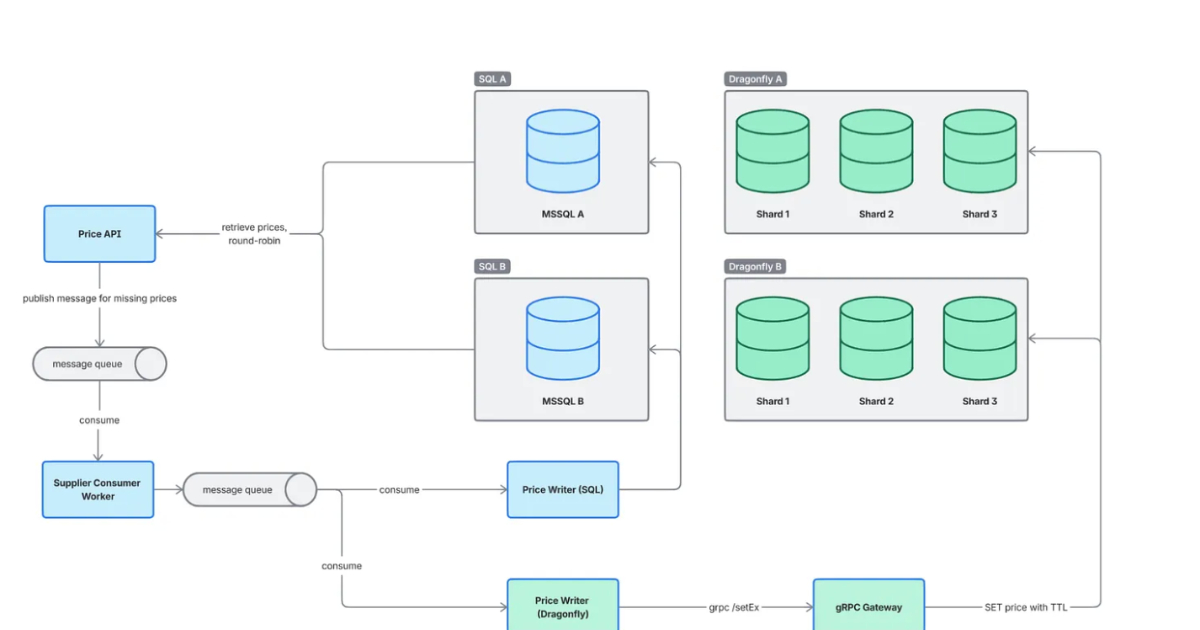
Agoda Replaces 72-Shard SQL Server Price Cache with DragonflyDB

Agoda migrated its 1.5 TB hotel Price Cache from 72 SQL Server shards to DragonflyDB to handle growing read and write volumes. The migration used staged dual reads, parity validation, gradual traffic shifting, and decentralized failover detection. Agoda reports an approximately eightfold reduction in P99 read latency, with two DragonflyDB clusters providing high availability.

By Leela Kumili
  •  

When Does AI Augment Work? A Workflow-Level Framework for Human-Agent Collaboration

arXiv:2609.12482v1 Announce Type: new Abstract: We aim to characterise the value of artificial intelligence in the workplace. Current studies largely measure this value in terms of the current automation capabilities and public adoption of AI. However, such metrics ignore the greater impacts of human--agent collaboration in transforming the nature of work. To account for this, we must expand the scope of our analysis beyond atomised tasks of today, and instead focus on how AI can augment entire workflows of the future. To ground this analysis, we establish a precise definition of AI augmentation comprising six conditions, spanning durable net value, meaningful human control, accountability and recovery, and long-term human development through learning, career pathways, and job purpose. We elaborate on these conditions and apply the framework in a case study of AI-mediated social surveys. We conclude by outlining how organisations, researchers, and government leaders can use this framework to make sense of the future of work.
  •  

Confidence-Gated Transductive Test Generation for Code Reranking

arXiv:2609.12489v1 Announce Type: new Abstract: Test case synthesis is crucial for evaluating and ranking programs generated by large language models (LLMs). However, constructing high-quality test cases remains challenging because reliable expected outputs are often difficult to obtain. We propose Confidence-Gated Transductive Test Generation (CoTT), which first uses an efficient inductive procedure and invokes transductive generation only when inductive confidence is low. This adaptive design improves output reliability while allocating extra computation only when needed. On code reranking benchmarks, CoTT outperforms prior baselines across the reported metrics while reducing cost relative to applying transductive generation to every input. These results show that confidence-based allocation of test-time computation provides a favorable efficiency-effectiveness trade-off with a single efficient LLM.
  •  

MPT: Missing Prototype Tracking via Barycentric Reconstruction in Vehicular Federated Learning

arXiv:2609.12771v1 Announce Type: new Abstract: Cross-vehicle federated learning enables vehicles to collaboratively improve perception models while keeping locally collected driving data private. However, vehicle participation is transient, and a vehicle may depart before training converges while permanently taking its local data. When this departing vehicle holds most samples of a target class, the class becomes rare in the remaining FL network, and its recognition can silently degrade as the shared backbone continues to evolve. Recovering the class is difficult since the few remaining samples provide a noisy prototype estimate, while FL privacy constraints prevent centralized access to raw data or per-sample features. This paper presents MPT, a cross-vehicle FL framework that maintains rare-class recognition by reconstructing its prototype at every round from privacy-preserving class-level statistics. MPT combines a barycentric decomposition that tracks drift shared with remaining-class prototypes, a covariance-based residual prediction that estimates out-of-span drift, and an adaptive calibration that weighs the remaining rare-class samples according to their reliability. We evaluate MPT on three vehicle classification tasks and four backbones against representative calibration and drift-compensation baselines. MPT outperforms all baselines in rare class F1, reaching 0.516 on the nuImages dataset with only 1\% of rare-class samples remaining, without raw data, per-sample features, or retraining.
  •  

Agentic TCAD Calibration Workflow for Oxide Semiconductor Transistors

arXiv:2609.12184v1 Announce Type: cross Abstract: Experimental TCAD calibration is essential for predictive technology modeling of emerging oxide semiconductor transistors. However, it remains time-consuming and expert dependent because of model ambiguity. Multiple physical models and parameter sets can reproduce the same measured transfer characteristics, while local fitting alone cannot uniquely identify the underlying device physics. We present the first demonstration of an agentic TCAD calibration workflow for a fabricated bottom-gate In--W--O (BG-IWO) transistor. Starting from the measured transfer curve and device information, the workflow uses measurement--TCAD residuals and local sensitivity tests to select bounded parameter corrections or evaluate additional physical models, and accept only updates that improve device metrics. The LLM agent orchestrates the workflow, while Sentaurus governs the device physics. For the 2\%-W reference device, five agent-suggested updates yield a fixed calibrated model, reducing the multi-metric device objective $J$ by 14.3$\times$. Maximum $V_{\mathrm{th}}$/$I_{\mathrm{on}}$ errors are 36.1~mV/0.022 decade for varying-drain-bias tests and 46.2~mV/0.062 decade for varying-channel-length tests, demonstrating model transferability across bias and geometry rather than a local parameter fit. W-composition tests provide process-sensitive insight. This agentic workflow provides a faster route to model development for emerging device technologies.
  •  

Clustering-Based Balanced Sampling and Allocation with Data Parallelism for High-Performance Fine-Tuning

arXiv:2609.12584v1 Announce Type: cross Abstract: Instruction-tuning datasets for large language models (LLMs) are often large, redundant, and imbalanced, limiting efficient adaptation. Naive large-batch fine-tuning repeatedly includes overrepresented sample groups while weakly covering underrepresented but informative ones, especially under data parallelism (DP) across multiple GPUs. We propose CluSTER, a Cluster-aware balanced Sampling framework for Training Efficient data Reduction in DP instruction tuning. CluSTER curates a representative reduced dataset through gradient-space clustering and DP-aware balanced allocation, ensuring dual-level coverage across clusters and workers, while preserving the original data distribution by weighted update. As a result, CluSTER reduces redundant computation and improves training stability without compromising model quality. Across multiple instruction-tuning datasets, CluSTER reduces training time by up to 69.6% with almost no accuracy loss compared to prior sampling and data reduction methods. Code is available at https://github.com/kaist-dmlab/CluSTER.
  •  

Explaining Time Series Forecasting with Horizon-Resolved Attribution

arXiv:2609.12639v1 Announce Type: cross Abstract: Recent advances in explaining time series (TS) models have produced methods that identify which past values a prediction depends on. However, most existing methods return a single importance vector, assuming that every predicted step depends on the same past values. In this paper, we show that this assumption does not hold, as different forecast steps depend on different past values. Motivated by this observation, we propose Horizon-Resolved eXplanation (HRX), which adds a horizon axis to the explanation, so that every forecast step receives its own importance map. HRX is a simple yet effective plug-in framework with three components: 1) an estimator that reads these maps out of any differentiable forecaster without modifying the TS backbone, 2) an evaluation protocol that validates the horizon axis by measuring how much a single forecast step changes when the inputs an importance map ranks highest are removed, and 3) a rank criterion that predicts in advance whether the axis is worth resolving on a given TS. We further show that this step-wise dependence is low-dimensional, as the explanations of all steps are built from a few shared maps whose number does not grow with the forecast length. Extensive experiments across various backbones and datasets show that the improvement comes from the horizon axis and holds for estimators of previous explanation methods. Code is available at https://github.com/seunghan96/HRX.
  •  

Dynin-Robotics: Omnimodal Unified Diffusion Vision-Language-Action Model

arXiv:2609.13053v1 Announce Type: cross Abstract: Visual goal and dynamics prediction can provide language-conditioned robot policies with both a target outcome and a representation of action-dependent scene changes. We bring these predictions into action generation and selection through a shared trajectory model. Dynin-Robotics implements this formulation on Dynin-Omni, an omnimodal masked-diffusion backbone, representing language, visual observations, goals, and actions as discrete tokens. By varying conditioning and target spans, the same model learns action prediction, action-conditioned next-observation prediction, terminal goal-state prediction, and trajectory-to-instruction reconstruction. These interfaces support test-time scaling through goal prediction, action-candidate evaluation, and joint refinement of action and future-state predictions. We continually pretrain the model on approximately 1.33 million trajectories from 48 Open X-Embodiment datasets and adapt it separately to downstream domains. On two VLABench tasks, robot pretraining improves adaptation within a fixed Stage-2 step budget, and the full objective mixture improves shifted-instruction success over Policy-only post-training under the same coupled decoder. Combining goal guidance with joint action-next-state denoising further improves shifted-instruction success over action-only decoding; the benefit depends on how the predictions are composed. Dynin-Robotics achieves competitive performance on LIBERO and zero-shot LIBERO-Plus, together with a 78.4% average success rate across four manipulation conditions on a Franka Research 3 robot. An optimized block-parallel implementation accelerates model-side action decoding by up to 29.2x relative to the base implementation under the reported profiling setup. These results support shared trajectory modeling as a common interface for learning complementary robot objectives and composing their predictions during control.
  •  

MP-Bench: Evaluating Voice Agents as a Multiparty Conversation Participant

arXiv:2609.13076v1 Announce Type: cross Abstract: Conversational voice agents have advanced significantly, offering increasingly natural human-machine interactions through both cascaded and end-to-end architectures. However, while recent benchmarks extensively evaluate dyadic interactions and passive audio comprehension, they largely overlook a prevalent real-world scenario: multi-party conversations. Evaluating agents in these settings is fundamentally more challenging than in dyadic interactions due to the exponentially greater conversational complexity. For voice agents to integrate seamlessly into human group dynamics, they must not only generate contextually appropriate responses but also demonstrate a nuanced understanding of open turn-taking. To address this gap, we introduce Multiparty Bench (MP-Bench), the first benchmark specifically designed to objectively evaluate conversational speech systems as active participants within multi-party contexts. MP-Bench assesses agent behavior along two primary dimensions: turn-taking awareness and response appropriateness. Additionally, we incorporate comprehension-based question-answering tasks as a complementary evaluation. By benchmarking 12 voice agents, we find that real-time voice agents stay at or below 22% on multiparty comprehension and remain near chance on multiparty turn-taking, exposing an open challenge for real-time voice agents under multiparty scenario.
  •  

PCBWorld: A Benchmark Environment for Engine-Grounded PCB Design Automation

arXiv:2607.05915v4 Announce Type: replace Abstract: PCB routing is the task of connecting the nets of a board with copper traces under strict design rules, yet learning-based methods still lag behind rule-based routers. We introduce PCBWorld, an open-source engine-grounded PCB routing environment built on KiCad, an electronic design automation (EDA) engine. As a human engineer does, agents in PCBWorld interactively route a board through the engine's native operations, guided by its Design Rule Check (DRC) feedback. The environment supports both RL and tool-using LLM agents. Alongside the environment, PCBWorld-Bench provides three board datasets in the native .kicad_pcb format, two controllable synthetic generators and 679 real open-source boards. It scores any completed board with eight engine-checked evaluation metrics, regardless of the routing method. In our experiments, agents in PCBWorld consistently outperformed grid-action RL policies and open-loop LLM baselines, and an RL policy trained only on synthetic boards transferred zero-shot to real boards, approaching rule-based routers. PCBWorld and PCBWorld-Bench are available at https://github.com/LGAI-Research/PCBWorld.
  •  

TestDG: Test-time Domain Generalization for Continual Test-time Adaptation

arXiv:2504.04981v3 Announce Type: replace-cross Abstract: This paper studies continual test-time adaptation (CTTA), the task of adapting a model to constantly changing unseen domains in testing while preserving previously learned knowledge. Existing CTTA methods mostly focus on adaptation to the current test domain only, overlooking generalization to arbitrary test domains a model may face in the future. To tackle this limitation, we present a novel online test-time domain generalization framework for CTTA, dubbed TestDG. TestDG aims to learn features invariant to both current and previous test domains on the fly during testing, improving the potential for effective generalization to future domains. To this end, we propose a new model architecture and a test-time adaptation strategy dedicated to learning domain-invariant features, along with prototype selection and update mechanisms for effectively managing information from previous test domains. TestDG achieved state of the art on four public CTTA benchmarks. Moreover, it showed superior generalization to unseen test domains.
  •  

Representation Before Training: A Practical Benchmark for Generative Medical Event Model Tokenization

arXiv:2604.16775v2 Announce Type: replace-cross Abstract: Generative medical event models use tokenized sequences of patient timelines as input, but practical guidance on the many decisions around tokenization is limited. We benchmark quantization granularity, reference-range anchoring, code--value fusion, numeric and temporal encodings, and native versus harmonized event representations from an expert-mapped common data model. Using both Llama and Qwen architectures, 156 models were trained from three initialization seeds, with each configuration following a shared training recipe for up to five epochs. We evaluated learned representations from the first 24 hours of hospitalization with linear probes to predict binary and continuous outcomes during hours 24-48. Fused tokens pairing codes with value deciles increased performance across all eight outcome families relative to the equivalent unfused tokenized input with area under the receiver operating characteristic curve (AUROC) gains of $+0.002$ to $+0.033$ and Spearman correlation gains of $+0.025$ to $+0.114$. Neither anchoring value bins to reference ranges nor increasing quantization granularity consistently improved performance, while xVal variants underperformed both discrete and soft encodings. Alternatives to explicit time tokens, such as event-order and admission-relative rotary position embeddings (RoPE), yielded higher family-mean point estimates across all eight families while reducing input length. When evaluating native input against input mapped to the Common Longitudinal Intensive Care Unit Data Format (CLIF), the CLIF pipeline used 30.8\% as many training tokens while improving performance in six of eight outcome families. These findings show tokenization and event encoding are consequential design choices when learning patient representations for downstream classification and regression.
  •  

ShadowPEFT: Shadow Network for Parameter-Efficient Fine-Tuning

arXiv:2604.19254v2 Announce Type: replace-cross Abstract: Popular low-rank parameter-efficient fine-tuning (PEFT) methods represent adaptation as separate updates to selected backbone weights, without maintaining an explicit task-specific state that is updated and reused across depth. These updates also require the backbone at inference and therefore cannot operate as standalone predictors. We propose ShadowPEFT, which consolidates trainable adaptation into a modular shadow component centered on a compact shadow model and lightweight Transformer layer-specific coupling modules. A persistent shadow state refines the frozen backbone representations and is updated from them in an interactive manner. Because the shadow model is trained as a complete predictor, it can be detached for shadow-only inference without executing the base model and can be initialized from a pretrained model. Experiments on text and image generation and understanding benchmarks show that ShadowPEFT matches or outperforms LoRA and DoRA under comparable trainable-parameter budgets. Additional analyses on shadow pretraining, cross-dataset transfer, parameter scaling, inference latency, and system-level evaluation suggest that centralized layer-space adaptation is a competitive and flexible alternative to conventional low-rank PEFT.
  •  

ReasoningFlow: Discourse Structures for Understanding LLM Reasoning Traces

arXiv:2606.05402v2 Announce Type: replace-cross Abstract: Large reasoning models (LRMs) produce reasoning traces with non-linear structures, such as backtracking and self-correction, that complicate the evaluation and monitoring of the reasoning process. We introduce ReasoningFlow, a framework that captures the discourse structures of LRM reasoning traces into fine-grained directed acyclic graphs (DAGs). We develop and validate our annotation schema through careful manual annotation of 31 traces (2.1k steps), achieving high inter-annotator agreement, then scale to automatic annotation of 1,260 traces (247.7k steps) spanning three tasks (math, science, argumentation) and five models (Qwen2.5-32B-Inst, QwQ-32B, DeepSeek-V3, DeepSeek-R1, GPT-oss-120B). By analyzing ReasoningFlow graphs, we find: (1) LRMs exhibit structurally similar traces, despite being trained from different base models and potentially non-overlapping post-training data. (2) ReasoningFlow reveals diverse fine-grained reasoning behaviors (e.g., local verification, self-reflection, and assumptions) that can be used for better reasoning trace monitorability. (3) In LRMs, most of the erroneous steps are not used to derive final answers. (4) Mechanistic causal dependencies between steps do not reflect the language-level discourse structure. We release the dataset and code in: https://github.com/jinulee-v/reasoningflow.

  •  

ProPS: Prompted Profile Synthesis for Natural Language-Conditioned Speaker Embedding Distributions

arXiv:2607.05276v2 Announce Type: replace-cross Abstract: Speaker embeddings, or x-vectors, are widely used to represent speaker identity and speaker-related attributes, but existing embedding extractors are typically descriptive rather than generative: they map an observed speech segment to an x-vector, which is then used for downstream applications. We introduce ProPS, Prompted Profile Synthesis, a framework for generating distributions of speaker embeddings conditioned on natural language prompts such as "a thirties male speaker with an Indian accent". ProPS converts human-written profile descriptions into sentence embeddings and uses a mixture density network trained on a large-scale dataset to predict a Gaussian mixture model in the x-vector space. The model is trained by maximizing the likelihood that real speaker embeddings match the requested profile, and its generated distributions are evaluated by negative log-likelihood on held-out x-vectors and by attribute classification accuracies on sampled synthetic x-vectors. Experiments show that ProPS produces profile-conditioned distributions and generates x-vectors that preserve requested speaker attributes such as age, gender, accent, and prosodic characteristics. This design enables controllable speaker-profile synthesis for speech generation systems like Text-To-Speech (TTS) or Voice Conversion (VC) while anchoring generated distributions in observed speaker-embedding structure.
  •  

Can Foundation Models Moderate Online Content? Evaluating Instruction- vs. Example-Driven Policy Operationalization

arXiv:2609.10410v2 Announce Type: replace-cross Abstract: The growing complexity of content moderation policies presents a critical challenge for their consistent operationalization. While foundation models possess the basic capabilities needed to confront this challenge, whether they can reliably moderate online content remains an unanswered question. In this paper, we systematically compare two competing paradigms for Vision-Language Model (VLM) guidance: an instruction-driven approach where models reason from policy precepts, and an example-driven approach where they generalize from prior precedents. We ground this investigation in ModerationBench, a new benchmark of 4,000 manually annotated, in-the-wild posts from the Bluesky platform. Our experiments reveal that foundation models can substantially outperform Bluesky's deployed moderation system, nearly tripling its $F_1$ score (0.60 vs. 0.22) on Random Posts in the benchmark, with both instruction- and example-driven paradigms achieving comparable peak effectiveness. Our findings thus chart a path toward reliable and adaptable policy operationalization at scale.
  •  

Publisher Correction: A scoping review on the mental health harms of LLM-based chatbots

npj Digital Medicine, Published online: 14 September 2026; doi:10.1038/s41746-026-03240-x

Publisher Correction: A scoping review on the mental health harms of LLM-based chatbots
  •  

High-resolution intrinsically stretchable quantum-dot displays through thermally assisted intaglio transfer printing

Nature Nanotechnology, Published online: 14 September 2026; doi:10.1038/s41565-026-02272-4

Innovative ligand engineering and thermally assisted intaglio transfer printing enhance charge injection and pixel resolution in stretchable quantum-dot light-emitting diodes, achieving high efficiencies and luminance while maintaining mechanical integrity under deformation.
  •  

Single-gate, multipartite entanglement on a room-temperature quantum register

Nature Nanotechnology, Published online: 14 September 2026; doi:10.1038/s41565-026-02254-6

This work demonstrates a parallelized four-qubit entangling gate on a room-temperature spin register, and it operates ten times faster than sequences of two-qubit gates with reduced errors.
  •  
❌