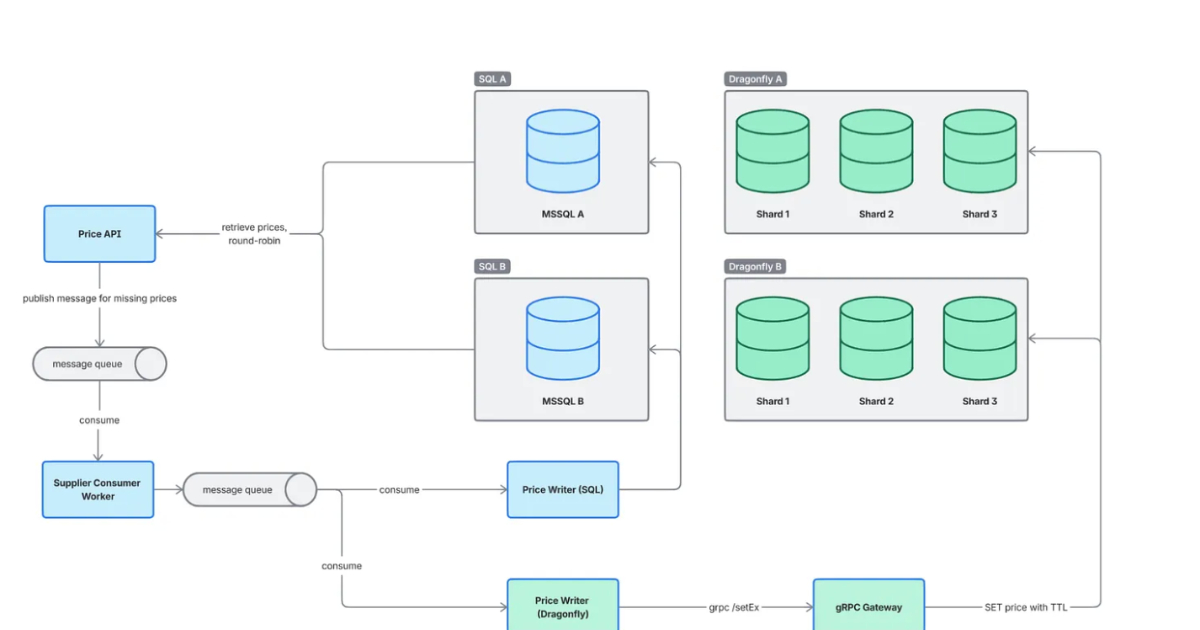
Agoda migrated its 1.5 TB hotel Price Cache from 72 SQL Server shards to DragonflyDB to handle growing read and write volumes. The migration used staged dual reads, parity validation, gradual traffic shifting, and decentralized failover detection. Agoda reports an approximately eightfold reduction in P99 read latency, with two DragonflyDB clusters providing high availability. By Leela Kumili
Agoda migrated its 1.5 TB hotel Price Cache from 72 SQL Server shards to DragonflyDB to handle growing read and write volumes. The migration used staged dual reads, parity validation, gradual traffic shifting, and decentralized failover detection. Agoda reports an approximately eightfold reduction in P99 read latency, with two DragonflyDB clusters providing high availability.
Coca-Cola is using AI to recommend which products Malaysian retailers should order and in what quantities through its Coke Buddy platform.
The Perfect Basket feature uses Coca-Cola’s Central Recommendation Engine to analyse previous orders, ordering frequency, seasonality, weather, and purchasing patterns among similar businesses.
Coca-Cola said Coke Buddy currently supports about 39,000 retail outlets across Malaysia. The company describes Coke Buddy as a self-ordering platform that allow
Coca-Cola is using AI to recommend which products Malaysian retailers should order and in what quantities through its Coke Buddy platform.
The Perfect Basket feature uses Coca-Cola’s Central Recommendation Engine to analyse previous orders, ordering frequency, seasonality, weather, and purchasing patterns among similar businesses.
Coca-Cola said Coke Buddy currently supports about 39,000 retail outlets across Malaysia. The company describes Coke Buddy as a self-ordering platform that allows retailers to buy products through its app, website, or WhatsApp, with personalised order suggestions and order tracking also available.
Perfect Basket builds on those existing ordering functions by recommending both products and quantities before a retailer completes an order. Retailers can review the recommendations and retain control over what they purchase.
How Perfect Basket guides retailer orders
Coke Buddy already uses previous purchase history to suggest products a retailer is likely to order again. Perfect Basket adds other signals, including seasonality, weather, ordering frequency, and purchasing trends among comparable businesses.
Perfect Basket recommends products and quantities before retailers submit their orders through Coke Buddy. Fulfilment is handled separately by Coca-Cola Refreshments Malaysia or its suppliers under existing sales and distribution arrangements.
Coca-Cola said its sales teams remain involved with retailers alongside the digital ordering system, while retailers retain control over the final purchasing decision.
Coca-Cola recently disclosed usage figures for Perfect Basket following its Perfect Basket, Perfect Ride campaign, which ran from January to April 2026. The campaign encouraged retailers to use the recommendation feature when placing orders and received more than 4,500 entries from over 4,000 retailers in Malaysia.
During the campaign, 83% of participating outlets adopted Perfect Basket recommendations, according to Coca-Cola. The figure applies only to retailers taking part in the campaign, not the full network of about 39,000 outlets supported by Coke Buddy.
Coca-Cola also said participating outlets that followed the recommendations recorded higher sales revenue growth than comparable retail outlets. The company did not disclose the size of the difference or provide detailed performance data showing how individual recommendations affected sales or inventory levels.
The available Malaysian campaign data does not provide figures for forecast accuracy, stock availability, inventory levels, or logistics costs.
Suggested orders extend beyond Malaysia
Coca-Cola has deployed similar suggested-order capabilities elsewhere in its bottling network. In its first-quarter 2024 results, the company said it and its bottling partners had connected nearly eight million customers to B2B platforms globally, while AI-enabled suggested-order capabilities had reached more than three million outlets in Latin America.
Coca-Cola has said these systems combine customer data, external information, and AI to generate predictive order recommendations. Then-chief executive James Quincey said in 2024 that digital ordering also allows retailers to adjust deliveries without waiting for a salesperson to visit.
Coca-Cola has also linked suggested orders to changes in its sales process. Quincey said AI-generated orders allow pre-sales staff to spend less time taking routine orders and more time on account development, while retailers continue to make the final purchasing decision.
Coca-Cola has reported results from earlier pilots using similar recommendation systems. In its second-quarter 2024 earnings call, the company said retailers receiving AI-generated product recommendations based on previous orders and market data were more than 30% more likely to purchase the recommended SKUs in initial pilots. These results did not relate specifically to Perfect Basket in Malaysia.
In a separate demand-prediction project, Coca-Cola combined historical sales data with weather and geolocation information to generate replenishment recommendations. CIO Neeraj Tolmare told Fortune in 2025 that a three-country pilot recorded sales 7% to 8% higher than outlets that were not using the AI algorithm.
Perfect Basket remains available after the campaign. Coca-Cola said it plans to continue developing Coke Buddy and the recommendation feature using retailer feedback and data, while retailers will continue to have access to the company’s sales representatives alongside the digital ordering system.
Want to learn more about AI and big data from industry leaders? Check out AI & Big Data Expo taking place in Amsterdam, California, and London. The comprehensive event is part of TechEx and is co-located with other leading technology events including the Cyber Security & Cloud Expo. Click here for more information.
AI News is powered by TechForge Media. Explore other upcoming enterprise technology events and webinars here.
Zhou Yu discusses why AI agents stall in demo phase and shares how simulation-driven testing solves compliance and reliability bottlenecks. Learn how Columbia and Arklex AI use synthetic user personas, trajectory entropy, and automated CI/CD pipelines to evaluate multi-turn agents, catch edge cases before deployment, and scale self-learning workflows in production. By Zhou Yu
Zhou Yu discusses why AI agents stall in demo phase and shares how simulation-driven testing solves compliance and reliability bottlenecks. Learn how Columbia and Arklex AI use synthetic user personas, trajectory entropy, and automated CI/CD pipelines to evaluate multi-turn agents, catch edge cases before deployment, and scale self-learning workflows in production.
Some lawmakers are calling for widespread reforms following years of surveillance scandals and abuses across successive U.S. administrations. But even if the spy law known as Section 702 expires in April, the government's spy powers will not automatically lapse.
Some lawmakers are calling for widespread reforms following years of surveillance scandals and abuses across successive U.S. administrations. But even if the spy law known as Section 702 expires in April, the government's spy powers will not automatically lapse.
The Etsy engineering team recently described how the company migrated its long-running MySQL sharding infrastructure to Vitess. The transition moved shard routing from Etsy’s internal systems to Vitess using vindexes, enabling capabilities such as resharding data and sharding previously unsharded tables. By Renato Losio
The Etsy engineering team recently described how the company migrated its long-running MySQL sharding infrastructure to Vitess. The transition moved shard routing from Etsy’s internal systems to Vitess using vindexes, enabling capabilities such as resharding data and sharding previously unsharded tables.
To protect enterprise margins, business leaders must invest in robust AI governance to securely manage AI infrastructure.
When evaluating enterprise software adoption, a recurring pattern dictates how technology matures across industries. As Rob Thomas, SVP and CCO at IBM, recently outlined, software typically graduates from a standalone product to a platform, and then from a platform to foundational infrastructure, altering the governing rules entirely.
At the initial product stage, exert
To protect enterprise margins, business leaders must invest in robust AI governance to securely manage AI infrastructure.
When evaluating enterprise software adoption, a recurring pattern dictates how technology matures across industries. As Rob Thomas, SVP and CCO at IBM, recently outlined, software typically graduates from a standalone product to a platform, and then from a platform to foundational infrastructure, altering the governing rules entirely.
At the initial product stage, exerting tight corporate control often feels highly advantageous. Closed development environments iterate quickly and tightly manage the end-user experience. They capture and concentrate financial value within a single corporate entity, an approach that functions adequately during early product development cycles.
However, IBM’s analysis highlights that expectations change entirely when a technology solidifies into a foundational layer. Once other institutional frameworks, external markets, and broad operational systems rely on the software, the prevailing standards adapt to a new reality. At infrastructure scale, embracing openness ceases to be an ideological stance and becomes a highly practical necessity.
AI is currently crossing this threshold within the enterprise architecture stack. Models are increasingly embedded directly into the ways organisations secure their networks, author source code, execute automated decisions, and generate commercial value. AI functions less as an experimental utility and more as core operational infrastructure.
The recent limited preview of Anthropic’s Claude Mythos model brings this reality into sharper focus for enterprise executives managing risk. Anthropic reports that this specific model can discover and exploit software vulnerabilities at a level matching few human experts.
In response to this power, Anthropic launched Project Glasswing, a gated initiative designed to place these advanced capabilities directly into the hands of network defenders first. From IBM’s perspective, this development forces technology officers to confront immediate structural vulnerabilities. If autonomous models possess the capability to write exploits and shape the overall security environment, Thomas notes that concentrating the understanding of these systems within a small number of technology vendors invites severe operational exposure.
With models achieving infrastructure status, IBM argues the primary issue is no longer exclusively what these machine learning applications can execute. The priority becomes how these systems are constructed, governed, inspected, and actively improved over extended periods.
As underlying frameworks grow in complexity and corporate importance, maintaining closed development pipelines becomes exceedingly difficult to defend. No single vendor can successfully anticipate every operational requirement, adversarial attack vector, or system failure mode.
Implementing opaque AI structures introduces heavy friction across existing network architecture. Connecting closed proprietary models with established enterprise vector databases or highly sensitive internal data lakes frequently creates massive troubleshooting bottlenecks. When anomalous outputs occur or hallucination rates spike, teams lack the internal visibility required to diagnose whether the error originated in the retrieval-augmented generation pipeline or the base model weights.
Integrating legacy on-premises architecture with highly gated cloud models also introduces severe latency into daily operations. When enterprise data governance protocols strictly prohibit sending sensitive customer information to external servers, technology teams are left attempting to strip and anonymise datasets before processing. This constant data sanitisation creates enormous operational drag.
Furthermore, the spiralling compute costs associated with continuous API calls to locked models erode the exact profit margins these autonomous systems are supposed to enhance. The opacity prevents network engineers from accurately sizing hardware deployments, forcing companies into expensive over-provisioning agreements to maintain baseline functionality.
Why open-source AI is essential for operational resilience
Restricting access to powerful applications is an understandable human instinct that closely resembles caution. Yet, as Thomas points out, at massive infrastructure scale, security typically improves through rigorous external scrutiny rather than through strict concealment.
This represents the enduring lesson of open-source software development. Open-source code does not eliminate enterprise risk. Instead, IBM maintains it actively changes how organisations manage that risk. An open foundation allows a wider base of researchers, corporate developers, and security defenders to examine the architecture, surface underlying weaknesses, test foundational assumptions, and harden the software under real-world conditions.
Within cybersecurity operations, broad visibility is rarely the enemy of operational resilience. In fact, visibility frequently serves as a strict prerequisite for achieving that resilience. Technologies deemed highly important tend to remain safer when larger populations can challenge them, inspect their logic, and contribute to their continuous improvement.
Thomas addresses one of the oldest misconceptions regarding open-source technology: the belief that it inevitably commoditises corporate innovation. In practical application, open infrastructure typically pushes market competition higher up the technology stack. Open systems transfer financial value rather than destroying it.
As common digital foundations mature, the commercial value relocates toward complex implementation, system orchestration, continuous reliability, trust mechanics, and specific domain expertise. IBM’s position asserts that the long-term commercial winners are not those who own the base technological layer, but rather the organisations that understand how to apply it most effectively.
We have witnessed this identical pattern play out across previous generations of enterprise tooling, cloud infrastructure, and operating systems. Open foundations historically expanded developer participation, accelerated iterative improvement, and birthed entirely new, larger markets built on top of those base layers. Enterprise leaders increasingly view open-source as highly important for infrastructure modernisation and emerging AI capabilities. IBM predicts that AI is highly likely to follow this exact historical trajectory.
Looking across the broader vendor ecosystem, leading hyperscalers are adjusting their business postures to accommodate this reality. Rather than engaging in a pure arms race to build the largest proprietary black boxes, highly profitable integrators are focusing heavily on orchestration tooling that allows enterprises to swap out underlying open-source models based on specific workload demands. Highlighting its ongoing leadership in this space, IBM is a key sponsor of this year’s AI & Big Data Expo North America, where these evolving strategies for open enterprise infrastructure will be a primary focus.
This approach completely sidesteps restrictive vendor lock-in and allows companies to route less demanding internal queries to smaller and highly efficient open models, preserving expensive compute resources for complex customer-facing autonomous logic. By decoupling the application layer from the specific foundation model, technology officers can maintain operational agility and protect their bottom line.
The future of enterprise AI demands transparent governance
Another pragmatic reason for embracing open models revolves around product development influence. IBM emphasises that narrow access to underlying code naturally leads to narrow operational perspectives. In contrast, who gets to participate directly shapes what applications are eventually built.
Providing broad access enables governments, diverse institutions, startups, and varied researchers to actively influence how the technology evolves and where it is commercially applied. This inclusive approach drives functional innovation while simultaneously building structural adaptability and necessary public legitimacy.
As Thomas argues, once autonomous AI assumes the role of core enterprise infrastructure, relying on opacity can no longer serve as the organising principle for system safety. The most reliable blueprint for secure software has paired open foundations with broad external scrutiny, active code maintenance, and serious internal governance.
As AI permanently enters its infrastructure phase, IBM contends that identical logic increasingly applies directly to the foundation models themselves. The stronger the corporate reliance on a technology, the stronger the corresponding case for demanding openness.
If these autonomous workflows are truly becoming foundational to global commerce, then transparency ceases to be a subject of casual debate. According to IBM, it is an absolute, non-negotiable design requirement for any modern enterprise architecture.
Want to learn more about AI and big data from industry leaders? Check out AI & Big Data Expo taking place in Amsterdam, California, and London. The comprehensive event is part of TechEx and is co-located with other leading technology events including the Cyber Security & Cloud Expo. Click here for more information.
AI News is powered by TechForge Media. Explore other upcoming enterprise technology events and webinars here.
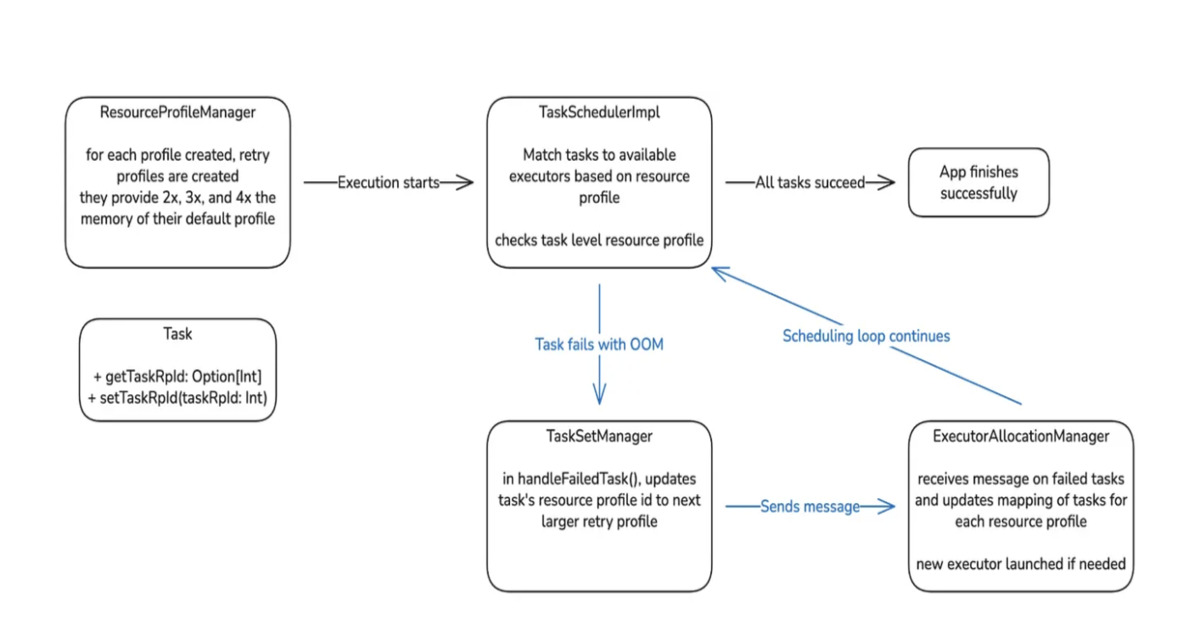
Pinterest Engineering cut Apache Spark out-of-memory failures by 96% using improved observability, configuration tuning, and automatic memory retries. Staged rollout, dashboards, and proactive memory adjustments stabilized data pipelines, reduced manual intervention, and lowered operational overhead across tens of thousands of daily jobs. By Leela Kumili
Pinterest Engineering cut Apache Spark out-of-memory failures by 96% using improved observability, configuration tuning, and automatic memory retries. Staged rollout, dashboards, and proactive memory adjustments stabilized data pipelines, reduced manual intervention, and lowered operational overhead across tens of thousands of daily jobs.

 Login
Login