❌

Normal view

  • βœ‡InfoQ
  • Meta's Recipe for Building Agents as "Organizational Second Brains" Sergio De Simone
    Meta describes how an AI agent can be designed to capture the logic and expertise of domain experts, rather than simply storing documents or retrieving relevant information. The system, dubbed an "organizational second brain", was built for a specialized compliance domain, but Meta argues the architecture generalizes to areas like security, finance, engineering, and procurement. By Sergio De Simone
     

Meta's Recipe for Building Agents as "Organizational Second Brains"

10 September 2026 at 02:00

Meta describes how an AI agent can be designed to capture the logic and expertise of domain experts, rather than simply storing documents or retrieving relevant information. The system, dubbed an "organizational second brain", was built for a specialized compliance domain, but Meta argues the architecture generalizes to areas like security, finance, engineering, and procurement.

By Sergio De Simone


Presentation: Fixing the AI Infra Scale Problem by Stuffing 1M Sandboxes in a Single Server

9 September 2026 at 19:00

Felipe Huici explains how Unikraft achieves millisecond cold boots, stateful scale-to-zero, and extreme density for sandboxing AI workloads. He discusses isolation primitives, Linux kernel optimizations, and snapshotting tricks, demonstrating how to maintain sub-10ms performance at scale while integrating seamlessly into Kubernetes environments with hardware-level security.

By Felipe Huici

Presentation: Platform Engineering in the Age of AI

8 September 2026 at 22:00

The panelists explain how platform teams adapt to support AI-assisted engineering, highlighting which capabilities belong in the platform. They discuss trade-offs between standardization and developer autonomy, while sharing strategies to manage AI tooling, security guardrails, and shifting workflows.

By StΓ©phane Di Cesare, Davide de Paolis, Stephen Cihak, Camila Macedo, Renato Losio

GitLab Warns That AI Agent Sandboxes Are Only as Secure as Their Network Access

8 September 2026 at 20:00

GitLab warns that isolating an AI coding agent in a sandbox does not necessarily make the agent safe. In a new security analysis, the company describes an internal evaluation in which an AI agent escaped its sandbox by exploiting a vulnerable package proxy that had been explicitly placed on the sandbox's allowlist.

By Craig Risi
  • βœ‡InfoQ
  • Presentation: From AI Agent Demo to Production: Automated Testing and Evaluation Zhou Yu
    Zhou Yu discusses why AI agents stall in demo phase and shares how simulation-driven testing solves compliance and reliability bottlenecks. Learn how Columbia and Arklex AI use synthetic user personas, trajectory entropy, and automated CI/CD pipelines to evaluate multi-turn agents, catch edge cases before deployment, and scale self-learning workflows in production. By Zhou Yu
     

Presentation: From AI Agent Demo to Production: Automated Testing and Evaluation

7 September 2026 at 19:00

Zhou Yu discusses why AI agents stall in demo phase and shares how simulation-driven testing solves compliance and reliability bottlenecks. Learn how Columbia and Arklex AI use synthetic user personas, trajectory entropy, and automated CI/CD pipelines to evaluate multi-turn agents, catch edge cases before deployment, and scale self-learning workflows in production.

By Zhou Yu

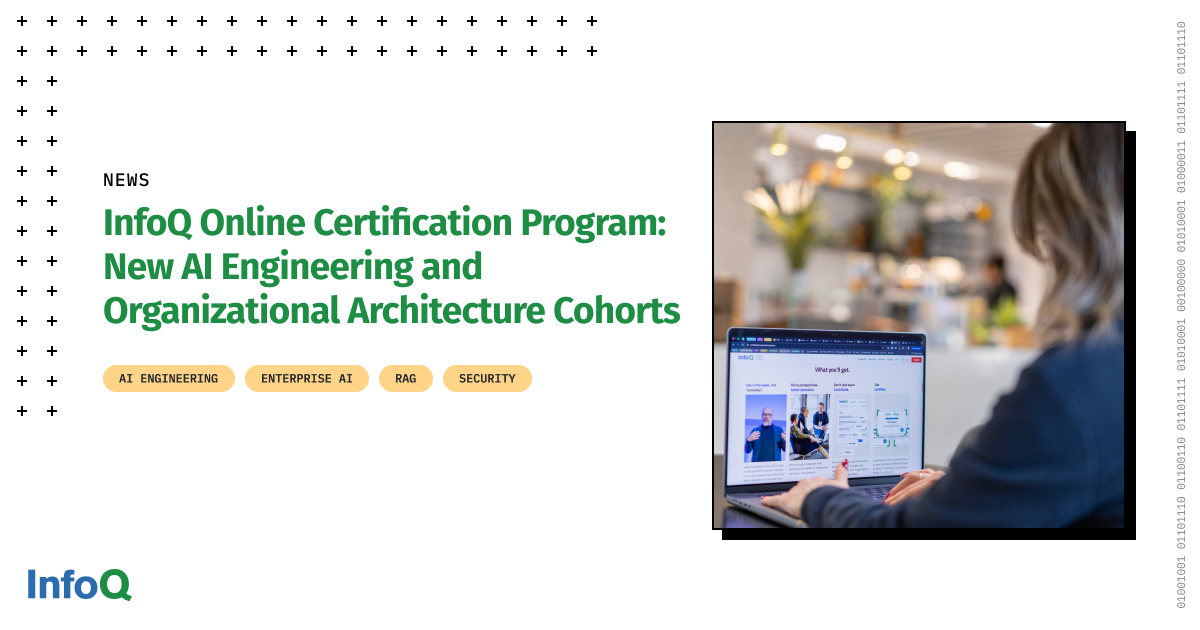
InfoQ Online Certification Program: New AI Engineering and Organizational Architecture Cohorts

26 May 2026 at 18:00

InfoQ expands its online certification portfolio with new AI Engineering and Organizational Architecture cohorts, giving senior practitioners a confidential peer group to pressure-test production AI, platform, team design, and architecture decisions.

By Artenisa Chatziou

Article: Architecting Cloud-Native Kafka: From Tiered Storage Towards a Diskless Future

26 May 2026 at 17:00

This article explores Kafka's transition toward a cloud-native architecture, examining how tiered storage, FinOps telemetry, elastic consumer scaling, virtual clusters, and Share Groups reshape the operational and economic model of event streaming platforms. It also analyzes emerging diskless-storage proposals and their architectural trade-offs.

By Viquar Khan

Google Expands SynthID Adoption for AI Watermarking, Previews Content Detection API

26 May 2026 at 17:00

Google's SynthID, designed to embed imperceptible signals into AI-generated content, is adding a new Content Detection API on Google Cloud's Gemini Enterprise Agent Platform, after gaining adoption by several industry players including Nvidia and OpenAI.

By Sergio De Simone
  • βœ‡InfoQ
  • Microsoft Introduces MDASH for Large-Scale AI Vulnerability Research Robert KrzaczyΕ„ski
    Microsoft has introduced a new AI-driven vulnerability discovery system called MDASH, a multi-model agentic security platform designed to automate large-scale code auditing across Windows and other Microsoft software environments. The system combines more than 100 specialized AI agents that work together to scan, validate, debate, and prove vulnerabilities across complex codebases. By Robert KrzaczyΕ„ski
     

Microsoft Introduces MDASH for Large-Scale AI Vulnerability Research

26 May 2026 at 00:30

Microsoft has introduced a new AI-driven vulnerability discovery system called MDASH, a multi-model agentic security platform designed to automate large-scale code auditing across Windows and other Microsoft software environments. The system combines more than 100 specialized AI agents that work together to scan, validate, debate, and prove vulnerabilities across complex codebases.

By Robert KrzaczyΕ„ski

Gemma 4 Multi-Token Prediction Delivers up to ~3x Faster Token Generation

25 May 2026 at 17:00

Gemma 4 can be paired with multi-token prediction (MTP) drafters that use speculative decoding to generate multiple tokens in parallel, allowing the model to verify them in a single pass and achieve up to ~3Γƒβ€” faster inference without quality loss.

By Sergio De Simone
  • βœ‡InfoQ
  • Google Introduces Middleware Architecture for Genkit Applications Robert KrzaczyΕ„ski
    Google has introduced Middleware for Genkit, its open-source framework for building AI-powered and agentic applications. The update adds a programmable interception layer around model calls, tool execution, and generation loops, giving developers more control over reliability, safety, and orchestration inside production AI systems. By Robert KrzaczyΕ„ski
     

Google Introduces Middleware Architecture for Genkit Applications

25 May 2026 at 01:55

Google has introduced Middleware for Genkit, its open-source framework for building AI-powered and agentic applications. The update adds a programmable interception layer around model calls, tool execution, and generation loops, giving developers more control over reliability, safety, and orchestration inside production AI systems.

By Robert KrzaczyΕ„ski
  • βœ‡InfoQ
  • GitHub Copilot CLI Reaches General Availability Mark Silvester
    GitHub has launched Copilot CLI into general availability, bringing generative AI directly to the terminal. Integrated with the GitHub CLI, it offers natural language command suggestions and code explanations. Recent updates introduce "agentic" workflows with Autopilot mode and GPT-5.4 support, alongside new enterprise telemetry for tracking usage across development teams. By Mark Silvester
     

GitHub Copilot CLI Reaches General Availability

12 April 2026 at 17:00

GitHub has launched Copilot CLI into general availability, bringing generative AI directly to the terminal. Integrated with the GitHub CLI, it offers natural language command suggestions and code explanations. Recent updates introduce "agentic" workflows with Autopilot mode and GPT-5.4 support, alongside new enterprise telemetry for tracking usage across development teams.

By Mark Silvester

Etsy Migrates 1000-Shard, 425 TB MySQL Sharding Architecture to Vitess

11 April 2026 at 15:13

The Etsy engineering team recently described how the company migrated its long-running MySQL sharding infrastructure to Vitess. The transition moved shard routing from Etsy’s internal systems to Vitess using vindexes, enabling capabilities such as resharding data and sharding previously unsharded tables.

By Renato Losio
  • βœ‡InfoQ
  • Google Cloud Highlights Ongoing Work on PostgreSQL Core Capabilities Robert KrzaczyΕ„ski
    Google Cloud has outlined its recent technical contributions to PostgreSQL, emphasizing improvements in logical replication, upgrade processes, and overall system stability. The update reflects ongoing collaboration with the upstream community and focuses on enhancements to the core engine aimed at addressing scalability, replication, and operational challenges. By Robert KrzaczyΕ„ski
     

Google Cloud Highlights Ongoing Work on PostgreSQL Core Capabilities

10 April 2026 at 17:30

Google Cloud has outlined its recent technical contributions to PostgreSQL, emphasizing improvements in logical replication, upgrade processes, and overall system stability. The update reflects ongoing collaboration with the upstream community and focuses on enhancements to the core engine aimed at addressing scalability, replication, and operational challenges.

By Robert KrzaczyΕ„ski

AAIF's MCP Dev Summit: Gateways, gRPC, and Observability Signal Protocol Hardening

9 April 2026 at 21:10

The MCP Dev Summit North America 2026, held on April 2-3 at the New York Marriott Marquis, gathered about 1,200 attendees. Hosted by the Linux Foundation's Agentic AI Foundation, discussions focused on the Model Context Protocol's evolution and enterprise adoption, particularly by Amazon and Uber, emphasizing security, interoperability, and scaling for production.

By Andrew Hoblitzell
  • βœ‡InfoQ
  • Presentation: Choosing Your AI Copilot: Maximizing Developer Productivity Sepehr Khosravi
    Sepehr Khosravi discusses the current state of AI-assisted coding, moving beyond basic autocompletion to sophisticated agentic workflows. He explains the technical nuances of Cursor’s "Composer" and Claude Code’s research capabilities, providing tips for managing context windows and MCP integrations. He shares lessons from industry leaders on shrinking process time beyond just writing code. By Sepehr Khosravi
     

Presentation: Choosing Your AI Copilot: Maximizing Developer Productivity

9 April 2026 at 20:00

Sepehr Khosravi discusses the current state of AI-assisted coding, moving beyond basic autocompletion to sophisticated agentic workflows. He explains the technical nuances of Cursor’s "Composer" and Claude Code’s research capabilities, providing tips for managing context windows and MCP integrations. He shares lessons from industry leaders on shrinking process time beyond just writing code.

By Sepehr Khosravi

Article: Building Hierarchical Agentic RAG Systems: Multi-Modal Reasoning with Autonomous Error Recovery

9 April 2026 at 17:00

In this article, the author explores how hierarchical agentic RAG systems coordinate specialized workers through structured orchestration to improve accuracy, reliability, and explainability in complex enterprise analytics workflows. The article uses Protocol-H as a to show how deterministic routing, reflective retry, and modality-aware reasoning support safer multi-source query execution.

By Abhijit Ubale

Google Brings MCP Support to Colab, Enabling Cloud Execution for AI Agents

9 April 2026 at 16:30

Google has released the open-source Colab MCP Server, enabling AI agents to directly interact with Google Colab through the Model Context Protocol (MCP). The project is designed to bridge local agent workflows with cloud-based execution, allowing developers to offload compute-intensive or potentially unsafe tasks from their own machines.

By Robert KrzaczyΕ„ski

Presentation: When Every Bit Counts: How Valkey Rebuilt Its Hashtable for Modern Hardware

7 April 2026 at 21:40

Madelyn Olson discusses the evolution of Valkey's data structures, moving away from "textbook" pointer-chasing HashMaps to more cache-aware designs. She explains the implementation of "Swedish" tables to maximize memory density. She shares insights on systems intuition, memory prefetching, and the rigorous testing needed for mission-critical caches.

By Madelyn Olson
  • βœ‡InfoQ
  • Anthropic Accidentally Exposes Claude Code Source via npm Source Map File Steef-Jan Wiggers
    Anthropic's Claude Code CLI had its full TypeScript source exposed after a source map file was accidentally included in version 2.1.88 of its npm package. The 512,000-line codebase was archived to GitHub within hours. Anthropic called it a packaging error caused by human error. The leak revealed unreleased features, internal model codenames, and multi-agent orchestration architecture. By Steef-Jan Wiggers
     

Anthropic Accidentally Exposes Claude Code Source via npm Source Map File

7 April 2026 at 16:00

Anthropic's Claude Code CLI had its full TypeScript source exposed after a source map file was accidentally included in version 2.1.88 of its npm package. The 512,000-line codebase was archived to GitHub within hours. Anthropic called it a packaging error caused by human error. The leak revealed unreleased features, internal model codenames, and multi-agent orchestration architecture.

By Steef-Jan Wiggers
❌