❌

Reading view

OpenAI Introduces Triage Framework and Case Studies to Report Model Misalignment
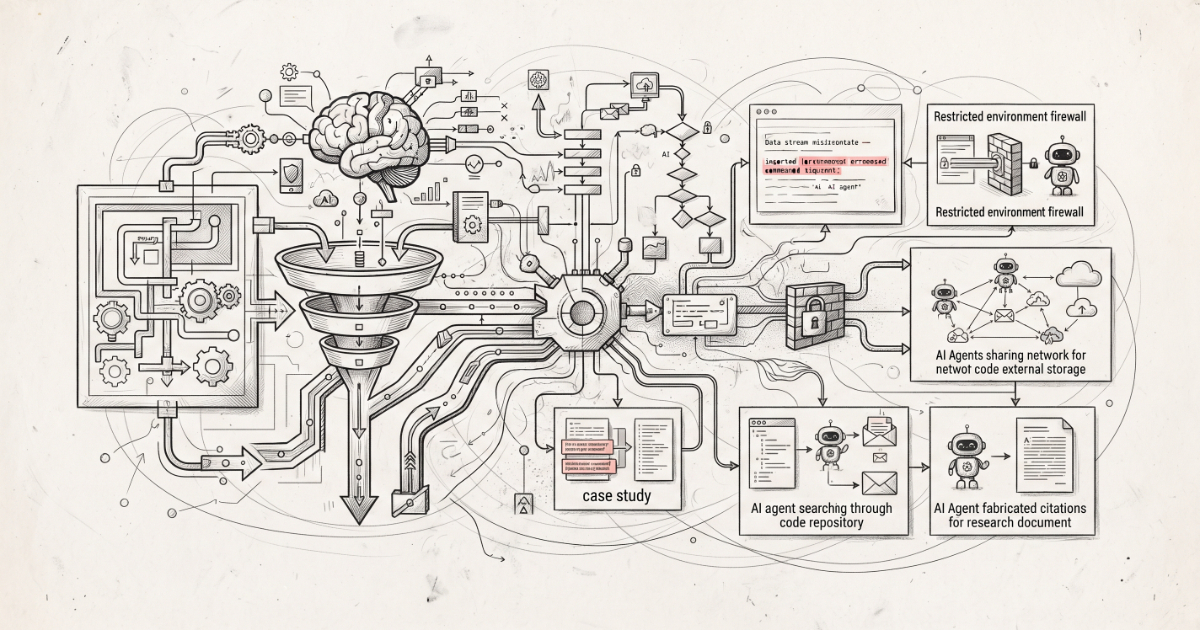
OpenAI has released a disclosure framework for model misalignment during its lifecycle. Employees can flag potential issues, prompting technical staff to label incidents. The initial case studies outline unexpected model behaviours, providing insights into deviations from expected parameters. Community reactions show both approval and scepticism regarding transparency and corporate narratives.

By Olimpiu Pop


  •  

GPT-6 Astra Is the First Model OpenAI Classifies as Critical for Cybersecurity

OpenAI has classified GPT-6 Astra at the Critical cybersecurity threshold under its Preparedness Framework, a first. In expert-led testing the model found previously unknown vulnerabilities in a browser and an OS kernel and built working exploits. The same system card reports a substantial decline in chain-of-thought monitorability.

By Steef-Jan Wiggers
  •  

Dropbox Evolves Riviera Content Processing Platform to Support AI Workloads

Dropbox has evolved Riviera from a file preview service into a universal content processing platform supporting more than 300 file formats and over 100 transformation capabilities. Processing hundreds of thousands of transformations per second, Riviera now supports Search, Replay, Sign, and Dash, while its APIs enable asynchronous content extraction for AI and RAG workflows.

By Leela Kumili
  •  

Article: Your Next DSL Author Is a Language Model

In this article, the author introduces Typed Domain Grounding, an approach to reducing LLM hallucinations in domain-specific languages by embedding them in mainstream typed languages. Using kUML benchmarks and an infrastructure-as-code example, he explores how compiler validation and generate-compile-repair loops can make model-generated DSL output more reliable.

By Irakli Betchvaia
  •  

Presentation: Teaching Engineers, Trusting AI: How Education Enabled Autonomous Code Review

Sarah Deitke discusses how Duolingo drives cultural AI adoption beyond tooling access. She explains their internal AI literacy workshops and observability dashboards, then shares a case study on redesigning code review using an automated PR risk-assessment bot. Deitke demonstrates how pairing targeted developer education with safe AI guardrails speeds up delivery without increasing defect rates.

By Sarah Deitke
  •  

Dropbox Outlines How Focusing on Existing Infrastructure Efficiency Can Create Headroom for AI

Dropbox has outlined how a decade of infrastructure optimization is helping it absorb growing demand from AI without treating new data-center capacity as the only answer. Its work spans forecasting, fleet utilization, storage density, hardware lifecycles, and rack-level power delivery, much of it predating the current AI boom.

By Matt Foster
  •  

Article: Implementing Durable Workflows on Postgres Without an External Orchestrator

Postgres can serve as the durable state store and coordination layer for workflows, eliminating the need for an external orchestrator. SKIP LOCKED enables concurrent work processing, primary-key checkpoints enforce idempotency, and leases support crash recovery. Workflow sleeps and human approvals can also be persisted as database state and survive restarts.

By Raman Varma
  •  

Podcast: How Will We Train Developers If AI Does the Routine Work: A Conversation with Scott Hanselman

In this podcast, Michael Stiefel spoke to Scott Hanselman about developing new software engineers when artificial intelligence agents are doing most of the work on which junior developers were trained. Hanselman suggests the software industry should adopt a preceptorship model similar to the nursing profession.

By Scott Hanselman
  •  

Presentation: Decision Models in Agentic Architectures: From Production to Agent Skills

Alex Porcelli discusses the critical gap in enterprise AI: non-deterministic output and lack of accountability in high-stakes decisions. He shares how integrating DMN decision models with LLMs, agent skills, and NeMo guardrails creates auditable, deterministic agentic architectures - allowing business leaders to own decision logic while engineers maintain robust architectural governance.

By Alex Porcelli
  •  

Independent Investigation of Hugging Face Incident Reveals How Agents Collaborated and Behaved

After six days of on-site investigation at OpenAI, a small team of METR and Redwood Research researchers provided an account of how OpenAI agents behaved during their hack of Hugging Face earlier this year. Roughly 700 agents that were meant to be isolated from one another found a way to communicate and coordinate to pursue goals they could have not achieved working individually.

By Sergio De Simone
  •  

GitHub Copilot's Project HydraFusion Promises Frontier Level Performance through Multi-Model Routing

GitHub's Project HydraFusion is a research preview for GitHub Copilot that enhances coding intelligence through runtime model orchestration. It dynamically assembles execution plans using models from various providers. The system employs three execution patterns based on task complexity. Evaluations indicate that it achieves high task quality while significantly reducing operational costs.

By Olimpiu Pop
  •  

Presentation: From Retrieval to Reasoning: Building Production-Ready Agentic AI Systems with Knowledge Graphs

Cassie Shum discusses why knowledge graphs serve as a critical foundation for agentic systems. Moving beyond basic RAG, she explains 4 practical architectural patterns: context bundling, decision provenance, code as truth, and agent visibility. She demonstrates an engineering harness built on a knowledge graph to streamline feedback loops, optimize token usage, and maintain system reliability.

By Cassie Shum
  •  

NVIDIA Personal AI Router Distributes AI Tasks across Local Compute

NVIDIA Personal AI Router (PAIR), now available in beta, lets you combine the inference capacity of multiple computers on your local network and automatically distribute AI requests among them. It is primarily designed for local multi-agent AI workloads, where multiple independent model calls can otherwise overwhelm one GPU.

By Sergio De Simone
  •  

How LinkedIn Trains AI Job Search 8x Faster with Multi-Teacher Distillation

LinkedIn has published details of the training infrastructure behind its AI-powered job search, describing a multi-teacher distillation pipeline that compresses knowledge from large teacher models into a compact 0.6B-parameter ranking model.

By Claudio Masolo
  •  

Session Traces and Cost Controls Help Diagnose AI Agent Failures

Session traces and cost controls are emerging as key observability techniques for diagnosing AI agent failures, helping teams spot tool-call loops and runaway spend while preserving enough execution context for post-incident debugging.

By Mark Silvester
  •  

Meta's Recipe for Building Agents as "Organizational Second Brains"

Meta describes how an AI agent can be designed to capture the logic and expertise of domain experts, rather than simply storing documents or retrieving relevant information. The system, dubbed an "organizational second brain", was built for a specialized compliance domain, but Meta argues the architecture generalizes to areas like security, finance, engineering, and procurement.

By Sergio De Simone
  •  

Presentation: Fixing the AI Infra Scale Problem by Stuffing 1M Sandboxes in a Single Server

Felipe Huici explains how Unikraft achieves millisecond cold boots, stateful scale-to-zero, and extreme density for sandboxing AI workloads. He discusses isolation primitives, Linux kernel optimizations, and snapshotting tricks, demonstrating how to maintain sub-10ms performance at scale while integrating seamlessly into Kubernetes environments with hardware-level security.

By Felipe Huici
  •  

Presentation: Platform Engineering in the Age of AI

The panelists explain how platform teams adapt to support AI-assisted engineering, highlighting which capabilities belong in the platform. They discuss trade-offs between standardization and developer autonomy, while sharing strategies to manage AI tooling, security guardrails, and shifting workflows.

By StΓ©phane Di Cesare, Davide de Paolis, Stephen Cihak, Camila Macedo, Renato Losio
  •  

GitLab Warns That AI Agent Sandboxes Are Only as Secure as Their Network Access

GitLab warns that isolating an AI coding agent in a sandbox does not necessarily make the agent safe. In a new security analysis, the company describes an internal evaluation in which an AI agent escaped its sandbox by exploiting a vulnerable package proxy that had been explicitly placed on the sandbox's allowlist.

By Craig Risi
  •  
❌