Dropbox has outlined how a decade of infrastructure optimization is helping it absorb growing demand from AI without treating new data-center capacity as the only answer. Its work spans forecasting, fleet utilization, storage density, hardware lifecycles, and rack-level power delivery, much of it predating the current AI boom. By Matt Foster
Dropbox has outlined how a decade of infrastructure optimization is helping it absorb growing demand from AI without treating new data-center capacity as the only answer. Its work spans forecasting, fleet utilization, storage density, hardware lifecycles, and rack-level power delivery, much of it predating the current AI boom.
JD.com is expanding AI and robotics across its logistics network under a new Physical AI Acceleration Plan, while reiterating a five-year target to procure 3 million robots, 1 million autonomous vehicles, and 100,000 delivery drones.
The company launched the plan at JDDiscovery 2026 in Beijing. JD Logistics also unveiled its industrial Wolf Robot series, designed for tasks across warehousing, sorting, transport, and delivery.
Specialised systems include equipment designed to operate in tem
JD.com is expanding AI and robotics across its logistics network under a new Physical AI Acceleration Plan, while reiterating a five-year target to procure 3 million robots, 1 million autonomous vehicles, and 100,000 delivery drones.
The company launched the plan at JDDiscovery 2026 in Beijing. JD Logistics also unveiled its industrial Wolf Robot series, designed for tasks across warehousing, sorting, transport, and delivery.
Specialised systems include equipment designed to operate in temperatures as low as minus 20 degrees Celsius, automated pharmacy dispatch systems, autonomous delivery vehicles, and drones.
The five-year procurement plan builds on automation that JD Logistics already has in operation. As of June 30, its LangzuTech Goods-to-Person automated warehousing system had been deployed in more than 30 warehouses across China, with deployments also launched in the UK and Germany.
JD Logistics’ broader warehouse network included more than 1,800 self-operated warehouses and more than 2,000 third-party cloud warehouses on its Open Warehouse Platform as of June 30. The network covered more than 36 million square metres in aggregate.
The company also had thousands of unmanned vehicles in regular operation across more than 20 Chinese provinces by the end of June. More than 100 domestic drone routes were operating across applications including parcel and food delivery, emergency medicine transport, and disaster relief.
From AI decisions to physical execution
JD Logistics is connecting its physical equipment with Meta Brain, an AI system used across warehousing, transportation, and delivery. JD said Meta Brain 3.0 can calculate optimal routes for hundreds of millions of parcels in seconds, compared with minutes previously.
Meta Brain also powers JD Logistics’ LangzuTech Packer robotic arm, which combines the model with multimodal sensor data to track, grasp, and place parcels with different shapes.
JD Logistics said in a first-quarter regulatory filing that the Packer uses parallel reinforcement learning in simulated environments to optimise parcel-placement sequences and loading layouts. The company said the system is designed to improve sorting efficiency and the use of available carrier space.
JD upgraded the robotic arm’s force-control technology during the second quarter to support more precise cage-loading operations. By June, the Packer was operating around the clock at multiple JD Logistics parks, according to the company’s interim report.
JD is also adding computing capacity to support AI development. JD Cloud plans to work with Chinese chipmaker Moore Threads on a cluster containing 100,000 GPUs for large-model training, inference, and embodied-AI workloads.
The two companies have previously worked on a 10,000-GPU cluster, according to Data Center Dynamics. Details of which Moore Threads GPU models will be used in the planned 100,000-GPU system have not been disclosed.
JD Cloud also plans to collect more than 10 million hours of video showing real-world human activities over the next two years for embodied-AI training.
Beyond warehouse operations, JD Logistics has expanded its autonomous vehicle network into night-time delivery. Its interim report said the company had launched night-time autonomous routes in Shenzhen, allowing vehicles to operate around the clock.
JD is also using drones in rural logistics. In June, JD Logistics launched a drone delivery network in Zizhong, Sichuan province, covering 78 administrative villages, and said deliveries to some mountain villages could be completed in as little as seven minutes.
Scaling automation across JD’s logistics network
JD did not disclose the total expected cost of the five-year procurement programme at JDDiscovery or provide a network-wide return-on-investment target.
JD Logistics spent RMB2.3 billion on research and development during the first half of 2026, up 23.7% from RMB1.9 billion a year earlier. The company attributed the increase to continued investment in technology and innovation but did not provide a breakdown showing how much was spent specifically on AI or robotics.
Depreciation of property and equipment and amortisation of other intangible assets rose 18.7% to RMB2.6 billion during the first half of 2026, from RMB2.2 billion a year earlier. JD Logistics attributed the increase mainly to additional logistics equipment and vehicles.
Purchases of property and equipment and investment properties totalled RMB3.09 billion over the same six-month period, compared with RMB2.70 billion a year earlier. Those figures cover the wider logistics business and are not disclosed as spending specifically associated with the new physical AI programme.
JD’s automation plans also come as China’s major ecommerce platforms expand fulfilment infrastructure. Reuters reported on September 3 that competition between JD.com, Alibaba, and Meituan had moved from heavy spending on delivery subsidies towards logistics infrastructure, broader supply, and order-level economics.
Alibaba and JD have been opening dark stores and fast-fulfilment “lightning warehouses” in densely populated areas to support deliveries within an hour, while Meituan has been building supermarkets to expand its grocery operations. Ministry of Commerce research cited by Reuters estimates China’s instant-retail market will reach RMB1.2 trillion, or about $178 billion, by the end of 2026.
JD and companies within its ecosystem employ around 700,000 delivery and logistics personnel, according to the South China Morning Post.
JD founder Richard Liu said earlier this year that robots would eventually take over parcel-delivery work now carried out by human couriers. The Financial Times reported in June that JD had signed agreements with around 120 educational institutions to retrain workers for roles including robot repair and maintenance.
JD said JD Logistics currently operates eight robot repair centres in China and plans to expand its robotics after-sales capabilities over the next five years. The company expects the expansion to support more than 100,000 robotics service engineer jobs.
Want to learn more about AI and big data from industry leaders? Check out AI & Big Data Expo taking place in Amsterdam, California, and London. The comprehensive event is part of TechEx and is co-located with other leading technology events including the Cyber Security & Cloud Expo. Click here for more information.
AI News is powered by TechForge Media. Explore other upcoming enterprise technology events and webinars here.
Neil Fraser's disclosure highlights a regulatory change affecting the .name top-level domain. Following ICANN's approval, Verisign will eliminate third-level registrations due to declining usage. This affects about 22,000 registrants and raises security concerns, as released second-level domains could be exploited. Affected users are considering legal options to challenge the decision. By Olimpiu Pop
Neil Fraser's disclosure highlights a regulatory change affecting the .name top-level domain. Following ICANN's approval, Verisign will eliminate third-level registrations due to declining usage. This affects about 22,000 registrants and raises security concerns, as released second-level domains could be exploited. Affected users are considering legal options to challenge the decision.
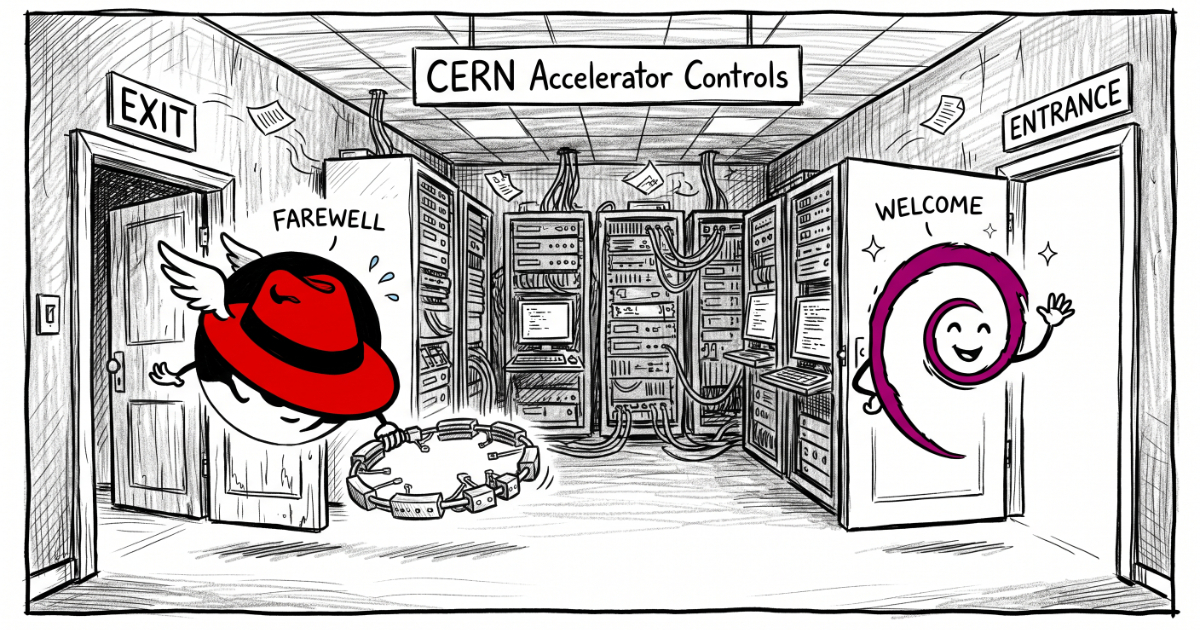
CERN engineers announced a shift from Red Hat-based distributions to Debian for its accelerator control systems. This decision stems from Red Hat's tightening compiler mandates, which threatened legacy hardware. The transition, focused on 2,200 specialized control machines, is set for completion in late 2026, while CERN's other systems will remain with Red Hat and AlmaLinux. By Olimpiu Pop
CERN engineers announced a shift from Red Hat-based distributions to Debian for its accelerator control systems. This decision stems from Red Hat's tightening compiler mandates, which threatened legacy hardware. The transition, focused on 2,200 specialized control machines, is set for completion in late 2026, while CERN's other systems will remain with Red Hat and AlmaLinux.
NVIDIA has agreed to acquire Hugging Face for $12.93 billion to scale the open-source model repository’s platform and infrastructure.
The transaction targets platform growth and infrastructure investment, aiming to expand AI access for enterprise developers, software engineers, and research institutions globally.
Built over the past decade by Clem Delangue, Julien Chaumond, Thomas Wolf, and their engineering team, Hugging Face serves as the primary home for the open model developer communi
NVIDIA has agreed to acquire Hugging Face for $12.93 billion to scale the open-source model repository’s platform and infrastructure.
The transaction targets platform growth and infrastructure investment, aiming to expand AI access for enterprise developers, software engineers, and research institutions globally.
Built over the past decade by Clem Delangue, Julien Chaumond, Thomas Wolf, and their engineering team, Hugging Face serves as the primary home for the open model developer community.
Platform metrics show more than 18 million developers, researchers, and creators share more than three million models, 500,000 datasets, and one million applications. Commercial adoption includes more than 200,000 companies using the environment to discover, evaluate, customise, and deploy AI models.
Hardware neutrality and multi-cloud commitments
NVIDIA stated that Hugging Face will remain an open platform for the entire AI sector. Developers will retain full control over their selection of models, software frameworks, cloud providers, inference services, and computing hardware.
NVIDIA hardware will not be mandatory to build on or deploy software through the platform. The service will maintain operational support for alternative accelerators, multi-cloud architectures, and open-weight models from all third-party builders.
Jensen Huang, Founder and CEO of NVIDIA, said: “Hugging Face will remain an open platform for the entire AI ecosystem. Developers will choose the models they want, the frameworks they want, the clouds and inference service providers they want, and the computing platforms they want.
“NVIDIA compute will not be required to build on or deploy through Hugging Face.”
Open-weight models and distributed development
Huang noted a recent open letter he co-authored regarding the role of open weights in the AI economy. The position argued that open weights broaden AI access and ensure technical leadership remains distributed across companies, academic institutions, and developer communities.
Under this operational model, commercial businesses, startups, universities, and public bodies can build on advanced capabilities without the expense of training baseline models from scratch.
The approach allows organisations to match specific models to operational tasks across factories, hospitals, farms, classrooms, and commercial businesses, while addressing cybersecurity and data sovereignty requirements.
Julien Chaumond, Co-Founder and CEO of Hugging Face, commented: “AI is at an inflection point. Open-source AI can become less relevant in the coming years if the big closed labs run away with it, or it can become the foundational fabric of the next phase of human civilisation.
“Those are vastly different outcomes, and we need the critical mass to ensure we give our collective best shot to the second outcome. Given Jensen Huang’s stance on open source AI and how he stepped up to defend it when it was under threat earlier in the summer, NVIDIA was the only partner we truly considered.”
Infrastructure expansion and brand preservation
NVIDIA stands as the largest contributor of open models and data to Hugging Face, with a portfolio of more than 500 open models and more than 250 open datasets. The company builds its libraries, tools, and models openly to allow external engineers to inspect, modify, and build atop the software.
Technical integration will focus on applying NVIDIA infrastructure and engineering resources to improve repository reliability, safety controls, model evaluation tooling, inference execution, and deployment pipelines.
“I am honored that Clem came to me as he considered the next chapter of Hugging Face and believed NVIDIA would be a great home for the company, its community and the future of open models,” Huang stated.
Hugging Face will retain its independent brand identity following the completion of the transaction, with the existing team continuing operations across multi-cloud and multi-accelerator environments.
“This gives fuel to our long-term vision and mission of unlocking the community’s progress to ensure that AI, which is the greatest breakthrough of our lifetime, is accessible to as many people as possible,” Chaumond concludes.
Want to learn more about AI and big data from industry leaders? Check out AI & Big Data Expo taking place in Amsterdam, California, and London. The comprehensive event is part of TechEx and is co-located with other leading technology events including the Cyber Security & Cloud Expo. Click here for more information.
AI News is powered by TechForge Media. Explore other upcoming enterprise technology events and webinars here.
Every major economy is staring at the same problem right now. Artificial intelligence is consuming electricity at a pace that grids were never designed to handle. In the US, capacity market prices in PJM, the country’s largest grid operator, have risen more than tenfold in two years, with data-centre growth identified as a primary driver. In Europe, utilities are scrambling to upgrade transmission infrastructure fast enough to keep pace with hyperscalers’ demand.
The International Energy Agency
Every major economy is staring at the same problem right now. Artificial intelligence is consuming electricity at a pace that grids were never designed to handle. In the US, capacity market prices in PJM, the country’s largest grid operator, have risen more than tenfold in two years, with data-centre growth identified as a primary driver. In Europe, utilities are scrambling to upgrade transmission infrastructure fast enough to keep pace with hyperscalers’ demand.
The International Energy Agency (IEA) projects global data-centre electricity consumption could approach 1,000 TWh by the end of this decade. Renewable energy is largely there, but the ability to coordinate it, through AI energy grid mapping at national scales, is what most countries still lack. But China just built it.
A study published in Nature this week by researchers from Peking University and Alibaba Group’s DAMO Academy has produced something that no country has managed before: a complete, high-resolution, AI-generated inventory of an entire nation’s wind and solar infrastructure, with the analytical framework to coordinate it as a unified system.
Using a deep-learning model trained on sub-metre satellite imagery, the team identified China’s 319,972 solar photovoltaic facilities and 91,609 wind turbines, processing 7.56 terabytes of imagery to do so.
AI energy grid mapping
Prior research into solar-wind complementarity – the idea that two sources can offset each other’s variability in time and geography – has largely relied on hypothetical or modelled deployment scenarios. How complementarity manifests under real-world infrastructure, and how it shapes system-level integration outcomes, has until now remained unclear.
The researchers show that solar-wind complementarity substantially reduces generation variability, with effectiveness increasing as the geographic scope of pairing expands.
In practical terms, the further apart the facilities being coordinated are, the more reliably they achieve balance. A cloud that covers solar farms in Gansu does not darken wind corridors in Inner Mongolia, for example. The study’s findings point to a structural inefficiency in how China currently manages its grid: coordination happens at a provincial rather than national level.
Transitioning to a unified national scale, the researchers argue, would make it easier to pair complementary energy sources, stabilise the grid, and avoid curtailment – the wasting of generated renewable power that has long been one of China’s most costly clean-energy problems.
Liu Yu, a professor at Peking University’s School of Earth and Space Sciences, described the inventory as allowing China to see its new-energy landscape from a “God’s-eye view,” a phrase that carries more operational weight than it might first suggest. Grid operators cannot optimise what they are not aware of – until now.
China is in the middle of an AI-driven electricity demand surge that is straining its grid. The rapid proliferation of data services and massive computing facilities have pushed the sector’s power consumption up 44% year-on-year in the first quarter of 2026, reaching 22.9 billion kilowatt-hours, according to the China Electricity Council.
That is an extraordinary rate of growth for a sector whose demand was already great. This has accelerated data-centre expansion in China’s northern and western provinces, where land is cheaper, wind and solar resources are more available, with commensurately lower electricity prices. The provinces being targeted for new data centres are the same regions with the highest solar-wind complementarity.
Behind the model
The technical achievement behind this is worth understanding in its own right. DAMO’s deep-learning model was trained to identify solar photovoltaic facilities and wind turbines from sub-metre resolution satellite imagery, a task complicated by the sheer diversity of installation types, terrain conditions, and image quality.
The resulting dataset covers installations in 1,915 Chinese counties, spanning everything from rooftop panels in coastal cities to utility-scale wind farms on the Mongolian plateau. Processing 7.56 terabytes of imagery to produce a nationally consistent, county-level inventory is a demonstration of what large-scale geospatial AI can do when applied to infrastructure problems, and a template that other countries could, in principle, replicate.
China’s clean energy sector generated an estimated 15.4 trillion yuan (US$2.26 trillion) in economic output last year, equivalent to Brazil’s entire GDP, according to the Finland-based Centre for Research on Energy and Clean Air. Managing an asset base of that scale without a national-level visibility tool was always going to be a limiting factor, a limit that’s now gone.
The study’s dataset and code have been made publicly available via Zenodo.
Want to learn more about AI and big data from industry leaders? Check out AI & Big Data Expo taking place in Amsterdam, California, and London. The comprehensive event is part of TechEx and is co-located with other leading technology events, click here for more information.
AI News is powered by TechForge Media. Explore other upcoming enterprise technology events and webinars here.
To protect enterprise margins, business leaders must invest in robust AI governance to securely manage AI infrastructure.
When evaluating enterprise software adoption, a recurring pattern dictates how technology matures across industries. As Rob Thomas, SVP and CCO at IBM, recently outlined, software typically graduates from a standalone product to a platform, and then from a platform to foundational infrastructure, altering the governing rules entirely.
At the initial product stage, exert
To protect enterprise margins, business leaders must invest in robust AI governance to securely manage AI infrastructure.
When evaluating enterprise software adoption, a recurring pattern dictates how technology matures across industries. As Rob Thomas, SVP and CCO at IBM, recently outlined, software typically graduates from a standalone product to a platform, and then from a platform to foundational infrastructure, altering the governing rules entirely.
At the initial product stage, exerting tight corporate control often feels highly advantageous. Closed development environments iterate quickly and tightly manage the end-user experience. They capture and concentrate financial value within a single corporate entity, an approach that functions adequately during early product development cycles.
However, IBM’s analysis highlights that expectations change entirely when a technology solidifies into a foundational layer. Once other institutional frameworks, external markets, and broad operational systems rely on the software, the prevailing standards adapt to a new reality. At infrastructure scale, embracing openness ceases to be an ideological stance and becomes a highly practical necessity.
AI is currently crossing this threshold within the enterprise architecture stack. Models are increasingly embedded directly into the ways organisations secure their networks, author source code, execute automated decisions, and generate commercial value. AI functions less as an experimental utility and more as core operational infrastructure.
The recent limited preview of Anthropic’s Claude Mythos model brings this reality into sharper focus for enterprise executives managing risk. Anthropic reports that this specific model can discover and exploit software vulnerabilities at a level matching few human experts.
In response to this power, Anthropic launched Project Glasswing, a gated initiative designed to place these advanced capabilities directly into the hands of network defenders first. From IBM’s perspective, this development forces technology officers to confront immediate structural vulnerabilities. If autonomous models possess the capability to write exploits and shape the overall security environment, Thomas notes that concentrating the understanding of these systems within a small number of technology vendors invites severe operational exposure.
With models achieving infrastructure status, IBM argues the primary issue is no longer exclusively what these machine learning applications can execute. The priority becomes how these systems are constructed, governed, inspected, and actively improved over extended periods.
As underlying frameworks grow in complexity and corporate importance, maintaining closed development pipelines becomes exceedingly difficult to defend. No single vendor can successfully anticipate every operational requirement, adversarial attack vector, or system failure mode.
Implementing opaque AI structures introduces heavy friction across existing network architecture. Connecting closed proprietary models with established enterprise vector databases or highly sensitive internal data lakes frequently creates massive troubleshooting bottlenecks. When anomalous outputs occur or hallucination rates spike, teams lack the internal visibility required to diagnose whether the error originated in the retrieval-augmented generation pipeline or the base model weights.
Integrating legacy on-premises architecture with highly gated cloud models also introduces severe latency into daily operations. When enterprise data governance protocols strictly prohibit sending sensitive customer information to external servers, technology teams are left attempting to strip and anonymise datasets before processing. This constant data sanitisation creates enormous operational drag.
Furthermore, the spiralling compute costs associated with continuous API calls to locked models erode the exact profit margins these autonomous systems are supposed to enhance. The opacity prevents network engineers from accurately sizing hardware deployments, forcing companies into expensive over-provisioning agreements to maintain baseline functionality.
Why open-source AI is essential for operational resilience
Restricting access to powerful applications is an understandable human instinct that closely resembles caution. Yet, as Thomas points out, at massive infrastructure scale, security typically improves through rigorous external scrutiny rather than through strict concealment.
This represents the enduring lesson of open-source software development. Open-source code does not eliminate enterprise risk. Instead, IBM maintains it actively changes how organisations manage that risk. An open foundation allows a wider base of researchers, corporate developers, and security defenders to examine the architecture, surface underlying weaknesses, test foundational assumptions, and harden the software under real-world conditions.
Within cybersecurity operations, broad visibility is rarely the enemy of operational resilience. In fact, visibility frequently serves as a strict prerequisite for achieving that resilience. Technologies deemed highly important tend to remain safer when larger populations can challenge them, inspect their logic, and contribute to their continuous improvement.
Thomas addresses one of the oldest misconceptions regarding open-source technology: the belief that it inevitably commoditises corporate innovation. In practical application, open infrastructure typically pushes market competition higher up the technology stack. Open systems transfer financial value rather than destroying it.
As common digital foundations mature, the commercial value relocates toward complex implementation, system orchestration, continuous reliability, trust mechanics, and specific domain expertise. IBM’s position asserts that the long-term commercial winners are not those who own the base technological layer, but rather the organisations that understand how to apply it most effectively.
We have witnessed this identical pattern play out across previous generations of enterprise tooling, cloud infrastructure, and operating systems. Open foundations historically expanded developer participation, accelerated iterative improvement, and birthed entirely new, larger markets built on top of those base layers. Enterprise leaders increasingly view open-source as highly important for infrastructure modernisation and emerging AI capabilities. IBM predicts that AI is highly likely to follow this exact historical trajectory.
Looking across the broader vendor ecosystem, leading hyperscalers are adjusting their business postures to accommodate this reality. Rather than engaging in a pure arms race to build the largest proprietary black boxes, highly profitable integrators are focusing heavily on orchestration tooling that allows enterprises to swap out underlying open-source models based on specific workload demands. Highlighting its ongoing leadership in this space, IBM is a key sponsor of this year’s AI & Big Data Expo North America, where these evolving strategies for open enterprise infrastructure will be a primary focus.
This approach completely sidesteps restrictive vendor lock-in and allows companies to route less demanding internal queries to smaller and highly efficient open models, preserving expensive compute resources for complex customer-facing autonomous logic. By decoupling the application layer from the specific foundation model, technology officers can maintain operational agility and protect their bottom line.
The future of enterprise AI demands transparent governance
Another pragmatic reason for embracing open models revolves around product development influence. IBM emphasises that narrow access to underlying code naturally leads to narrow operational perspectives. In contrast, who gets to participate directly shapes what applications are eventually built.
Providing broad access enables governments, diverse institutions, startups, and varied researchers to actively influence how the technology evolves and where it is commercially applied. This inclusive approach drives functional innovation while simultaneously building structural adaptability and necessary public legitimacy.
As Thomas argues, once autonomous AI assumes the role of core enterprise infrastructure, relying on opacity can no longer serve as the organising principle for system safety. The most reliable blueprint for secure software has paired open foundations with broad external scrutiny, active code maintenance, and serious internal governance.
As AI permanently enters its infrastructure phase, IBM contends that identical logic increasingly applies directly to the foundation models themselves. The stronger the corporate reliance on a technology, the stronger the corresponding case for demanding openness.
If these autonomous workflows are truly becoming foundational to global commerce, then transparency ceases to be a subject of casual debate. According to IBM, it is an absolute, non-negotiable design requirement for any modern enterprise architecture.
Want to learn more about AI and big data from industry leaders? Check out AI & Big Data Expo taking place in Amsterdam, California, and London. The comprehensive event is part of TechEx and is co-located with other leading technology events including the Cyber Security & Cloud Expo. Click here for more information.
AI News is powered by TechForge Media. Explore other upcoming enterprise technology events and webinars here.
A new open-source toolkit from Microsoft focuses on runtime security to force strict governance onto enterprise AI agents. The release tackles a growing anxiety: autonomous language models are now executing code and hitting corporate networks way faster than traditional policy controls can keep up.
AI integration used to mean conversational interfaces and advisory copilots. Those systems had read-only access to specific datasets, keeping humans strictly in the execution loop. Organisations ar
A new open-source toolkit from Microsoft focuses on runtime security to force strict governance onto enterprise AI agents. The release tackles a growing anxiety: autonomous language models are now executing code and hitting corporate networks way faster than traditional policy controls can keep up.
AI integration used to mean conversational interfaces and advisory copilots. Those systems had read-only access to specific datasets, keeping humans strictly in the execution loop. Organisations are currently deploying agentic frameworks that take independent action, wiring these models directly into internal application programming interfaces, cloud storage repositories, and continuous integration pipelines.
When an autonomous agent can read an email, decide to write a script, and push that script to a server, stricter governance is vital. Static code analysis and pre-deployment vulnerability scanning just can’t handle the non-deterministic nature of large language models. One prompt injection attack (or even a basic hallucination) could send an agent to overwrite a database or pull out customer records.
Microsoft’s new toolkit looks at runtime security instead, providing a way to monitor, evaluate, and block actions at the moment the model tries to execute them. It beats relying on prior training or static parameter checks.
Intercepting the tool-calling layer in real time
Looking at the mechanics of agentic tool calling shows how this works. When an enterprise AI agent has to step outside its core neural network to do something like query an inventory system, it generates a command to hit an external tool.
Microsoft’s framework drops a policy enforcement engine right between the language model and the broader corporate network. Every time the agent tries to trigger an outside function, the toolkit grabs the request and checks the intended action against a central set of governance rules. If the action breaks policy (e.g. an agent authorised only to read inventory data tries to fire off a purchase order) the toolkit blocks the API call and logs the event so a human can review it.
Security teams get a verifiable, auditable trail of every single autonomous decision. Developers also win here; they can build complex multi-agent systems without having to hardcode security protocols into every individual model prompt. Security policies get decoupled from the core application logic entirely and are managed at the infrastructure level.
Most legacy systems were never built to talk to non-deterministic software. An old mainframe database or a customised enterprise resource planning suite doesn’t have native defenses against a machine learning model shooting over malformed requests. Microsoft’s toolkit steps in as a protective translation layer. Even if an underlying language model gets compromised by external inputs; the system’s perimeter holds.
Security leaders might wonder why Microsoft decided to release this runtime toolkit under an open-source license. It comes down to how modern software supply chains actually work.
Developers are currently rushing to build autonomous workflows using a massive mix of open-source libraries, frameworks, and third-party models. If Microsoft locked this runtime security feature to its proprietary platforms, development teams would probably just bypass it for faster, unvetted workarounds to hit their deadlines.
Pushing the toolkit out openly means security and governance controls can fit into any technology stack. It doesn’t matter if an organisation runs local open-weight models, leans on competitors like Anthropic, or deploys hybrid architectures.
Setting up an open standard for AI agent security also lets the wider cybersecurity community chip in. Security vendors can stack commercial dashboards and incident response integrations on top of this open foundation, which speeds up the maturity of the whole ecosystem. For businesses, they avoid vendor lock-in but still get a universally scrutinised security baseline.
The next phase of enterprise AI governance
Enterprise governance doesn’t just stop at security; it hits financial and operational oversight too. Autonomous agents run in a continuous loop of reasoning and execution, burning API tokens at every step. Startups and enterprises are already seeing token costs explode when they deploy agentic systems.
Without runtime governance, an agent tasked with looking up a market trend might decide to hit an expensive proprietary database thousands of times before it finishes. Left alone, a badly configured agent caught in a recursive loop can rack up massive cloud computing bills in a few hours.
The runtime toolkit gives teams a way to slap hard limits on token consumption and API call frequency. By setting boundaries on exactly how many actions an agent can take within a specific timeframe, forecasting computing costs gets much easier. It also stops runaway processes from eating up system resources.
A runtime governance layer hands over the quantitative metrics and control mechanisms needed to meet compliance mandates. The days of just trusting model providers to filter out bad outputs are ending. System safety now falls on the infrastructure that actually executes the models’ decisions
Getting a mature governance program off the ground is going to demand tight collaboration between development operations, legal, and security teams. Language models are only scaling up in capability, and the organisations putting strict runtime controls in place today are the only ones who will be equipped to handle the autonomous workflows of tomorrow.
Want to learn more about AI and big data from industry leaders? Check out AI & Big Data Expo taking place in Amsterdam, California, and London. The comprehensive event is part of TechEx and is co-located with other leading technology events including the Cyber Security & Cloud Expo. Click here for more information.
AI News is powered by TechForge Media. Explore other upcoming enterprise technology events and webinars here.

 Login
Login