❌

Normal view

Platform Engineering Labs Expands formae with Kubernetes Support, Native Helm Integration

26 May 2026 at 20:00

Platform Engineering Labs has announced a major update to its open-source Infrastructure-as-Code platform, formae, introducing full Kubernetes support, native Helm integration, direct .tfvars compatibility, and a new public plugin hub aimed at simplifying cloud-native infrastructure management

By Craig Risi
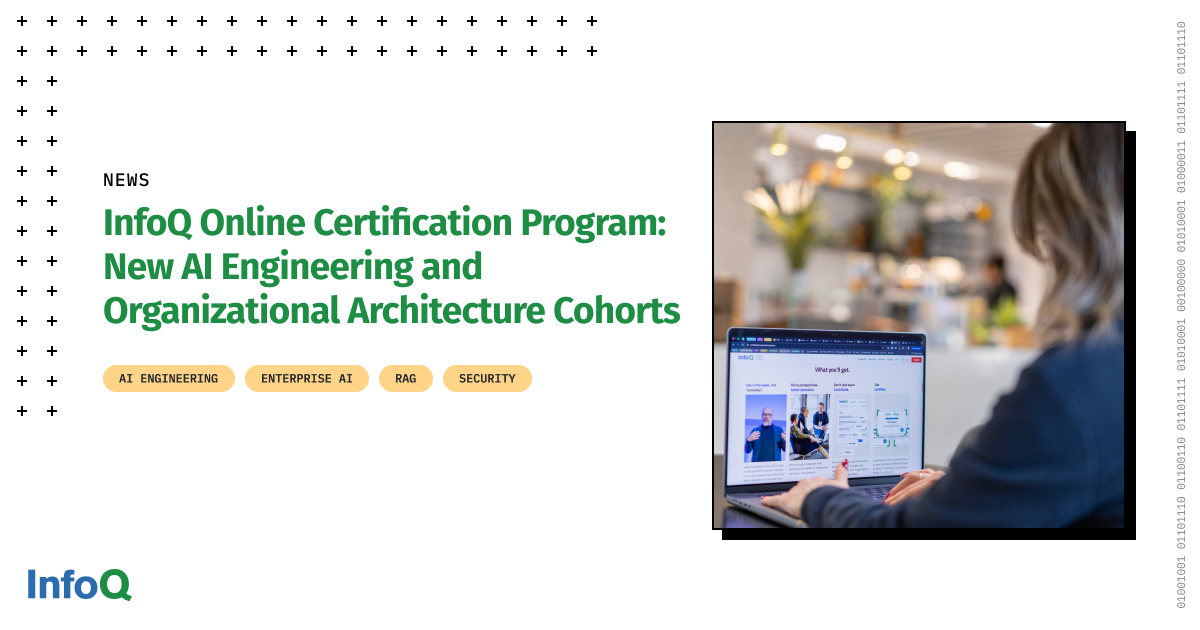
InfoQ Online Certification Program: New AI Engineering and Organizational Architecture Cohorts

26 May 2026 at 18:00

InfoQ expands its online certification portfolio with new AI Engineering and Organizational Architecture cohorts, giving senior practitioners a confidential peer group to pressure-test production AI, platform, team design, and architecture decisions.

By Artenisa Chatziou
  • βœ‡InfoQ
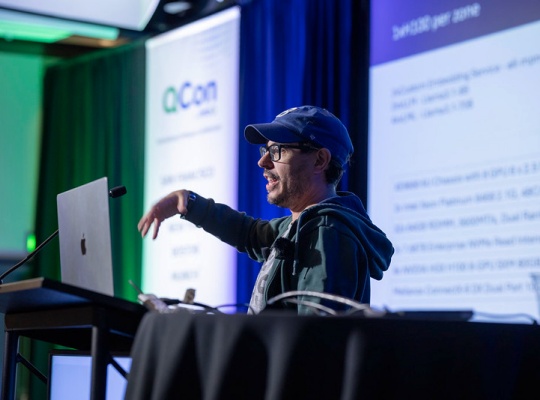
  • Presentation: Realtime and Batch Processing of GPU Workloads Joseph Stein
    Joseph Stein discusses engineering an enterprise AI-as-a-Service platform within a private cloud data center. He explains how to maximize underutilized GPU pools via multi-namespace scheduling, leverage Valkey and Lua for atomic priority queuing and backpressure management, mitigate OWASP Top 10 LLM risks via central proxy gateways, and scale batch pipelines using a custom S3-to-Kafka proxy. By Joseph Stein
     

Presentation: Realtime and Batch Processing of GPU Workloads

26 May 2026 at 17:08

Joseph Stein discusses engineering an enterprise AI-as-a-Service platform within a private cloud data center. He explains how to maximize underutilized GPU pools via multi-namespace scheduling, leverage Valkey and Lua for atomic priority queuing and backpressure management, mitigate OWASP Top 10 LLM risks via central proxy gateways, and scale batch pipelines using a custom S3-to-Kafka proxy.

By Joseph Stein

Article: Architecting Cloud-Native Kafka: From Tiered Storage Towards a Diskless Future

26 May 2026 at 17:00

This article explores Kafka's transition toward a cloud-native architecture, examining how tiered storage, FinOps telemetry, elastic consumer scaling, virtual clusters, and Share Groups reshape the operational and economic model of event streaming platforms. It also analyzes emerging diskless-storage proposals and their architectural trade-offs.

By Viquar Khan

Google Expands SynthID Adoption for AI Watermarking, Previews Content Detection API

26 May 2026 at 17:00

Google's SynthID, designed to embed imperceptible signals into AI-generated content, is adding a new Content Detection API on Google Cloud's Gemini Enterprise Agent Platform, after gaining adoption by several industry players including Nvidia and OpenAI.

By Sergio De Simone
  • βœ‡InfoQ
  • TamboUI Promises to Bring Better Capabilities to Build TUIs in Java Olimpiu Pop
    The call to action β€œto make 2026 the year of Java in the terminal” was quickly responded to by the launch of TamboUI. Inspired by Ratatui, the library used in Claude CLI, it promises support ranging from low-level terminal drawing to high-level APIs such as components and event handling. Currently at version 0.3.0, it has already been adopted by major projects such as Maven and Spring. By Olimpiu Pop
     

TamboUI Promises to Bring Better Capabilities to Build TUIs in Java

26 May 2026 at 17:00

The call to action β€œto make 2026 the year of Java in the terminal” was quickly responded to by the launch of TamboUI. Inspired by Ratatui, the library used in Claude CLI, it promises support ranging from low-level terminal drawing to high-level APIs such as components and event handling. Currently at version 0.3.0, it has already been adopted by major projects such as Maven and Spring.

By Olimpiu Pop

Java News Roundup: WildFly, Micronaut, Spring AI, Apache Fory, GlassFish Plugin, Open Liberty

26 May 2026 at 10:30

This week's Java roundup for May 18th, 2026, features news highlighting: GA releases of WildFly 40, Micronaut 5.0, Maven Embedded GlassFish Plugin 8.0 and Apache Fory 1.0; the May 2026 edition of Open Liberty; point releases of Gatherers4j, Apache and Kafka; and the seventh milestone release of Spring AI 2.0.

By Michael Redlich
  • βœ‡InfoQ
  • Microsoft Introduces MDASH for Large-Scale AI Vulnerability Research Robert KrzaczyΕ„ski
    Microsoft has introduced a new AI-driven vulnerability discovery system called MDASH, a multi-model agentic security platform designed to automate large-scale code auditing across Windows and other Microsoft software environments. The system combines more than 100 specialized AI agents that work together to scan, validate, debate, and prove vulnerabilities across complex codebases. By Robert KrzaczyΕ„ski
     

Microsoft Introduces MDASH for Large-Scale AI Vulnerability Research

26 May 2026 at 00:30

Microsoft has introduced a new AI-driven vulnerability discovery system called MDASH, a multi-model agentic security platform designed to automate large-scale code auditing across Windows and other Microsoft software environments. The system combines more than 100 specialized AI agents that work together to scan, validate, debate, and prove vulnerabilities across complex codebases.

By Robert KrzaczyΕ„ski
  • βœ‡InfoQ
  • Article: The Schema Proliferation Problem in Kafka and Flink Pipelines: How to Solve It Spoorthi Basu
    Schema proliferation builds slowly and gets expensive fast. One schema per event type feels right until there are ten tables, union queries spanning all of them, and a single field rename touching every schema. Discriminator-based schema consolidation collapses that to two tables, turning multi-table unions into a single query, while new variants are additive and don't break existing consumers. By Spoorthi Basu
     

Article: The Schema Proliferation Problem in Kafka and Flink Pipelines: How to Solve It

25 May 2026 at 21:00

Schema proliferation builds slowly and gets expensive fast. One schema per event type feels right until there are ten tables, union queries spanning all of them, and a single field rename touching every schema. Discriminator-based schema consolidation collapses that to two tables, turning multi-table unions into a single query, while new variants are additive and don't break existing consumers.

By Spoorthi Basu

Presentation: From Legacy to Sovereignty: Driving the Future of Insurance through Platform Engineering

25 May 2026 at 19:35

Sergiu Petean discusses the strategic journey of evolving DevOps into platform engineering within heavily regulated enterprise environments. He explains how to maximize efficiency using dynamic reference architectures, align platform KPIs directly with board-level business goals, reduce cognitive load via custom team topologies, and maintain innovation sovereignty through open-source technology.

By Sergiu Petean

Podcast: Chasing Efficient Java Development: From 1BRC to Developing Hardwood AI Natively

25 May 2026 at 19:00

Gunnar Morling, technologist at Confluent and Java Champion, shares his experiences with building high-performance applications in Java, especially in the data space. He shares insights from experiments with building durable execution engines, bootstrapping, and AI natively developing Apache Hardwood - a minimal dependencies Java parser for Apache Parquet.

By Gunnar Morling

Gemma 4 Multi-Token Prediction Delivers up to ~3x Faster Token Generation

25 May 2026 at 17:00

Gemma 4 can be paired with multi-token prediction (MTP) drafters that use speculative decoding to generate multiple tokens in parallel, allowing the model to verify them in a single pass and achieve up to ~3Γƒβ€” faster inference without quality loss.

By Sergio De Simone

NodeJS Proposes Built-In Virtual File System, Sparking Debate over AI-Generated Contributions

25 May 2026 at 14:24

Matteo Collina has proposed a Virtual File System (VFS) for Node.js core through the node:vfs module. The proposal includes about 19,000 lines of code and addresses common workflow challenges. While it has community support, concerns have arisen regarding the use of AI in its development, prompting debates about its implications for code verification and necessity in the Node.js ecosystem.

By Daniel Curtis

OpenJDK News Roundup: Vector API, Compact Object Headers and G1GC as Default in JDK 27

25 May 2026 at 10:30

There was a flurry of activity in the OpenJDK ecosystem during the week of May 18th, 2026, highlighting three JEPs elevated from Proposed to Target to Targeted and three JEPs elevated from Candidate to Proposed to Target for JDK 27. The proposed release schedule has also been finalized.

By Michael Redlich
  • βœ‡InfoQ
  • Google Introduces Middleware Architecture for Genkit Applications Robert KrzaczyΕ„ski
    Google has introduced Middleware for Genkit, its open-source framework for building AI-powered and agentic applications. The update adds a programmable interception layer around model calls, tool execution, and generation loops, giving developers more control over reliability, safety, and orchestration inside production AI systems. By Robert KrzaczyΕ„ski
     

Google Introduces Middleware Architecture for Genkit Applications

25 May 2026 at 01:55

Google has introduced Middleware for Genkit, its open-source framework for building AI-powered and agentic applications. The update adds a programmable interception layer around model calls, tool execution, and generation loops, giving developers more control over reliability, safety, and orchestration inside production AI systems.

By Robert KrzaczyΕ„ski
  • βœ‡InfoQ
  • GitHub Copilot CLI Reaches General Availability Mark Silvester
    GitHub has launched Copilot CLI into general availability, bringing generative AI directly to the terminal. Integrated with the GitHub CLI, it offers natural language command suggestions and code explanations. Recent updates introduce "agentic" workflows with Autopilot mode and GPT-5.4 support, alongside new enterprise telemetry for tracking usage across development teams. By Mark Silvester
     

GitHub Copilot CLI Reaches General Availability

12 April 2026 at 17:00

GitHub has launched Copilot CLI into general availability, bringing generative AI directly to the terminal. Integrated with the GitHub CLI, it offers natural language command suggestions and code explanations. Recent updates introduce "agentic" workflows with Autopilot mode and GPT-5.4 support, alongside new enterprise telemetry for tracking usage across development teams.

By Mark Silvester

Etsy Migrates 1000-Shard, 425 TB MySQL Sharding Architecture to Vitess

11 April 2026 at 15:13

The Etsy engineering team recently described how the company migrated its long-running MySQL sharding infrastructure to Vitess. The transition moved shard routing from Etsy’s internal systems to Vitess using vindexes, enabling capabilities such as resharding data and sharding previously unsharded tables.

By Renato Losio
  • βœ‡InfoQ
  • Presentation: Latency: the Race to Zero...Are We There Yet? Amir Langer
    Amir Langer discusses the evolution of latency reduction, from the Pony Express to modern hardware. He explains how separation of concerns - decoupling business logic from I/O - and tools like Aeron and the Disruptor achieve single-digit microsecond speeds. He shares insights into replicated state machines, consensus protocols like Raft, and the future of low-latency sequencer architectures. By Amir Langer
     

Presentation: Latency: the Race to Zero...Are We There Yet?

10 April 2026 at 22:28

Amir Langer discusses the evolution of latency reduction, from the Pony Express to modern hardware. He explains how separation of concerns - decoupling business logic from I/O - and tools like Aeron and the Disruptor achieve single-digit microsecond speeds. He shares insights into replicated state machines, consensus protocols like Raft, and the future of low-latency sequencer architectures.

By Amir Langer

CNCF and Kusari Partner to Strengthen Software Supply Chain Security across Cloud-Native Projects

10 April 2026 at 20:00

The Cloud Native Computing Foundation (CNCF) and Kusari have announced a new collaboration aimed at strengthening software supply chain security across cloud-native projects, providing free access to Kusari's AI-powered security tooling for CNCF-hosted projects.

By Craig Risi
  • βœ‡InfoQ
  • Google Cloud Highlights Ongoing Work on PostgreSQL Core Capabilities Robert KrzaczyΕ„ski
    Google Cloud has outlined its recent technical contributions to PostgreSQL, emphasizing improvements in logical replication, upgrade processes, and overall system stability. The update reflects ongoing collaboration with the upstream community and focuses on enhancements to the core engine aimed at addressing scalability, replication, and operational challenges. By Robert KrzaczyΕ„ski
     

Google Cloud Highlights Ongoing Work on PostgreSQL Core Capabilities

10 April 2026 at 17:30

Google Cloud has outlined its recent technical contributions to PostgreSQL, emphasizing improvements in logical replication, upgrade processes, and overall system stability. The update reflects ongoing collaboration with the upstream community and focuses on enhancements to the core engine aimed at addressing scalability, replication, and operational challenges.

By Robert KrzaczyΕ„ski
❌