GitHub's Project HydraFusion is a research preview for GitHub Copilot that enhances coding intelligence through runtime model orchestration. It dynamically assembles execution plans using models from various providers. The system employs three execution patterns based on task complexity. Evaluations indicate that it achieves high task quality while significantly reducing operational costs. By Olimpiu Pop
GitHub's Project HydraFusion is a research preview for GitHub Copilot that enhances coding intelligence through runtime model orchestration. It dynamically assembles execution plans using models from various providers. The system employs three execution patterns based on task complexity. Evaluations indicate that it achieves high task quality while significantly reducing operational costs.
Cassie Shum discusses why knowledge graphs serve as a critical foundation for agentic systems. Moving beyond basic RAG, she explains 4 practical architectural patterns: context bundling, decision provenance, code as truth, and agent visibility. She demonstrates an engineering harness built on a knowledge graph to streamline feedback loops, optimize token usage, and maintain system reliability. By Cassie Shum
Cassie Shum discusses why knowledge graphs serve as a critical foundation for agentic systems. Moving beyond basic RAG, she explains 4 practical architectural patterns: context bundling, decision provenance, code as truth, and agent visibility. She demonstrates an engineering harness built on a knowledge graph to streamline feedback loops, optimize token usage, and maintain system reliability.
NVIDIA Personal AI Router (PAIR), now available in beta, lets you combine the inference capacity of multiple computers on your local network and automatically distribute AI requests among them. It is primarily designed for local multi-agent AI workloads, where multiple independent model calls can otherwise overwhelm one GPU. By Sergio De Simone
NVIDIA Personal AI Router (PAIR), now available in beta, lets you combine the inference capacity of multiple computers on your local network and automatically distribute AI requests among them. It is primarily designed for local multi-agent AI workloads, where multiple independent model calls can otherwise overwhelm one GPU.
LinkedIn has published details of the training infrastructure behind its AI-powered job search, describing a multi-teacher distillation pipeline that compresses knowledge from large teacher models into a compact 0.6B-parameter ranking model. By Claudio Masolo
LinkedIn has published details of the training infrastructure behind its AI-powered job search, describing a multi-teacher distillation pipeline that compresses knowledge from large teacher models into a compact 0.6B-parameter ranking model.
Session traces and cost controls are emerging as key observability techniques for diagnosing AI agent failures, helping teams spot tool-call loops and runaway spend while preserving enough execution context for post-incident debugging. By Mark Silvester
Session traces and cost controls are emerging as key observability techniques for diagnosing AI agent failures, helping teams spot tool-call loops and runaway spend while preserving enough execution context for post-incident debugging.
OpenAI has released GPT-6 Astra, a new model focused on coding, computer use, long-running agentic tasks, and cybersecurity, with availability across ChatGPT, Codex, and the OpenAI API. By Daniel Dominguez
OpenAI has released GPT-6 Astra, a new model focused on coding, computer use, long-running agentic tasks, and cybersecurity, with availability across ChatGPT, Codex, and the OpenAI API.
Meta describes how an AI agent can be designed to capture the logic and expertise of domain experts, rather than simply storing documents or retrieving relevant information. The system, dubbed an "organizational second brain", was built for a specialized compliance domain, but Meta argues the architecture generalizes to areas like security, finance, engineering, and procurement. By Sergio De Simone
Meta describes how an AI agent can be designed to capture the logic and expertise of domain experts, rather than simply storing documents or retrieving relevant information. The system, dubbed an "organizational second brain", was built for a specialized compliance domain, but Meta argues the architecture generalizes to areas like security, finance, engineering, and procurement.
Felipe Huici explains how Unikraft achieves millisecond cold boots, stateful scale-to-zero, and extreme density for sandboxing AI workloads. He discusses isolation primitives, Linux kernel optimizations, and snapshotting tricks, demonstrating how to maintain sub-10ms performance at scale while integrating seamlessly into Kubernetes environments with hardware-level security. By Felipe Huici
Felipe Huici explains how Unikraft achieves millisecond cold boots, stateful scale-to-zero, and extreme density for sandboxing AI workloads. He discusses isolation primitives, Linux kernel optimizations, and snapshotting tricks, demonstrating how to maintain sub-10ms performance at scale while integrating seamlessly into Kubernetes environments with hardware-level security.
Samsung has partnered with Mistral AI to deploy on-premises models across its semiconductor manufacturing and engineering operations.
The agreement was announced during the bilateral state summit held in Paris between South Korea and France. Samsung will integrate Mistral’s software suite – including its flagship Mistral Large model – into internal semiconductor facilities to build customised models for intelligence-driven factory infrastructure.
On-premises AI models for semiconductor fab
Samsung has partnered with Mistral AI to deploy on-premises models across its semiconductor manufacturing and engineering operations.
The agreement was announced during the bilateral state summit held in Paris between South Korea and France. Samsung will integrate Mistral’s software suite – including its flagship Mistral Large model – into internal semiconductor facilities to build customised models for intelligence-driven factory infrastructure.
On-premises AI models for semiconductor fab infrastructure
The deployment relies on private enterprise installations to process sensitive engineering and operational records within Samsung’s computing perimeter. This architecture keeps proprietary technical data contained within company infrastructure, avoiding external cloud exposure while maintaining control over operational assets.
“Increasing complexities involved in AI chip design and manufacturing requires continuous innovation in semiconductor technologies,” says Young Hyun Jun, Vice Chairman and CEO of the Device Solutions (DS) Division at Samsung Electronics.
Mistral will provide Samsung with a specialised stack of software tools to assist in how processors are designed and produced.
“AI is reshaping how we build complex technologies, from silicon to software,” says Arthur Mensch, co-founder and CEO of Mistral.
“We are proud to support Samsung Electronics with our expertise in electronics and semiconductors, helping to improve how chips are designed and manufactured, and to accelerate technical progress across the global semiconductor and AI value chain.”
Defect detection and yield stabilisation
Samsung plans to deploy the targeted models directly to automated defect detection and fab machinery tuning. As semiconductor production processes advance, rapid data analysis inside the fab becomes necessary to maintain factory throughput.
The company expects targeted AI models to accelerate development cycles, improve manufacturing precision, and stabilise production yields across advanced memory and logic chips. The operational scope covers Samsung’s memory division, logic design units, and contract foundry business.
Samsung also led Mistral AI’s Series D funding round, securing a strategic equity stake to support long-term technical cooperation.
The lead investment expands cross-industry collaboration between silicon manufacturers and AI developers across advanced memory, logic, and foundry operations.
Want to learn more about AI and big data from industry leaders? Check out AI & Big Data Expo taking place in Amsterdam, California, and London. The comprehensive event is part of TechEx and is co-located with other leading technology events including the Cyber Security & Cloud Expo. Click here for more information.
AI News is powered by TechForge Media. Explore other upcoming enterprise technology events and webinars here.
The panelists explain how platform teams adapt to support AI-assisted engineering, highlighting which capabilities belong in the platform. They discuss trade-offs between standardization and developer autonomy, while sharing strategies to manage AI tooling, security guardrails, and shifting workflows. By Stéphane Di Cesare, Davide de Paolis, Stephen Cihak, Camila Macedo, Renato Losio
The panelists explain how platform teams adapt to support AI-assisted engineering, highlighting which capabilities belong in the platform. They discuss trade-offs between standardization and developer autonomy, while sharing strategies to manage AI tooling, security guardrails, and shifting workflows.
By Stéphane Di Cesare, Davide de Paolis, Stephen Cihak, Camila Macedo, Renato Losio
GitLab warns that isolating an AI coding agent in a sandbox does not necessarily make the agent safe. In a new security analysis, the company describes an internal evaluation in which an AI agent escaped its sandbox by exploiting a vulnerable package proxy that had been explicitly placed on the sandbox's allowlist. By Craig Risi
GitLab warns that isolating an AI coding agent in a sandbox does not necessarily make the agent safe. In a new security analysis, the company describes an internal evaluation in which an AI agent escaped its sandbox by exploiting a vulnerable package proxy that had been explicitly placed on the sandbox's allowlist.
Standard chaos engineering assumes experiments stop cleanly, blast radius is knowable in advance, and production is fair game. Payment systems violate all three. Salim Adedeji describes ECS-specific failure modes from enterprise deployments: a 60-second DNS TTL that produced 93-second failover, retry logic amplifying database load 2.4x, and AZ rebalancing loops that generic tooling misses. By Salim Adedeji
Standard chaos engineering assumes experiments stop cleanly, blast radius is knowable in advance, and production is fair game. Payment systems violate all three. Salim Adedeji describes ECS-specific failure modes from enterprise deployments: a 60-second DNS TTL that produced 93-second failover, retry logic amplifying database load 2.4x, and AZ rebalancing loops that generic tooling misses.
Zhou Yu discusses why AI agents stall in demo phase and shares how simulation-driven testing solves compliance and reliability bottlenecks. Learn how Columbia and Arklex AI use synthetic user personas, trajectory entropy, and automated CI/CD pipelines to evaluate multi-turn agents, catch edge cases before deployment, and scale self-learning workflows in production. By Zhou Yu
Zhou Yu discusses why AI agents stall in demo phase and shares how simulation-driven testing solves compliance and reliability bottlenecks. Learn how Columbia and Arklex AI use synthetic user personas, trajectory entropy, and automated CI/CD pipelines to evaluate multi-turn agents, catch edge cases before deployment, and scale self-learning workflows in production.
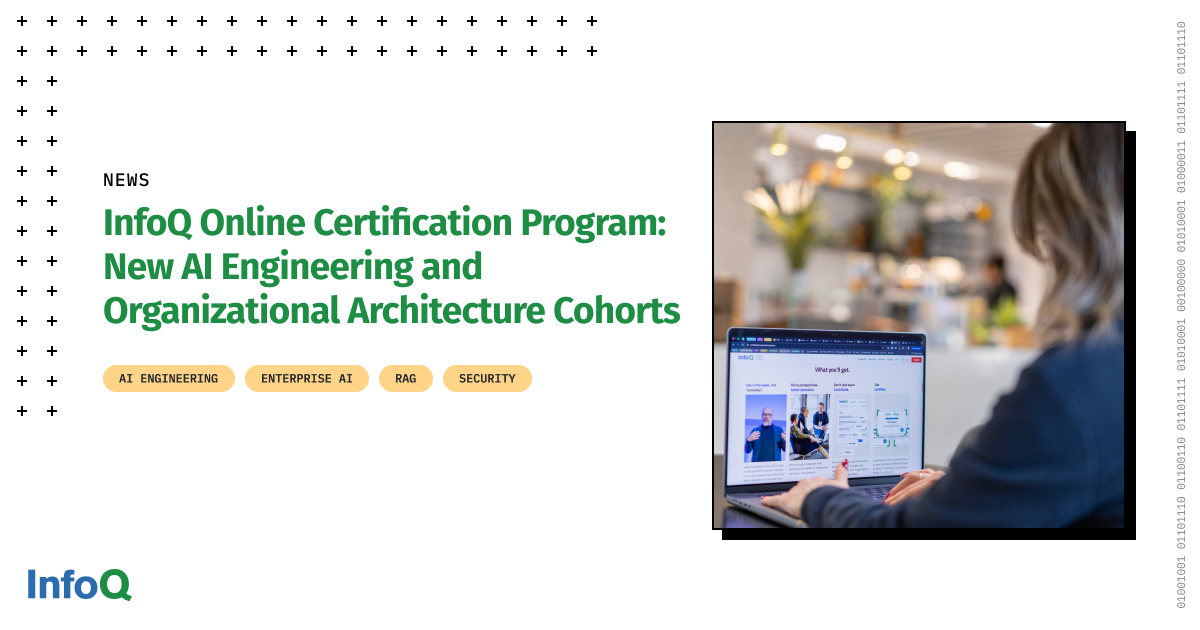
InfoQ expands its online certification portfolio with new AI Engineering and Organizational Architecture cohorts, giving senior practitioners a confidential peer group to pressure-test production AI, platform, team design, and architecture decisions. By Artenisa Chatziou
InfoQ expands its online certification portfolio with new AI Engineering and Organizational Architecture cohorts, giving senior practitioners a confidential peer group to pressure-test production AI, platform, team design, and architecture decisions.
This article explores Kafka's transition toward a cloud-native architecture, examining how tiered storage, FinOps telemetry, elastic consumer scaling, virtual clusters, and Share Groups reshape the operational and economic model of event streaming platforms. It also analyzes emerging diskless-storage proposals and their architectural trade-offs. By Viquar Khan
This article explores Kafka's transition toward a cloud-native architecture, examining how tiered storage, FinOps telemetry, elastic consumer scaling, virtual clusters, and Share Groups reshape the operational and economic model of event streaming platforms. It also analyzes emerging diskless-storage proposals and their architectural trade-offs.
Google's SynthID, designed to embed imperceptible signals into AI-generated content, is adding a new Content Detection API on Google Cloud's Gemini Enterprise Agent Platform, after gaining adoption by several industry players including Nvidia and OpenAI. By Sergio De Simone
Google's SynthID, designed to embed imperceptible signals into AI-generated content, is adding a new Content Detection API on Google Cloud's Gemini Enterprise Agent Platform, after gaining adoption by several industry players including Nvidia and OpenAI.
Microsoft has introduced a new AI-driven vulnerability discovery system called MDASH, a multi-model agentic security platform designed to automate large-scale code auditing across Windows and other Microsoft software environments. The system combines more than 100 specialized AI agents that work together to scan, validate, debate, and prove vulnerabilities across complex codebases. By Robert Krzaczyński
Microsoft has introduced a new AI-driven vulnerability discovery system called MDASH, a multi-model agentic security platform designed to automate large-scale code auditing across Windows and other Microsoft software environments. The system combines more than 100 specialized AI agents that work together to scan, validate, debate, and prove vulnerabilities across complex codebases.
Sergiu Petean discusses the strategic journey of evolving DevOps into platform engineering within heavily regulated enterprise environments. He explains how to maximize efficiency using dynamic reference architectures, align platform KPIs directly with board-level business goals, reduce cognitive load via custom team topologies, and maintain innovation sovereignty through open-source technology. By Sergiu Petean
Sergiu Petean discusses the strategic journey of evolving DevOps into platform engineering within heavily regulated enterprise environments. He explains how to maximize efficiency using dynamic reference architectures, align platform KPIs directly with board-level business goals, reduce cognitive load via custom team topologies, and maintain innovation sovereignty through open-source technology.
Gemma 4 can be paired with multi-token prediction (MTP) drafters that use speculative decoding to generate multiple tokens in parallel, allowing the model to verify them in a single pass and achieve up to ~3× faster inference without quality loss. By Sergio De Simone
Gemma 4 can be paired with multi-token prediction (MTP) drafters that use speculative decoding to generate multiple tokens in parallel, allowing the model to verify them in a single pass and achieve up to ~3× faster inference without quality loss.
Google has introduced Middleware for Genkit, its open-source framework for building AI-powered and agentic applications. The update adds a programmable interception layer around model calls, tool execution, and generation loops, giving developers more control over reliability, safety, and orchestration inside production AI systems. By Robert Krzaczyński
Google has introduced Middleware for Genkit, its open-source framework for building AI-powered and agentic applications. The update adds a programmable interception layer around model calls, tool execution, and generation loops, giving developers more control over reliability, safety, and orchestration inside production AI systems.

 Login
Login