Meta describes how an AI agent can be designed to capture the logic and expertise of domain experts, rather than simply storing documents or retrieving relevant information. The system, dubbed an "organizational second brain", was built for a specialized compliance domain, but Meta argues the architecture generalizes to areas like security, finance, engineering, and procurement. By Sergio De Simone
Meta describes how an AI agent can be designed to capture the logic and expertise of domain experts, rather than simply storing documents or retrieving relevant information. The system, dubbed an "organizational second brain", was built for a specialized compliance domain, but Meta argues the architecture generalizes to areas like security, finance, engineering, and procurement.
Felipe Huici explains how Unikraft achieves millisecond cold boots, stateful scale-to-zero, and extreme density for sandboxing AI workloads. He discusses isolation primitives, Linux kernel optimizations, and snapshotting tricks, demonstrating how to maintain sub-10ms performance at scale while integrating seamlessly into Kubernetes environments with hardware-level security. By Felipe Huici
Felipe Huici explains how Unikraft achieves millisecond cold boots, stateful scale-to-zero, and extreme density for sandboxing AI workloads. He discusses isolation primitives, Linux kernel optimizations, and snapshotting tricks, demonstrating how to maintain sub-10ms performance at scale while integrating seamlessly into Kubernetes environments with hardware-level security.
Microsoft has made Azure Virtual Desktop Hybrid generally available. Session hosts run on customer hardware through Azure Arc while brokering stays in Azure. The Hybrid service license is unpriced, Windows Server support requires RDS CALs with Software Assurance, and multi-session Windows is not supported at all. By Steef-Jan Wiggers
Microsoft has made Azure Virtual Desktop Hybrid generally available. Session hosts run on customer hardware through Azure Arc while brokering stays in Azure. The Hybrid service license is unpriced, Windows Server support requires RDS CALs with Software Assurance, and multi-session Windows is not supported at all.
Arm has launched Arm Total Design for Physical AI alongside a new robotics framework to establish common standards across automated systems.
Physical industries – spanning mining, agriculture, manufacturing, and global transport – account for trillions of dollars in economic activity and an estimated $200 billion annual compute opportunity by the 2030s.
To address engineering fragmentation across these sectors, Arm is convening more than 80 partner organisations spanning software, hardware
Arm has launched Arm Total Design for Physical AI alongside a new robotics framework to establish common standards across automated systems.
Physical industries – spanning mining, agriculture, manufacturing, and global transport – account for trillions of dollars in economic activity and an estimated $200 billion annual compute opportunity by the 2030s.
To address engineering fragmentation across these sectors, Arm is convening more than 80 partner organisations spanning software, hardware, and AI. Initial ecosystem participants include AWS, ECARX, Hugging Face, Liquid AI, NXP, PlusAI, PSYONIC, QNX, Qwen, Siemens, and Unitree Robotics.
The initiative targets physical systems that combine AI models, runtime software, compute silicon, sensors, and actuators to sense, reason, and act in operational environments. Hardware manufacturers and software developers require standardised baselines to reduce integration risk, optimise compute workloads, and move from proof-of-concept testing to deployment at scale.
Arm standardises capability tiers for robotics systems
Robotics currently lacks a common method to describe, compare, and communicate system capabilities, according to an architectural manifesto (PDF) published by Arm chief architect Richard Grisenthwaite. This fragmentation makes robotic systems harder to design, integrate, and scale across industrial deployments.
In response, Arm has introduced the Robotics Capability Framework as a collaborative starting point for a shared technical vocabulary, patterned after the SAE Levels used for driving automation.
Arm’s new framework categorises robotic systems across progressing tiers of operational sophistication, mapping machines from reactive setups to context-aware, cognitive, and self-improving systems.
Each capability tier links real-world use cases to machine behaviours, outputs, and hardware constraints. These criteria establish parameters for system latency, compute placement, memory allocation, power constraints, determinism, and safety standards.
Arm developed the initial baseline using feedback from across the robotics sector. Participating organisations contributing to the framework include Anaxi Labs, ANYbotics, FMC³ Robotics, Fourier, GALBOT, Gravis Robotics, Lenovo, McKinsey, and Robotec.ai.
Virtual platforms accelerate pre-silicon automotive physical AI development
Arm Total Design for Physical AI extends a collaborative development structure previously used for cloud AI infrastructure. The programme brings together AI models, virtual platforms, digital twins, sensors, compute silicon, and software stacks to enable earlier development and testing cycles.
Autonomous transport and robotics face common technical requirements across sensory perception, AI processing, real-time control, safety, and power-efficient compute. Arm demonstrated this collaborative methodology in the automotive sector alongside AWS, Google, HERE, RemotiveLabs, and Siemens.
The participating automotive companies developed an integrated digital cockpit reference solution. This environment enabled software engineering teams to develop, test, and validate complex automotive code on the Arm Zena CSS platform prior to physical silicon availability.
Arm is now soliciting technical contributions from the wider engineering community to expand the Robotics Capability Framework as physical AI implementations progress.
Learn more about physical AI during thePhysical AI Expoheld in Amsterdam, London, and North America.
Want to learn more about AI and big data from industry leaders? Check out AI & Big Data Expo taking place in Amsterdam, California, and London. The comprehensive event is part of TechEx and is co-located with other leading technology events including the Cyber Security & Cloud Expo. Click here for more information.
AI News is powered by TechForge Media. Explore other upcoming enterprise technology events and webinars here.
Standard chaos engineering assumes experiments stop cleanly, blast radius is knowable in advance, and production is fair game. Payment systems violate all three. Salim Adedeji describes ECS-specific failure modes from enterprise deployments: a 60-second DNS TTL that produced 93-second failover, retry logic amplifying database load 2.4x, and AZ rebalancing loops that generic tooling misses. By Salim Adedeji
Standard chaos engineering assumes experiments stop cleanly, blast radius is knowable in advance, and production is fair game. Payment systems violate all three. Salim Adedeji describes ECS-specific failure modes from enterprise deployments: a 60-second DNS TTL that produced 93-second failover, retry logic amplifying database load 2.4x, and AZ rebalancing loops that generic tooling misses.
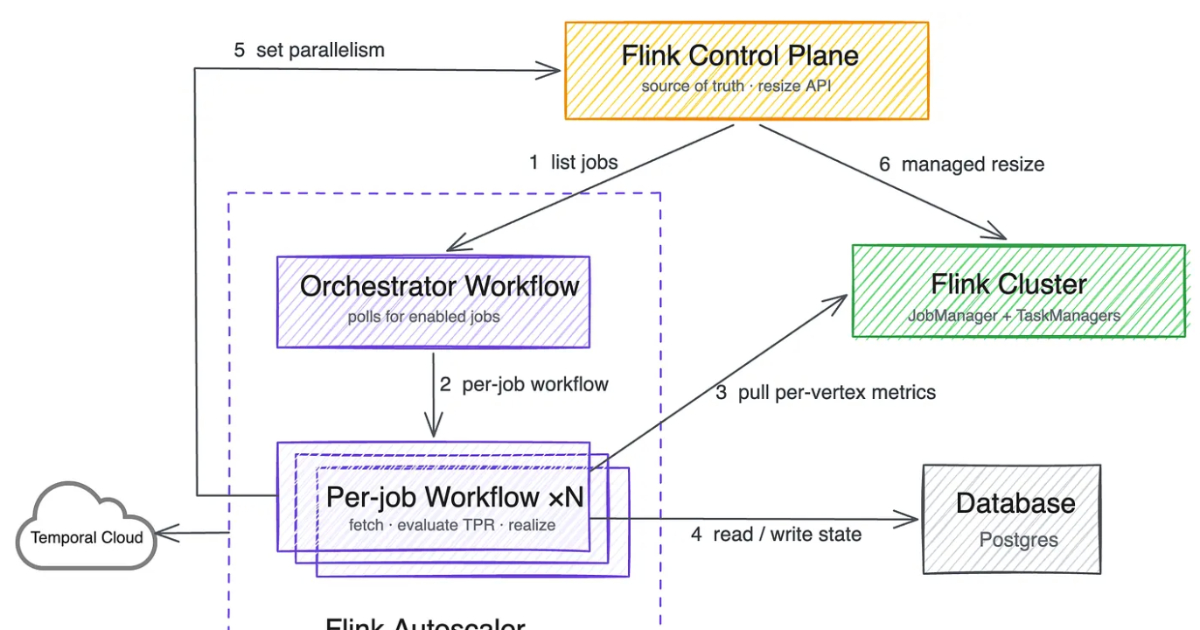
Netflix is moving toward the open-source Apache Flink Autoscaler for more than 30,000 streaming jobs across multiple AWS regions. The operator-level approach addresses limitations of Netflix’s cluster level autoscaler for complex, stateful pipelines. Netflix reports a 58% reduction in annualized Flink compute expenditure for one team, saving approximately $1.1 million annually. By Leela Kumili
Netflix is moving toward the open-source Apache Flink Autoscaler for more than 30,000 streaming jobs across multiple AWS regions. The operator-level approach addresses limitations of Netflix’s cluster level autoscaler for complex, stateful pipelines. Netflix reports a 58% reduction in annualized Flink compute expenditure for one team, saving approximately $1.1 million annually.
Zhou Yu discusses why AI agents stall in demo phase and shares how simulation-driven testing solves compliance and reliability bottlenecks. Learn how Columbia and Arklex AI use synthetic user personas, trajectory entropy, and automated CI/CD pipelines to evaluate multi-turn agents, catch edge cases before deployment, and scale self-learning workflows in production. By Zhou Yu
Zhou Yu discusses why AI agents stall in demo phase and shares how simulation-driven testing solves compliance and reliability bottlenecks. Learn how Columbia and Arklex AI use synthetic user personas, trajectory entropy, and automated CI/CD pipelines to evaluate multi-turn agents, catch edge cases before deployment, and scale self-learning workflows in production.
Microsoft has enabled zone redundancy on the Standard v2 tier of Azure API Management, following its arrival on Premium v2 in December. Standard v2 starts at $700 per month against $2,801 for Premium v2, but carries a 99.95% SLA rather than 99.99%. Zone redundancy can only be configured when creating an instance. By Steef-Jan Wiggers
Microsoft has enabled zone redundancy on the Standard v2 tier of Azure API Management, following its arrival on Premium v2 in December. Standard v2 starts at $700 per month against $2,801 for Premium v2, but carries a 99.95% SLA rather than 99.99%. Zone redundancy can only be configured when creating an instance.

 Login
Login